
Strengths
- Coinbase has partnered with Better Home & Finance, a Fannie Mae-approved digital mortgage lender, to let homebuyers use bitcoin or USDC as collateral for down payments. This expands crypto’s practical use by helping borrowers access housing without selling digital assets or triggering taxes. As a conforming loan backed by Fannie Mae standards, the partnership adds credibility to crypto and signals growing institutional acceptance in traditional finance.
- Despite trading in a tight range for nearly 50 days, bitcoin’s price action reflects structural consolidation rather than a bearish continuation pattern. Unlike prior cycles, the market has built stronger support, with significant demand reported between $50,000 and $70,000. Short-term momentum remains muted, but bitcoin shows resilience and a more stable foundation than in previous drawdowns.
- Trust Wallet, the self-custody digital wallet acquired by Binance founder Changpeng Zhao, launched AI-powered agents that execute crypto transactions across 25+ blockchains for its 220+ million users. The toolkit automates recurring buys, cross-chain swaps, and portfolio actions while keeping users in control of assets and permissions. The launch demonstrates how digital asset platforms are evolving beyond storage into intelligent, scalable, and user-friendly financial tools.
Weaknesses
- Proposed restrictions on stablecoin rewards in the latest U.S. market structure draft highlight a key weakness in digital assets: user adoption can still be driven by incentives rather than transactional utility. Citigroup noted the development is not a fundamental threat to Circle’s USDC but could slow growth by making certain platforms less attractive. The episode shows parts of the stablecoin market remain vulnerable to policy changes and evolving monetization models.
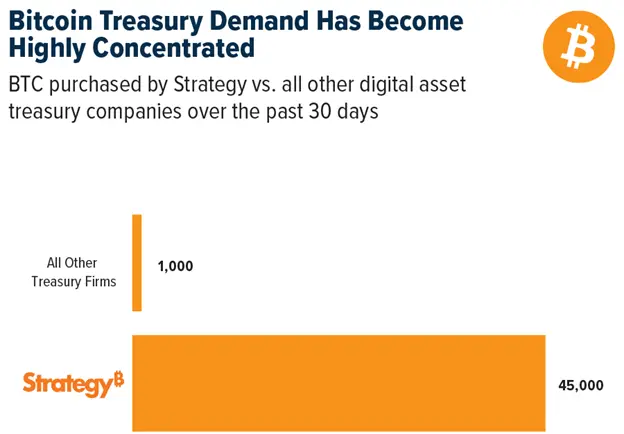
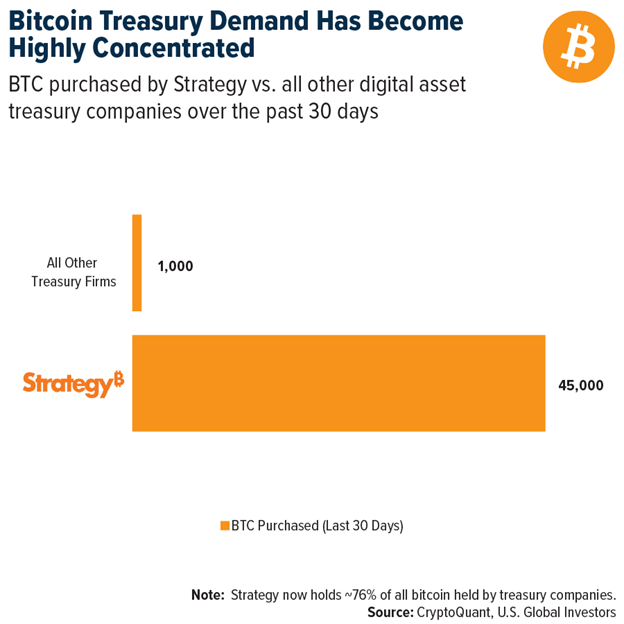
- Over the past 30 days, Strategy purchased about 45,000 BTC, while all other digital asset treasury companies combined bought around 1,000 BTC, according to CryptoQuant. Strategy now holds roughly 76% of all bitcoin owned by treasury companies, underscoring how reliant the narrative is on a single buyer. This concentration weakens the case for broad corporate adoption and raises concerns about the durability of treasury-driven demand in challenging market conditions.
- Bhutan’s government transferred another 519.7 BTC, worth about $36.8 million, bringing its total crypto outflows in 2026 to more than $152 million, according to Arkham data. Its bitcoin holdings have fallen from a peak of roughly 13,000 BTC in late 2024 to about 4,453 BTC today, a decline of nearly 66%. The increasing pace of these sovereign sales adds persistent supply to the market and raises concerns about whether state-backed bitcoin accumulation stories are as durable as previously believed.
Opportunities
- Elon Musk’s X is advancing its push into payments with the upcoming launch of X Money across 40+ U.S. states, while hiring a senior crypto-native design leader with experience at Coinbase’s Base and Aave. The platform plans to offer peer-to-peer payments, bank deposits, debit cards, and up to 6% yield on balances, signaling ambitions to become a full financial super app. While crypto integration has not yet been confirmed, the addition of experienced DeFi talent highlights growing optionality for future blockchain-based features.
- BitGo, a leading institutional digital asset custodian, and ZKsync, an Ethereum-based scaling network developed by Matter Labs, are building infrastructure that allows banks to issue, transfer, and settle tokenized deposits on blockchain rails while staying within regulatory frameworks. The platform combines BitGo’s custody and wallet services with ZKsync’s permissioned, privacy-preserving network and is already being tested by regulated financial institutions ahead of a broader rollout later this year. This underscores growing momentum for bringing traditional banking activity on-chain in a compliant, scalable way.
- Tether’s omnichain stablecoin, USDT0, is expanding to Tempo, a payments-focused Layer 1 blockchain co-developed by Stripe and Paradigm. Powered by LayerZero Labs, USDT0 surpassed $70 billion in cumulative transaction volume within its first 12 months, and this integration will mark its 23rd blockchain deployment. The expansion highlights growing momentum for stablecoins as scalable payment and settlement rails across an increasingly interoperable digital asset ecosystem.
Threats
- Political uncertainty ahead of the U.S. midterm elections poses a risk to the digital asset industry, as a shift in congressional control could weaken support for crypto legislation. Advocacy groups like Stand With Crypto are mobilizing, but priorities such as market reform, crypto tax rules, and a potential U.S. strategic bitcoin reserve could lose momentum, creating a more uncertain regulatory backdrop heading into 2027.
- Brazil’s government enacted a law allowing authorities to seize, freeze, and repurpose cryptocurrencies linked to criminal activity, highlighting growing state oversight. Confiscated crypto can fund public security initiatives, and judicial powers over wallets and exchanges are expanded. While aimed at organized crime, the measures raise concerns about broader state control and legal risks for crypto holders.
- TRM Labs, a blockchain intelligence firm used by law enforcement and financial institutions, launched an AI-powered investigative assistant as illicit crypto activity grows. Illicit crypto volume reached $158 billion last year, while AI-enabled fraud and scams surged 500%, driven by automation, deepfakes, and more sophisticated criminal tools. The trend shows a rising threat to the ecosystem, intensifying regulatory scrutiny and potentially weakening user and institutional trust.
