

(Kitco Commentary) - CME Group, one of the world’s largest regulated derivatives exchanges, plans to launch Nasdaq CME Crypto Index futures, providing diversified exposure to major cryptocurrencies including BTC, ETH, SOL, XRP, ADA, LINK, and XLM through a single regulated instrument.
Strengths
- The launch comes as CME’s crypto product suite surpassed $7.3 trillion in lifetime notional volume, while average daily trading volume increased 43% year-to-date. In the first quarter of 2026 alone, CME’s crypto average daily volume rose from 191,000 to 310,000 contracts year-over-year, highlighting accelerating institutional demand for regulated digital asset products and risk-management tools.
- Coinbase is expanding its role in decentralized finance by becoming the official manager of USDC liquidity on Hyperliquid, one of crypto’s fastest-growing on-chain trading networks. The partnership strengthens USDC’s position as a core settlement asset within decentralized trading infrastructure, as USDC supply on Hyperliquid has doubled year-over-year to approximately $5 billion. Circle also announced plans to expand its technical role on the network and stake 500,000 HYPE tokens. The collaboration highlights the growing integration of stablecoins into decentralized trading, collateral, and treasury systems as DeFi trading activity continues accelerating.
- The Digital Asset Market Clarity Act advanced through the U.S. Senate Banking Committee in a bipartisan 15-9 vote, marking a major step toward establishing a clearer federal regulatory framework for digital assets in the United States. The legislation, which still requires approval from the full Senate and House of Representatives, includes provisions related to investor protections, DeFi oversight, and banking participation in digital assets. The bipartisan support signals growing political momentum for crypto regulation in the world’s largest capital market, reducing uncertainty for institutional investors and strengthening the long-term outlook for the digital asset industry.
Weaknesses
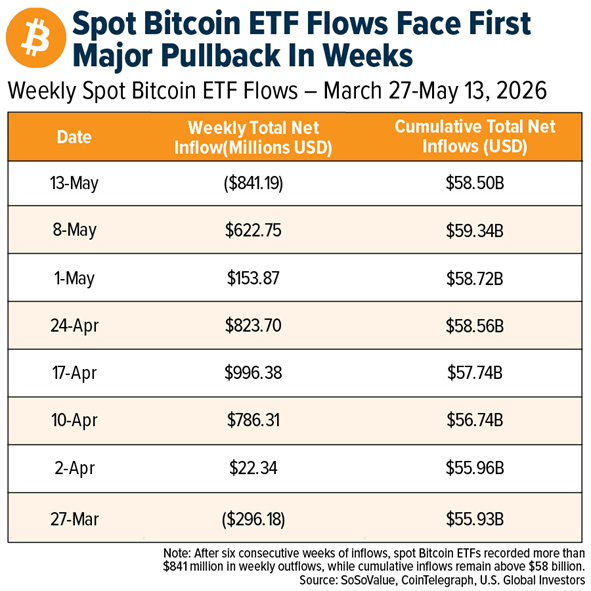
- Bitcoin’s rebound toward the $80,000 level may be less durable than it appears, as several indicators suggest the rally is being driven more by short-term trading activity than by institutional demand. U.S. spot bitcoin ETFs recorded $635 million in outflows on May 13, the largest daily withdrawal since January, while corporate bitcoin purchases fell 80% from last month. Analysts also estimate that nearly $2 billion in derivatives positions around the $82,000 level may be temporarily supporting prices through market hedging activity. Elevated realized losses of roughly $479 million per day further suggest the market has not fully stabilized despite the recent rebound.
- U.S. spot bitcoin ETFs recorded $635.2 million in outflows in a single day, the largest withdrawal since January, as bitcoin struggled to hold the $80,000 level amid rising profit-taking pressure. Weekly outflows have already reached approximately $841 million, putting the market on track for its first negative week following six consecutive weeks of inflows totaling roughly $3.4 billion. BlackRock’s IBIT led redemptions with approximately $285 million in outflows, while analysts warned that weakening spot demand and elevated unrealized gains could increase the risk of a deeper correction toward the $70,000 range.
- Bitcoin remains under pressure as rising U.S. Treasury yields and fading expectations for interest rate cuts reduce investor appetite for non-yielding assets such as BTC and gold. The U.S. 2-year Treasury yield climbed to 4.05%, its highest level since June 2025, while the 10-year yield reached 4.5% amid persistent inflation concerns and expectations that the Federal Reserve could keep rates higher for longer. Markets are now pricing in more than a 44% probability of another rate hike by December, up from 22.5% just one week ago. Bitcoin continues trading below its closely watched 200-day moving average near $82,000, highlighting ongoing macroeconomic pressure on the crypto market despite recent regulatory progress in the U.S.
Opportunities
- The Bank of England signaled it may soften proposed stablecoin restrictions following criticism from the digital asset industry, highlighting growing regulatory openness toward blockchain-based financial infrastructure. The central bank is reconsidering a proposed 20,000-pound ($27,000) holding cap per stablecoin and reviewing reserve requirements that would have required issuers to keep 40% of backing assets at the BOE earning no interest and 60% in short-term U.K. government debt. Industry participants argued the framework risked making the U.K. less competitive than markets such as the U.S. in the digital economy.
- Turnkey, a crypto infrastructure company that builds wallet and key-management technology for digital asset applications, raised $12.5 million in a funding round backed by major investors including Circle Ventures, Sequoia Capital, Bain Capital Crypto, and Galaxy Ventures, bringing its total funding to more than $65 million. The company’s technology is used for non-custodial wallets, automated on-chain transactions, and secure digital asset operations. The new capital will support the launch of Turnkey Verifiable Cloud, a secure computing platform designed for digital assets, stablecoin payments, and AI-driven blockchain activity. The investment highlights growing confidence in the long-term expansion of crypto infrastructure and stablecoin-based financial systems.
- Fasset, a digital bank that uses stablecoins and blockchain infrastructure for cross-border payments, raised $51 million to expand across emerging markets. The company operates in more than 50 financial corridors across Asia, Africa, and the Middle East, using stablecoins to offer faster and lower-cost international transactions than traditional banking systems. Fasset currently processes more than $32 billion in annualized transaction volume across 125 countries and serves more than 1,000 small and medium-sized businesses. The funding highlights growing adoption of stablecoin-based financial services, particularly in regions with inefficient traditional financial infrastructure.
Threats
- Cybersecurity threats remain a major risk for the digital asset industry, with North Korea–linked hackers responsible for more than $2 billion in crypto losses in 2025, a 51% year-over-year increase, according to CrowdStrike. The report identified DPRK-affiliated groups as the largest threat actors targeting exchanges, Web3 projects, and users through social engineering. In one major case, decentralized exchange Drift Protocol suffered about $280 million in losses after attackers used long-term infiltration and malware. The growing sophistication of state-backed cyberattacks continues to raise operational and financial risks across crypto markets.
- Strategy announced plans to repurchase about $1.5 billion of its 2029 convertible notes, with part of the transaction potentially funded through bitcoin sales. The company issued $3 billion of 0% convertible debt in 2024 with a conversion price of $672.40 per share, while the stock currently trades near $183, well below that level. The situation highlights risks tied to leveraged bitcoin treasury strategies, where debt-heavy firms may face pressure during market weakness. Forced capital raises or bitcoin sales to manage liabilities could add volatility to the broader crypto market.
- THORChain, a decentralized cross-chain liquidity protocol that enables native asset swaps across blockchains without intermediaries, suffered a cross-chain exploit of about $10.8 million, prompting a temporary halt of trading and signing operations. Following the attack, the protocol’s token RUNE fell 12%, underscoring ongoing security risks in decentralized finance. Cross-chain bridges remain among the most vulnerable areas in crypto, with more than $2.8 billion stolen from bridge exploits since 2021. The incident reinforces concerns around DeFi security and investor confidence as cross-chain ecosystems expand.
