Precious metals prices are booming. The gold price in US dollars has risen by 68 per cent over the last twelve months, silver by 157 per cent, platinum by 137 per cent, and palladium by 85 per cent. The price rally is driven by numerous factors.
Particularly significant is China’s licensing requirement for commodity exports starting January 1, 2026. It is creating supply uncertainty in the commodity space, especially in the silver market: China, with an annual production of about 3,300 tons, is the second-largest supplier worldwide, providing a good 13 percent of global annual production.
And the silver market has been in a deficit situation for years: The demand overhang of an estimated 100 million ounces cannot be covered from ongoing production but requires the use of stored silver. And silver demand continues to rise: for electronic applications, green technologies, artificial intelligence (AI), investment purposes.
The “stress” in the silver market has increased dramatically. Since mid-December 2025, the silver spot price on the Shanghai Gold Exchange (SGE), currently at around 80–84 USD per ounce, has been trading between 6 and 8 USD per ounce above the silver futures price on the Shanghai Futures Exchange (SFE)—a sign of drastic shortage of readily available physical silver.
Silver is significantly cheaper on the US COMEX: The silver futures price is only at 77 USD per ounce. The reasons for the gaping West-East price difference: In China, there are import licenses for silver, a 13 per cent value-added tax on silver imports, and logistical and regulatory hurdles for importing 1,000-ounce silver bars into China. All of this prevents perfect price arbitrage between the trading venues.
In addition, the COMEX recently increased the “margin requirement” for silver futures. This has reduced the costs and thus attractiveness for investors to build up silver positions via futures and keeps the COMEX silver price low.
And let’s not forget: The U.S. has classified not only silver but also platinum and palladium as “critical metals,” thereby raising doubts in the markets about supply security, which also has a price-driving effect. The price surge for platinum and palladium—these metals are mainly used in catalytic converter technology—is additionally fuelled by robust industrial demand, which, similar to silver, is facing persistent supply deficits.
But it is above all the explosive rise in the gold price that is pulling the other precious metals prices upward. The price of the yellow metal has been on an uptrend since at least the beginning of the 21st century, averaging a good 12 per cent increase per year to date. Since spring 2023 alone, gold has become nearly 120 per cent more expensive. Gold is not only gaining more value in US dollars but in all fiat currencies worldwide. In other words: The purchasing power of the U.S. dollar, euro, and others is declining against the yellow metal. Gold is increasingly in demand as a “safe haven”—no wonder given swelling global debt burdens, artificially suppressed interest rates, and growing inflation and crisis risks.
And the world is in upheaval, the consequences of which many investors may not yet have fully considered. The U.S., under the Trump administration, has returned to the Monroe Doctrine, named after the 5th US President James Monroe (1758–1831). In 1823, he formulated the Monroe Doctrine, according to which the influence of European colonial powers on North and South America (that is the Western Hemisphere) must be limited, rejected.
America is now zooming in on the Western hemisphere, that is North and South America, including parts of the Atlantic and Pacific, and withdrawing from other world regions. The sphere of influence from which it is withdrawing, the counterpole, is the Eastern Hemisphere: Europe, Africa, Asia, and Australia.
Against this backdrop it is not unfounded to assign a rather high probability that the gold price will continue to rise in the coming years—for gold is famously the proven and time-tested “safe haven”, which is typically in high demand in times of great geopolitical and/or economic uncertainties; and a rising gold prices will most likely push up all other precious metal prices.
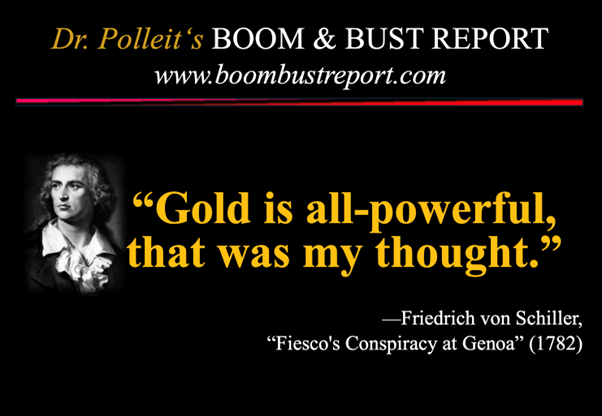
And so, in the end, Friedrich von Schiller’s words indeed come to mind: “Gold is all-powerful, that was my thought,” as he wrote in “Fiesco's Conspiracy at Genoa,” second act, in 1782.
And if you would like to know how to position yourself sensibly as an investor now, what you should specifically do, then the best thing is to read Dr. Polleit’s BOOM & BUST REPORT. All information at www.boombustreport.com. Thank you for your interest—and I wish you a good and successful new year.

