
Silver was among the best-performing asset classes of 2025, alongside platinum and gold mining equities. With gains of 148% in U.S. Dollar terms and 118% in Euro terms, the precious metal significantly outperformed equity markets as well as Bitcoin. The rally was particularly pronounced in December, when silver surged by 25% alone. Both December and the full year 2025 ended with silver priced at $71.50 per troy ounce.
At its peak, silver temporarily reached $84 per ounce, and in China even the equivalent of $89 per ounce. Notably, the previous nominal high from 1980 – $54.50 per ounce – had only been exceeded a few weeks earlier.
This spectacular rally until shortly after Christmas was abruptly interrupted. On Monday, December 29, silver fell by nearly 10% within just over an hour during early morning trading in Australia. This sharp decline raises important questions, most notably whether the move may have been driven by deliberate price manipulation.
A Brief History of Precious Metals Price Manipulation
Price manipulation in the precious metals markets is not a rumor; it has been established repeatedly in courts of law. Fines and settlement payments in the tens and hundreds of millions of dollars have been imposed on institutions such as Deutsche Bank, JPMorgan, and Scotiabank. In several cases, multi-year prison sentences were handed down to individuals involved in the manipulation of precious metals prices. Most cases involved downward price pressure rather than upward distortion. In addition to private actors, government institutions have also influenced prices, most notably the gold price.
On August 5, 1993, the longest systematic suppression of the gold price began. It lasted for more than two decades. Initially, it prevented gold from trading above $400 per ounce until 1996 and subsequently pushed the price down to around $250 per ounce by 2001. Price interventions also occurred during the gold bull market after 2001, when prices eventually rose to nearly $2,000 per ounce by 2011. During that phase, the objective was not to stop the overall upward trend, but rather to prevent excessively rapid price increases occurring at sensitive times – particularly during crises, presumably to calm market participants.
One explicit motive for price suppression was articulated by then-Federal Reserve Chairman Alan Greenspan on May 18, 1993, nearly three months before the start of the suppression campaign. His statement can be found in minutes published five years later. He said the following in the context of inflationary risks, with the word “thermometer” referring to the price of gold: “If we are dealing with psychology, then the thermometers one uses to measure it have an effect. I was raising the question on the side with Governor Mullins of what would happen if the Treasury sold a little gold in this market. There’s an interesting question here because if the gold price broke in that context, the thermometer would not be just a measuring tool. It would basically affect the underlying psychology.” Greenspan was thus contemplating gold sales to prevent a rapidly rising price, as such a move would have signaled inflation. The intention was to dampen inflation expectations and, in turn, influence the behavior of savers, businesses, and workers.
Price manipulation can therefore influence precious metals markets for many years, making it one of the most important factors affecting the price. For investors, this raises the question of whether the late-December 2025 price decline was manipulated – and to what extent similar interventions could shape prices in the coming months. In recent years, such manipulations have become relatively rare, with only a few suspected cases. Notably, during silver’s surge to its 2011 high, prices were not suppressed; however, afterwards, the market was demonstrably subjected to systematic manipulation.
Unlike consumable commodities, precious metals can be suppressed for extended periods by influencing inventory and storage dynamics. In contrast, attempts to suppress prices in crude oil, for example, would quickly lead to increased consumption, thereby counteract the effect. I have discussed precious metals manipulation in detail in my book The Gold Cartel (Palgrave Macmillan). The Gold Anti-Trust Action Committee has been investigating gold price manipulation since 1998.
Intraday Price Action in Late December 2025
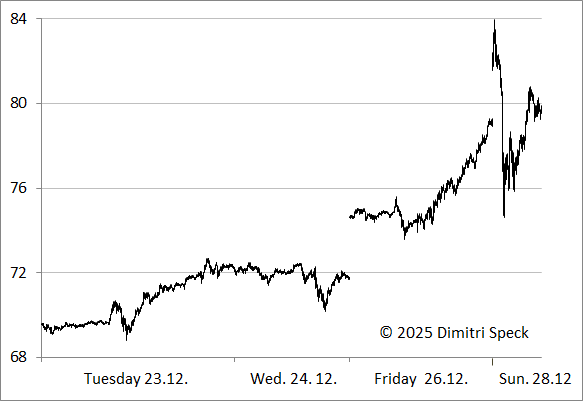
Let us turn to silver’s price behavior near its year-end high in 2025. The chart illustrates the intraday spot silver price movement from Tuesday, December 23, through the holiday-shortened session on Wednesday, December 24, and the subsequent trading day on Friday, December 26, extending to Sunday, December 28, 2025, when the price peak occurred. All intraday prices are shown in New York time. As a result, price data already appears on Sunday afternoon, corresponding to the start of Monday morning trading in Australia, while it is still Sunday on the U.S. East Coast.
Silver at its 2025 high, in U.S. Dollar per troy ounce, December 23-28, 2025
Data source: Dukascopy
It is clearly visible how the price surged sharply in a short period of time from $72 per troy ounce on Wednesday before the Christmas day to $84 per ounce after the weekend on Sunday in New York (Monday morning in Australia). This was followed by the previously mentioned sharp decline during early morning trading in Australia, when silver fell by nearly 10% within just over an hour.
What stands out about this decline is an unusually high futures-market trading volume during early Monday trading in Australia, a time that is typically characterized by very low liquidity. Institutional market participants executing large volumes generally do not place sizable orders into thin markets. Instead, they prefer high-liquidity periods and typically spread large orders over extended time frames in order to minimize market impact. Market manipulators, by contrast, can exploit thin liquidity by triggering stop-loss orders and drawing other market participants into the move, before later closing their positions at a profit during more liquid trading hours. Stop-loss-driven sell-offs – often referred to as flash crashes – that are occasionally observed in other markets typically result in a rapid rebound. Such immediate counter-move, however, was not observed in this case.
The evidence therefore suggests that this was highly likely a case of price manipulation, aimed at preventing a continuation of silver’s steep upward trajectory. Another notable aspect is that the price suppression occurred before the opening of the Chinese market. Silver prices in China rose to the above-mentioned high of approximately $89 per ounce, even though prices in non-Chinese markets were already trading in the $76-78 per ounce range.
There are also precedents for precious metals price suppression in early Australian trading hours on the futures market. One such case involved gold at the height of the Eurozone crisis, when gold prices were driven sharply lower via the futures market during early Australian trading on April 15, 2013. At the time, the apparent objective was to signal to savers worldwide – amid the partial confiscation of bank deposits in Cyprus – that gold was not a safe alternative to bank deposits.
Another precedent concerns silver in 2011, which, much like in 2025, occurred immediately after the metal had reached its price peak.
Silver Intraday Price Action in 2011
The next chart shows the intraday spot silver price movement from Wednesday, April 27, through Sunday, May 1, 2011. In the center of the chart the 2011 silver price peak, reached on April 28, 2011, is clearly visible.
Silver at its 2011 high, in U.S. Dollar per troy ounce, April 27 to May 1, 2011

Data source: Disktrading
On the right-hand side of the chart, a similarly sharp price decline can be observed during early Monday trading in Australia shortly after market opening (or Sunday trading in the United States). At that time, silver lost 12% within just 12 minutes. As in 2025, this move occurred amid very high futures-market trading volume, at a time when trading activity is normally minimal. The sharp decline, which took place two trading days after the price peak, was the result of price manipulation. The parallels with the recent events in late December 2025 are striking.
Is a Repeat of the 2011 Scenario Likely?
This raises the question of whether the events of 2011 could repeat themselves. At that time, silver prices entered a multi-year period of significantly lower levels.
However, there are important differences. In the current case, silver prices quite rapidly moved back toward the previous highs, whereas in 2011 only a brief counter-move occurred before prices resumed their decline. In addition, speculative investor positioning in 2011 had built up over several years, while in the current cycle it has only emerged over the past few months. Elevated silver lease rates are also noteworthy, as they point to a shortage of readily available physical silver. Although the strong rally would normally argue for a technical correction, the near-term outlook therefore includes not only downside moves, but also the possibility of further rises or a sideways consolidation.
The geopolitical environment also differs materially from that of 2011. The United States is seeking to secure raw material supply chains within the Western Hemisphere. However, higher prices are required to incentivize production, processing, and storage of raw materials. The price suppression observed in late December therefore appears less aimed at reversing the trend and more at preventing excessively rapid price increases in a metal that is strategically important for industry – while simultaneously easing pressure on short sellers. China, in turn, has implemented export restrictions.
In 2011, China played a much smaller role in the silver market. Today, however, Chinese investors command significantly more capital in search of yield, particularly as the domestic real estate market no longer offers attractive returns. Western investors, meanwhile, remain relatively little in precious metals, while the equity exposure in the United States is at record highs.
At the same time, conditions within the global financial system have deteriorated further. Total global debt now exceeds 250% of annual global economic output, more than double the level seen during the 1950-1980 period. These debt levels will never be serviced in real terms. Particularly concerning is the global rise in interest rates since 2020, currently most visible in Japan. Precious metals have traditionally served as the counterpart to debt-based currencies. These conditions should continue to give the gold price a further boost. It is also benefiting from ongoing central bank purchases in the wake of the freezing of Russian foreign exchange reserves.
Silver is likely to continue following gold’s broader trend. The gold-to-silver ratio, which is currently below 60 (albeit with significant volatility), remains far from its 2011 level of around 30. This also suggests that we will see rising rather than falling silver prices in the years to come.
