
When I first began buying gold when it was around $300 in price (yes, I am 55 years old), I remember people saying how they would not want to live in a world of $1,000 gold. This fear was based upon the commonly held expectation that the world would be more dysfunctional, turbulent or volatile the higher the price of gold.
But, when gold eventually approached the $1,000 level and the world was not necessarily more dysfunctional, turbulent or volatile than before, that perspective then shifted to not wanting to live in a world of $2,000 gold. And, as we were approaching the $2,000 price back in 2011 without any real change in the dysfunctional, turbulent or volatile nature of the world, the perspective again shifted to not wanting to live in a world of $5,000 gold.
Well, here we are at almost $5,000 gold and the world is not really more of a mess than it was at $300 gold. Well, at least not yet. But, you see, the beliefs and views held by most market participants are not really based upon fact. And, the same applies to most beliefs and views held by the investor and analyst communities alike.
For example, many still believe that gold is a safe haven against stock market volatility. Yet, most won’t even bother to recognize that gold lost over 30% of its value during the Great Financial Crisis and crash of 2008. Is that really the safe haven many would expect it to be at a time when they needed it most? But, why be burdened by the facts when a belief provides such a wonderfully veiled sense of comfort and bliss?
As a number of you may have seen, I was interviewed by KITCO regarding my perspective that the gold bull market, which began at the end of 2015, will probably come to a conclusion for this segment of the cycle in the coming year. You can read the article here:
After reading a number of comments on other sites which carried this article, it is quite clear that many were terribly perturbed by what I said. And, many were taking the perspective that “this time is different.”
What really amazes me is that gold “aficionados” (I will refrain from the use of the term “bugs”) always believe that “this time is different,” and that normal financial market cycles simply do not apply to gold. So, when gold does go through a typical and normal down-cycle, they view the only reason as being manipulation. I have written about this in the past, and you can read that article here, so I will not again address this perspective in this missive:
Some of the other comments I have seen are included just below and are representative of most of the hundreds of comments, which, by the way, were almost all vociferously bullish of gold:
“With US Deficit spending and growing Debt, with Russia and China central banks buying Gold to get out of a weaponized Reserve Currency grip, with Bitcoin proving it does not preserve wealth ... Gold will fall because of an Elliot Wave pattern? Don't bet on it.”
“I’m bullish on Gold. Weakening dollar, more QE, bad employment numbers, burgeoning US deficit and more recently than likely AI bubble are all factors that drove gold prices.”
“But isn't it different this time [name deleted]? Since the Biden administration and the EU stole Russia's money friend and foe have been buying physical metals and crushing the metals suppression by bullion banks for central banks [mainly the FED] to massively suppress silver and somewhat gold.”
“The problem with “technical analysis” and charts is that they assume that the future will be the same as the past. But since 2000, and especially since 2008-9, the future is condemned to be different. It has and will be dominated by increasing debts and deficits, and the only possible way forward is inflation/money printing/fiat debasement. So in nominal terms, gold and silver could (and probably will) go up by multiples of the current price, even if that doesn’t mean much in after inflation value. But that’s the point of owning precious metals (and the miners), isn’t it.”
Now, I want to address these comments in this missive. But, first I want to point out that these are almost the EXACT same type of comments I received when I called for the top of the gold market back in 2011. As you can see, some things never change. And, human nature is one of those things. Since human nature and sentiment is what drives markets, I do not believe this time will be any different.
I also want to point out that almost all the commenters were pretty much aligned in their thought process and conclusions. And, as the old saying goes (attributed to either George Patton or Benjamin Franklin), “if everyone is thinking alike, then no one is thinking.” This is nothing more than the non-rational herding phenomenon we always see in financial markets.
While I am not going to address some of the outlandish perspectives posted in the various comment sections, I do want to address some of the commenter’s main beliefs posted above.
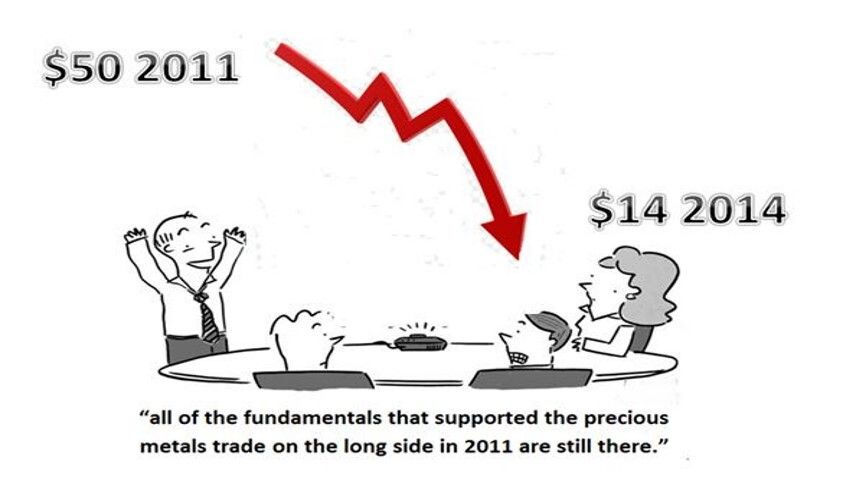
The first belief is that the fundamentals suggest that this rally will continue unabated, and with no end in sight. Well, for those with a very short memory, the fundamentals also supported a bullish continuation of the rally in 2011 and well beyond. In fact, the only arguments I had seen at the time was how far gold will rally beyond the $2,000 level as we looked into the year 2012. So, as the fundamentals supposedly stayed bullish during the decline in 2011-2015, it kept the majority of investors bullish during most of the 4 year and 45%+ decline (with silver seeing an over 70% decline). In fact, we made this cartoon to poke fun at this “fundamental phenomenon.”

But, towards the end of that bear market phase in 2015, it seems the fundamentals and expectations all turned bearish, which lead to a ubiquitously expected break of the $1,000 region in gold (which never happened).
And, just as everyone was turning bearish, we were turning bullish and did not expect a break-down below $1,000. In fact, we caught the bottom of gold at $1,050 when it hit one night in late December of 2015, and those who were in our trading room at Elliottwavetrader.net still remember that night quite fondly.
But, this is just how markets work and it is why most fundamentalists are unable to foresee a major turn coming in a market. In fact, it is just the opposite as they strongly proclaim how the fundamentals support the market continuing in the same direction unabated, whether it be at the lows or at the highs. And, this is exactly what we saw at the highs in 2011 and the lows in 2015. Yet, most people think it will be different this time. While they could be right, I highly doubt it.
Allow me to quote someone much smarter than me in this regard. In a paper written by Professor Hernan Cortes Douglas, former Luksic Scholar at Harvard University, former Deputy Research Administrator at the World Bank, and former Senior Economist at the IMF, he noted the following regarding those engaged in “fundamental” analysis for predictive purposes:
“The historical data say that they cannot succeed; financial markets never collapse when things look bad. In fact, quite the contrary is true. Before contractions begin, macroeconomic flows always look fine. That is why the vast majority of economists always proclaim the economy to be in excellent health just before it swoons. Despite these failures, indeed despite repeating almost precisely those failures, economists have continued to pore over the same macroeconomic fundamentals for clues to the future. If the conventional macroeconomic approach is useless even in retrospect, if it cannot explain or understand an outcome when we know what it is, has it a prayer of doing so when the goal is assessing the future?”
Another supporting argument I have heard from the “aficionados” is that central banks buying supports the price continuing higher. Well, I am sorry to disagree with you about this as well, but central banks were buying into the highs of 2011, and then selling into the lows of 2015. And, this is quite typical if you look at history.
History shows us that central banks are big buyers of gold as we approach the highs in a bull market phase, and big sellers of gold as we approach the lows in a bear market phase. In fact, I wrote an article about this many years ago when a central bank was selling their gold near the lows at the time, and I outlined how central banks are notoriously buying at the highs and selling at the lows.
Then, of course, there is the issue of the “weakening dollar” and QE expectations that we hear about so often. Well, I want to note that the dollar is likely completing a multi-year corrective pullback and will likely begin a major rally as we move into 2026. Moreover, it seems that many have short memories as the dollar rallied quite strongly during the QE years, as we predicted at the time, against all prevailing contrary expectations. Moreover, gold dropped precipitously during the midst of QE, as we also predicted at the time, and, again, against all prevailing contrary expectations.
You see, many of the expectations and beliefs held by the masses are not really burdened by the facts of history. These statements about QE, about Central Banks, about fundamentals supporting the metals rally, etc., are regurgitated in the media and among investors as though they are absolute truth. And, as Daniel Kahneman said in his seminal book “Thinking Fast and Slow,” “[a] reliable way to make people believe in falsehoods is frequent repetition, because familiarity is not easily distinguishable from truth.”
As Daniel Crosby, in his book The Behavioral Investor, also noted: “Storytelling bypasses many of the critical filters we apply to other forms of information gathering . . . For this reason, stories are the enemy of the behavioral investor.”
So, many investors and analysts automatically take these stories and beliefs at face value due to their constant repetition and do not engage in further due diligence into their veracity. Well, appropriate analysis of history’s facts regarding the commonly held beliefs of the metals aficionados reveals that they are quite specious, if not resoundingly fallacious.
Lastly, my favorite argument that I heard in 2011, as well as again of late, is that technical analysis “assumes the future will be the same as the past” and cannot identify a top or bottom to the gold market. Well, let’s start by recognizing that we have accurately called the major metals market highs and lows during these last 15 years. Moreover, we were even able to provide advance warning for the latest silver parabolic move in the spring of 2025, well before it took hold.
Yet, while there is a lot of technical analysis that does project expectations in a linear fashion, many who make this argument fail to recognize that fundamental analysis projects expectations linearly as well. (And for those that question my understanding of fundamental analysis, you may not realize that my higher degree education and professional background were concentrated in fundamental analysis). Yet, financial markets are non-linear environments within which linear analysis will not be able to identify major turns, as it is not designed to do so. It is the proverbial square-peg-into-round-hole situation.
But, the analysis methodology that we utilize is based upon non-linear mathematical and fractal perspectives, which is in much greater alignment with the financial market non-linear environment. While we will never be 100% accurate, we certainly have a much better long-term record than most other analysis in the markets we have tracked over the last 15 years. In fact, this was a comment in my latest KITCO article when most commenters were quite negative regarding my perspective:
“I merely pointed out that lots of people are critical of Avi, but he has demonstrated in the past that he gets the big calls right. 2011 negative on precious metals; 2015 positive on PMs; 2019 negative on S&P; 2020 in the depths of Cov19 positive on stocks. If I had listened in 2011 and 2020, I'd be much richer today. He's not saying the PM bear starts imminently, but when he says it's coming, I'm listening and adjusting accordingly.”
As Daniel Crosby in his book The Behavioral Investor noted, “trusting in common myths is what makes you human. But learning not to is what will make you a successful investor.”
As one of my long-term members once stated, “the purpose of Elliott Wave analysis is to analyze market sentiment . . . not to participate in it.” So, ask yourself if you are analyzing the metals market in an objective manner, or simply participating in it?
