

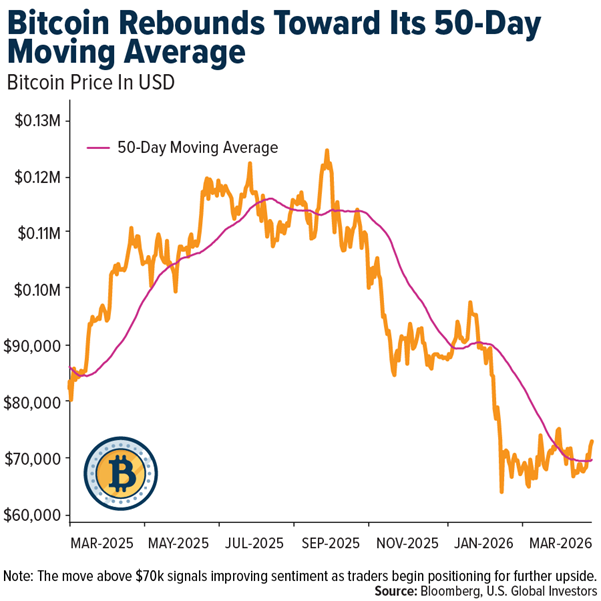
(Kitco Commentary) - Bullish sentiment appears to be returning to Bitcoin, with the $80,000 call option now the most popular trade on Deribit, the world’s largest crypto options exchange.
Strengths
- Open interest at that strike has risen to more than $1.6 billion, overtaking the previously dominant $60,000 downside put, suggesting traders are shifting from a defensive stance to a more optimistic one. Bitcoin has also rebounded above $70,000, supported by easing geopolitical tensions and a macro backdrop that could turn more favorable for risk assets if lower oil prices revive expectations for Federal Reserve rate cuts.
- Crypto’s institutional foundation continues to strengthen as Galaxy Digital, led by Mike Novogratz, highlighted its first annual report as a Nasdaq-listed company. The firm emphasized the growing convergence between crypto, AI, and digital infrastructure, with its Helios data center campus in West Texas now valued at over $15 billion and backed by 1.6 gigawatts of approved power capacity. Galaxy also reported approximately $12.3 billion in platform assets as of year-end 2025, underscoring how major crypto-native firms are evolving into diversified financial and infrastructure businesses.
- Tokenized trading of traditional assets is gaining traction, with weekly volumes in perpetual swaps tied to commodities and equities reaching $30.7 billion, according to BitMEX. The surge has been driven by macro volatility, with oil-linked contracts hitting $6.9 billion in weekly volume amid geopolitical tensions, while equity-based perpetuals jumped over 900% to $4.9 billion. By enabling 24/7 trading with no expiry, these instruments are expanding crypto’s role beyond digital assets into global financial markets and increasing the industry’s total addressable market.
Weaknesses
- Institutional demand still looks fragile, as U.S. spot Bitcoin ETFs posted about $93.9 million in net outflows on Wednesday, even as Bitcoin climbed from roughly $67,800 to nearly $71,000. Although BlackRock’s IBIT saw $40.4 million in inflows and Morgan Stanley’s new MSBT added $30.6 million on its first day, those gains were more than offset by outflows from Fidelity’s FBTC (-$79 million), ARKB (-$74.7 million), and Grayscale’s GBTC (-$11 million), suggesting investors are still using strength to reduce exposure rather than add to it.
- Institutional demand in Bitcoin derivatives has also weakened, with activity on CME Group, a key venue for institutional Bitcoin futures, falling to a 14-month low. Average daily open interest dropped to around $7.2 billion in early April, while monthly trading volume fell to $163 billion in March, nearly 50% below its January peak. The decline appears linked to unwinding of the basis trade, suggesting that a key source of earlier price support is fading.
- Even as tokenized commodities gain traction, adoption still faces key structural challenges. According to Binance Research, tokenized silver trading rose to nearly 15% of Comex silver futures volume in March and April, up from just 1.37% in January, while tokenized gold perpetuals surpassed the futures volume of some regional exchanges, reaching 401% of TOCOM in Japan. However, issues around pricing, liquidity, and investor trust continue to limit broader adoption, indicating the market remains early in its development.
Opportunities
- Stablecoins continue to emerge as one of crypto’s most compelling long-term growth opportunities, with Chainalysis projecting adjusted transaction volumes could reach $719 trillion by 2035. The firm noted stablecoins already moved more than $35 trillion last year, but only about 1% was tied to real-world payments, highlighting significant room for expansion. As younger, crypto-native generations inherit an estimated $100 trillion in wealth, stablecoins could increasingly challenge legacy payment rails like Visa and Mastercard through faster, lower-cost, always-on settlement.
- Crypto platforms continue to expand into new financial verticals, as Binance integrated prediction markets into its wallet, allowing users to trade on real-world events directly within the app. The feature lowers barriers to entry by covering gas fees and enabling seamless access using existing balances. Prediction markets have surged from under $100 million to over $20 billion in monthly trading volume in two years, highlighting rapid growth in the space.
- Stablecoins are gaining real-world traction in emerging markets, with a Borderless report showing FX usage in parts of Latin America and East Africa now approaching institutional-grade pricing. In LATAM, stablecoin FX traded within ~22 bps of interbank rates, while execution costs in Brazil reached zero across multiple providers, underscoring growing efficiency in cross-border payments.
Threats
- Geopolitical risks tied to crypto are becoming more visible, as reports suggest Iran is increasingly using Bitcoin and stablecoins to facilitate oil trade and charge transit tolls through the Strait of Hormuz, a key route for roughly 20% of global oil flows. According to Chainalysis, these transactions are part of a broader sanctions-evasion network, with some flows tied to more than $178 million in activity and affiliated networks approaching $1 billion. The case underscores how crypto’s role in cross-border trade could face growing regulatory scrutiny and reputational pressure, particularly if sanctioned actors expand use of dollar-linked stablecoins.
- Regulatory pressure on stablecoins is rising as the U.S. Treasury proposed new rules requiring issuers to monitor, block, freeze, and reject suspicious transactions, effectively aligning them more closely with traditional financial institutions. The proposal, developed by FinCEN and OFAC, would require stronger compliance controls under the GENIUS Act, set for full implementation by 2027. While the framework could support legitimacy, it also raises compliance costs and regulatory burdens for issuers at scale.
- Sovereign Bitcoin selling remains a potential overhang, as Bhutan moved another 319 BTC (about $22.7 million), extending a months-long reduction in holdings. According to Arkham Intelligence, the country has transferred more than 9,000 BTC since late October 2024, cutting its stash from around 13,000 BTC to 3,654 BTC, a decline of roughly 70%. While Bhutan remains one of the largest publicly tracked sovereign holders, continued selling highlights the impact of government-linked supply on the market.
