
Strengths
- Institutional adoption continues to deepen as Charles Schwab, one of the largest U.S. brokerage firms with over $12.2 trillion in client assets, rolls out direct spot trading for Bitcoin and Ether to retail investors. The offering allows clients to trade crypto alongside traditional assets within Schwab’s existing platforms, lowering barriers to entry for mainstream investors. At launch, the service will charge a 0.75% transaction fee and initially support BTC and ETH, with plans to expand further.
- Momentum is building around the U.S. crypto regulatory framework, with JPMorgan indicating that the CLARITY Act is nearing completion as negotiations have narrowed from roughly a dozen contentious issues to just 2–3 remaining. The legislation aims to define how digital assets are regulated, including oversight between the SEC and CFTC and the treatment of stablecoins and DeFi. A clear and unified rulebook could unlock broader adoption, strengthen market structure, and accelerate the integration of crypto into the U.S. financial system.
- Institutional adoption of blockchain continues to strengthen as Ripple, a U.S.-based digital asset infrastructure firm focused on payments and custody solutions, partners with Kyobo Life Insurance, one of South Korea’s largest life insurers, to tokenize government bond settlement. The initiative aims to compress the traditional T+2 settlement cycle into near real-time execution, improving efficiency in a key segment of financial markets. While still in pilot stages, the collaboration highlights how established financial institutions are actively exploring blockchain for core operations.
Weaknesses
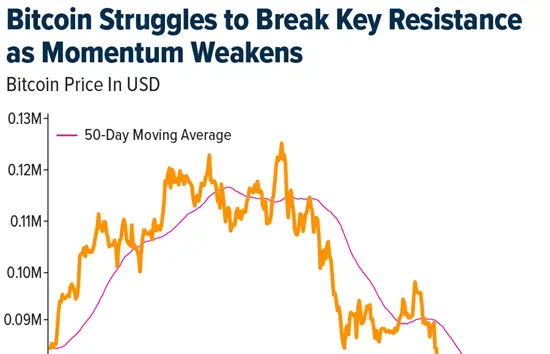
- Bitcoin continues to face strong resistance, failing again to break above the $75,000–$76,000 range and dropping nearly 2% to around $73,500 in intraday trading. This level remains a key psychological barrier, reinforcing doubts about Bitcoin’s ability to sustain a move back toward $90,000.

- Uncertainty around U.S. financial leadership and transparency is adding pressure to the crypto outlook, as Fed chair nominee Kevin Warsh disclosed over $100 million in assets but did not specify the value of several crypto-related investments. With key regulatory bodies like the SEC and CFTC facing leadership gaps, this lack of clarity may slow decision-making and weigh on institutional confidence.
- Security and operational risks remain a concern in parts of the crypto ecosystem, as Grinex, a Kyrgyzstan-based exchange linked to sanctioned Russian activity, halted operations after a cyberattack drained approximately $13 million from its systems. The breach left users unable to access funds, highlighting vulnerabilities in less regulated markets.
Opportunities
- Morgan Stanley’s entry into spot bitcoin ETFs is accelerating institutional adoption, with its MSBT fund attracting over $100 million in inflows in its first week, driven by a low 0.14% fee. While still smaller than BlackRock’s IBIT, which has surpassed $53 billion, the launch highlights growing demand and is prompting competitors like Goldman Sachs to develop new bitcoin-linked products.
- Bitcoin is showing a potential bullish signal as funding rates fall to around -0.005%, their most negative level since 2023, reflecting a surge in short positions. Despite this, BTC has climbed from the low $60,000s to nearly $75,000, suggesting resilience and increasing the likelihood of a short squeeze.
- South Korea is advancing blockchain adoption, with its Ministry of Economy and Finance planning to pilot tokenized deposit payments for government spending in Q4 2026. The initiative aims to improve efficiency and reduce costs by using programmable tokens, potentially scaling nationwide if successful.
Threats
- The potential launch of a yuan-backed stablecoin highlights growing geopolitical competition in digital finance as stablecoins become core global payment infrastructure. With the market nearing $315 billion and dominated by dollar-pegged tokens like USDT and USDC, a state-backed yuan alternative could challenge that dominance while expanding government control over cross-border transactions. The shift is notable given China’s 2021 ban on crypto trading and mining, signaling a strategic pivot toward controlled digital assets. However, strict capital controls and limited currency convertibility remain key barriers, raising the risk of a more fragmented and state-driven global financial system.
- The U.K.’s Financial Conduct Authority is tightening crypto rules, expanding custody definitions to include firms holding client assets for more than 24 hours during settlement. Companies may need full safeguarding licenses or face penalties, with a five-month application window from September 30, 2026 to February 28, 2027. Missing this deadline could result in fines, suspensions, or even permanent closure. As regulators move toward stricter oversight under the Financial Services and Markets Act, the increased compliance burden could slow innovation and create operational risks across the crypto ecosystem.
- A recent exploit involving Hyperbridge, a blockchain protocol that enables the transfer of assets between different networks (known as a cross-chain bridge), highlights ongoing security challenges in the crypto ecosystem. Losses were initially estimated at around $237,000 but were later revised up to approximately $2.5 million after a broader review. The attacker was able to exploit a flaw to create and sell nearly 1 billion tokens across multiple networks, forcing the platform to pause operations. Recovery could take months or even up to a year. This incident reflects a broader issue, with more than $2.8 billion lost to crypto exploits over the past two years, underscoring persistent risks in digital asset infrastructure.
