
Strengths
- Anchorage Digital, the first federally chartered crypto bank in the U.S., is expanding its stablecoin issuance platform through a partnership with M0, which enables institutions to create and manage customizable stablecoins. The collaboration reflects deeper integration between crypto and traditional finance as firms seek regulated digital dollar issuance. As frameworks like the GENIUS Act advance, stablecoins are increasingly positioned as core financial infrastructure across payments, fintech, and digital markets.
- Polymarket is strengthening market credibility through a partnership with Chainalysis, which tracks and analyzes on-chain transactions. The collaboration enables real-time monitoring for insider trading and manipulation, moving oversight closer to Wall Street standards. By combining blockchain transparency with advanced analytics, the partnership highlights crypto’s evolution toward greater trust and institutional adoption.
- Meta Platforms is advancing crypto adoption by allowing creators to receive payouts in USDC, a dollar-backed stablecoin, directly to digital wallets. Payments are supported on high-speed blockchains like Solana and Polygon, with infrastructure from Stripe. The move brings stablecoins into a platform with billions of users, underscoring their growing role in global payments and creator monetization.
Weaknesses
- Bitcoin is showing signs of weakness as it struggles to break above the $80,000 level, where investors may be taking profits. Futures open interest fell 2% to $119 billion, while trading volumes rose 26%, suggesting position unwinding rather than new risk-taking. More than $500 million in leveraged bets have been liquidated, mostly bullish positions, as rising bond yields and oil prices near $110 pressure risk assets. Overall, the data points to limited conviction and fragile momentum.
- Wasabi Protocol was exploited for $4.5 million after attackers compromised a single admin key. The incident adds to a broader trend, with over $605 million lost across at least 12 decentralized finance (DeFi) hacks this month and more than $770 million in total losses so far in 2026. The exploit, driven by missing safeguards such as multisignature controls and timelocks, highlights persistent security weaknesses undermining trust in DeFi.
- ARK Invest signaled weakening crypto momentum by selling $6.1 million of its spot Bitcoin exchange-traded fund (ETF) holdings while increasing its position in Robinhood. At the same time, Robinhood reported roughly a 50% drop in crypto trading volumes and revenue, with shares falling 13.2% after earnings. U.S. spot Bitcoin ETFs also saw $137.8 million in net outflows in a single day, pointing to softer investor demand. Overall, the data reflects cooling activity across the crypto ecosystem.
Opportunities
- Gemini, a U.S.-based crypto exchange founded by the Winklevoss twins, is expanding into derivatives after receiving approval from the Commodity Futures Trading Commission (CFTC) to operate its own clearinghouse. This allows the firm to control trade execution end-to-end and scale products such as perpetual futures, tapping a segment that drives a majority of crypto trading volumes. The announcement lifted shares 2.5% premarket and reflects a broader industry shift toward derivatives as exchanges seek more stable, less cyclical revenue beyond spot trading.
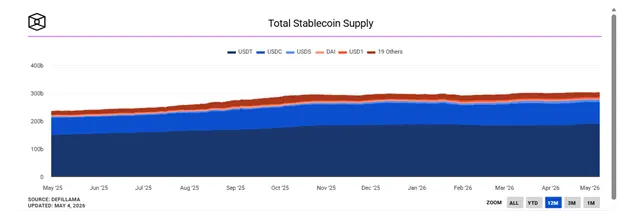
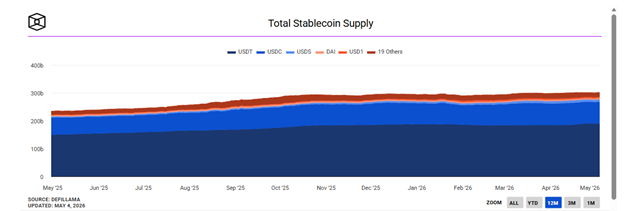
- Coinbase is expanding into institutional finance through its asset management arm with a stablecoin credit fund offering tokenized shares via Superstate, which enables traditional investment funds to be issued on blockchain. The product provides exposure to on-chain lending and private credit, reflecting growing convergence between traditional finance and digital assets. This comes as stablecoin supply has doubled to $300 billion and monthly transaction volumes have reached $1.2 trillion, underscoring accelerating adoption. The move highlights tokenization as a key channel for bringing traditional financial products on-chain and expanding institutional access.
- AllUnity, a joint venture backed by DWS Group, Flow Traders, and Galaxy Digital, is expanding its euro-backed stablecoin EURAU to the Solana, a high-speed blockchain used for payments and trading. Issued under the EU’s Markets in Crypto-Assets (MiCA) regulatory framework, the token enables faster and lower-cost cross-border transactions. The move comes as euro-denominated stablecoins have doubled to nearly $1 billion since early 2025, with projections reaching €570 billion by 2030, highlighting growing demand for non–U.S. dollar digital assets.
Threats
- Polymarket is facing growing scrutiny after new research analyzing over 435,000 markets and $54.4 billion in volume found patterns consistent with potential insider trading. In military-related bets, low-probability wagers show success rates above 50%, far above the typical ~14%, while fewer than 1% of wallets capture nearly half of all profits. The concentration of gains and potential information asymmetries raise concerns about market fairness and integrity, increasing the risk of tighter regulation and undermining trust in prediction markets.
- The crypto industry is facing escalating security risks, with hack-related losses surpassing $630 million across more than 25 incidents in April alone, marking the worst month since early 2025. Major exploits, including attacks on KelpDAO ($293 million) and Drift Protocol ($280 million), accounted for the majority of losses, highlighting concentrated risk in large decentralized finance (DeFi) platforms. Increasingly, attackers are targeting off-chain infrastructure such as key management systems and cloud services, making breaches harder to detect and prevent. The trend underscores persistent security challenges across the digital asset ecosystem.
- Regulatory uncertainty is intensifying in the U.S. as the Commodity Futures Trading Commission (CFTC) has sued multiple states, including New York and Illinois, over attempts to classify prediction markets as gambling rather than financial derivatives. The dispute highlights a fragmented regulatory landscape where federal and state authorities disagree on jurisdiction, creating uncertainty for platforms like Polymarket and Kalshi. If classified as gambling, these platforms could face stricter licensing requirements, limited market access, and reduced institutional participation. With cases potentially reaching the Supreme Court, the regulatory divide represents a material risk to the growth and legitimacy of crypto-based prediction markets.
