

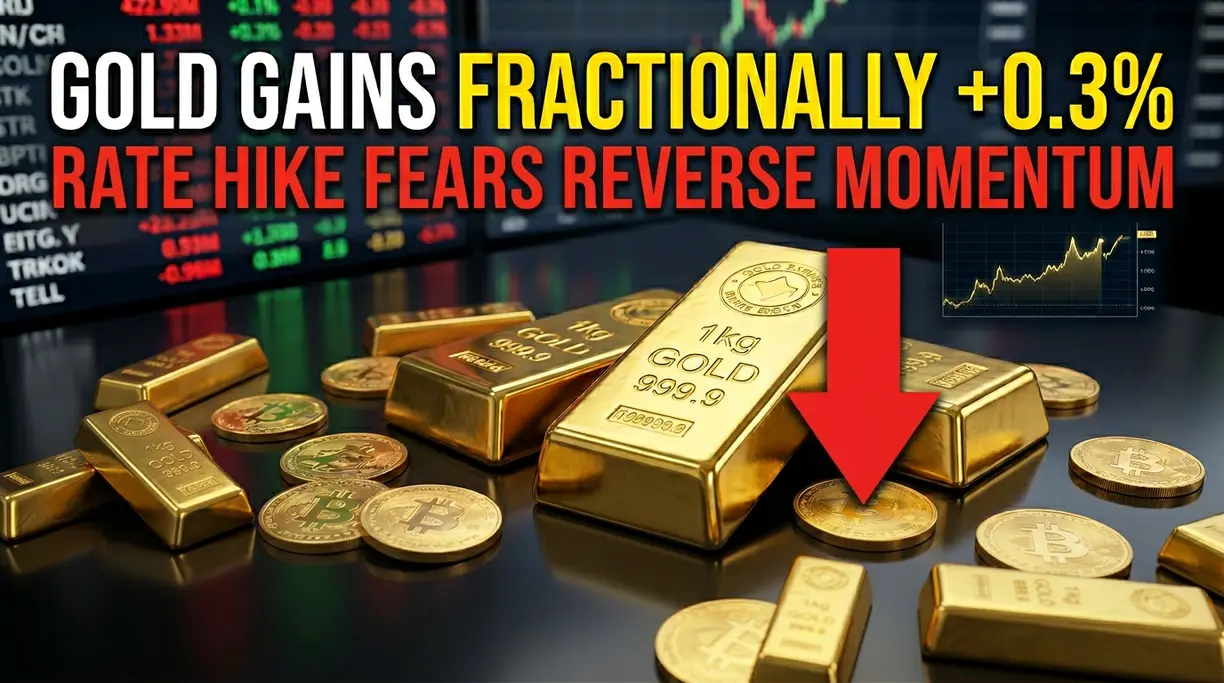
Gold has been one of the defining asset stories of this decade. After crossing $5,000 per troy ounce for the first time in history earlier this year, the metal has since consolidated near $4,494, a level that, in any prior era, would itself have been a record. The question now occupying investors and strategists alike is not whether gold belongs at elevated prices, but what catalysts could drive the next leg higher, and where the credible downside risks lie.
The structural forces underpinning gold remain as potent as they were when the rally began. Central banks particularly those in emerging markets seeking to reduce dollar exposure have continued accumulating at a historic pace. This sovereign-level demand has established a durable bid beneath spot prices that did not exist in prior cycles.
The scale of that shift is now measurable in sovereign balance sheets. According to the European Central Bank, gold accounted for 27% of global foreign reserves at the end of 2025 — surpassing both U.S. Treasuries, at 22%, and euro-denominated holdings, at 15%. That share had risen from 20% a year earlier, though the ECB attributed much of the increase to gold’s price appreciation rather than outright purchases. Indeed, as the metal has grown more expensive rising more than a third over the past twelve months some central banks have tempered their buying. Turkey, faced with currency pressure following the U.S. and Israeli strikes on Iran earlier this year, sold or loaned significant gold reserves, the ECB noted. The episode is a reminder that sovereign gold holdings, while structurally supportive, are not unconditional.
The de-dollarization trend is an equally significant backdrop. J.P. Morgan's strategists have stated that if just 0.5% of foreign U.S. asset holdings were reallocated into gold, that flow alone would generate enough demand to push prices to $6,000 per ounce. That scenario once considered theoretical is increasingly discussed as a base case within sovereign wealth circles.
Federal Reserve policy is the third and most near-term catalyst. Markets are watching for a rate-cutting cycle to resume; any dovish pivot would reduce the opportunity cost of holding non-yielding gold and simultaneously weigh on the dollar. The World Gold Council has estimated that if rates fall more than expected, gold could gain an additional 5% to 15% from current levels. A more severe economic downturn, the Council adds, could produce a 15% to 30% upside scenario.
Geopolitical risk and inflation hedging round out the bull case. Persistent global tensions from unresolved trade disputes to regional conflicts continue to channel institutional and retail capital into safe-haven assets. Meanwhile, ETF inflows, which lagged the 2024 rally, have been accelerating in 2026 as Western investors reconnect with the asset class after years of underweighting.
Institutional price targets for year-end 2026 span a wide range, but are skewed decisively to the upside. Goldman Sachs, after reaffirming its outlook following March’s 10% pullback, the metal’s steepest monthly decline since June 2013 — maintained a target of $5,400. J.P. Morgan has raised its 90-day target to $5,000, with a more bullish scenario pointing to $6,000 to $6,300. Morgan Stanley’s base case sits near $4,800 by Q4, describing it as the most measured on Wall Street. On the conservative end, Macquarie holds a 2026 average forecast of $4,323, reflecting concern about the impact of rising U.S. yields.
A Financial Times survey of eleven analysts found a consensus year-end forecast of $4,610, though several respondents noted asymmetric upside risks. S&P Global’s broader analyst consensus sits at $4,242, a figure that appears increasingly cautious given the current spot price environment.
Gold’s bull case is not without credible opposition. The most significant downside risk is a hawkish Federal Reserve pivot: if inflation were to reaccelerate and force the Fed to pause or reverse course on rate cuts, real yields would rise and the dollar would strengthen, a combination historically toxic for gold. UBS has explicitly identified a hawkish Fed as gold’s primary downside risk.
A durable resolution of major geopolitical conflicts, while broadly positive for global risk assets, would reduce safe-haven demand and could prompt ETF outflows. Similarly, if artificial intelligence delivers the productivity gains its proponents project, improved real growth could lift the dollar and dampen gold sentiment. Record-high prices are also beginning to restrain physical demand in price-sensitive markets, particularly in parts of Asia.
Even in a bearish scenario, most analysts expect physical demand from central banks and Asian buyers to provide a structural floor. A sustained break below $4,000 would require a genuine deflationary shock — a scenario few mainstream forecasters are currently modeling.
Reaching the $6,000 threshold before year-end would likely require one of two distinct scenarios: a Fed rate-cutting cycle that removes the opportunity-cost headwind and weakens the dollar, or a further deterioration in confidence in dollar-denominated assets that accelerates reserve diversification. Both scenarios are within the realm of possibility. Neither, as of this writing, appears imminent.
The more pressing consideration for investors may be positioning rather than price targets. Gold’s expansion beyond its traditional ownership pool — into insurance company portfolios, sovereign wealth funds, and even crypto-adjacent vehicles — suggests the demand base has broadened structurally, not just cyclically. That shift, if sustained, argues for treating gold not as a tactical hedge, but as a core allocation within a diversified portfolio.
With spot gold near $4,494, the metal is consolidating after a historic run. The preponderance of evidence including sovereign demand, geopolitical risk, dollar headwinds, and expanding investor pools favors a continued upward bias. The base case consensus of $4,600 to $5,400 by year-end reflects a market that believes the structural bull case remains intact, even as near-term volatility and macro uncertainty introduce caution. The risks are real; the tailwinds are stronger.
those that would like more information about our services click here.
Wishing you as always good trading,
