
Strengths
- SpaceX's recent SEC filing confirmed that the company continues to hold 18,712 BTC on its balance sheet, valued at approximately $1.3 billion as of March 31. The position has remained unchanged since its initial purchase in 2021, demonstrating a long-term commitment through multiple market cycles. Together, SpaceX and Tesla now hold more than 30,000 BTC, reinforcing Bitcoin's growing role as a corporate treasury asset among major technology companies.
- The crypto industry's political arm secured another victory as pro-crypto candidate Barry Moore won Alabama's Republican Senate primary after receiving strong support from Fairshake and affiliated PACs. Fairshake spent more than $12 million backing Moore and currently holds nearly $150 million in cash for future races. The win reinforces the industry's growing influence in U.S. politics as it works to build what supporters call the largest pro-crypto caucus in congressional history.
- More than 200 crypto firms have urged the U.S. Senate to advance the Digital Asset Market Clarity Act, legislation designed to establish a federal framework for digital assets and clarify regulatory responsibilities between the SEC and CFTC. The bill, which already passed the House of Representatives, could provide greater legal certainty for blockchain networks, developers, and digital asset businesses. The broad industry support emphasizes growing momentum toward comprehensive crypto regulation in the U.S.
Weaknesses
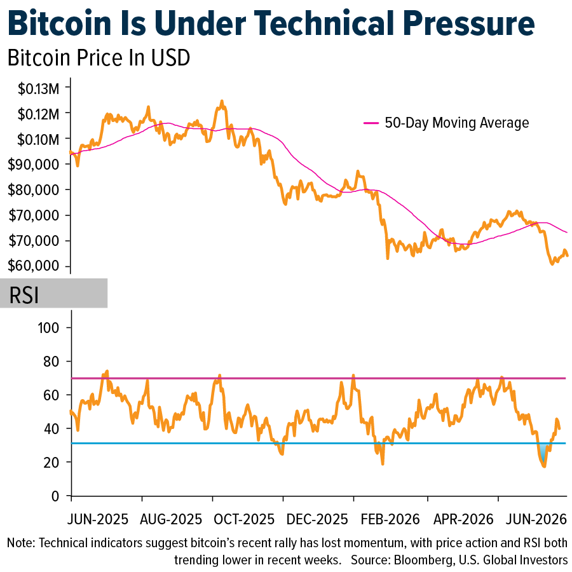
Bitcoin's 11% decline in June has significantly impacted investor positioning ahead of the June 26 options expiration. Approximately $8.6 billion, or 80% of the $10.6 billion in outstanding options contracts, are currently out of the money and could expire worthless if prices do not recover. The data suggests that many traders expected bitcoin to trade well above current levels near $65,000, highlighting weaker market sentiment and increasing the potential for heightened volatility as expiration approaches.
- Forward Industries, the largest publicly traded Solana treasury company by SOL holdings, failed to secure any of its three proposed stock-for-stock acquisitions after all targets either rejected or ignored its offers. The company holds nearly 7 million SOL acquired for approximately $1.6 billion at an average price of $232 per token, leaving it with more than $1 billion in unrealized losses at current market prices. The outcome raises questions about the viability of its consolidation strategy and investor confidence in SOL-backed corporate structures.
- U.S. spot Bitcoin ETFs experienced persistent investor withdrawals in early June, posting net outflows in 11 of 13 trading sessions between May 29 and June 16. The largest daily redemption reached $519 million on June 2, while BlackRock's IBIT accounted for a significant share of the withdrawals. The trend suggests weaker investor demand for bitcoin exposure and reflects a more cautious market environment amid ongoing price volatility.
Opportunities
- Coinbase unveiled a broad suite of new products as it advances its vision of becoming an "everything exchange." New offerings include tokenized U.S. stocks, stock and crypto options trading, AI-powered investment advice, prediction markets, and perpetual futures linked to private companies such as SpaceX, with OpenAI and Anthropic expected to follow. The expansion shows the growing convergence of traditional finance, artificial intelligence, and digital assets within a single platform.
- Prediction markets experienced a surge in activity during the 2026 FIFA World Cup, with Polymarket's tournament winner market alone generating more than $2.5 billion in trading volume. The event has attracted multi-million-dollar wagers, including one trader who earned $9.24 million in a single day after correctly predicting four match outcomes.
- Hyperliquid, a leading decentralized perpetual futures exchange, surpassed $10 billion in open interest as demand grows for blockchain-based trading of equities, commodities, indexes, and pre-IPO markets. According to Talos, a digital asset trading and infrastructure provider serving institutional investors, roughly $4 billion of open interest is tied to non-crypto perpetual products, while pre-IPO contracts attracted more than $250 million ahead of SpaceX's public listing. The trend stresses increasing demand for 24/7 access to financial markets and the growing convergence of traditional finance and digital asset infrastructure.
Threats
- Binance may face restrictions on operating across the European Union after Reuters reported that Greece's regulator is expected to reject the exchange's MiCA license application ahead of the June 30 deadline. MiCA, the EU's new regulatory framework for crypto assets, requires firms to obtain authorization to serve customers across member states. If denied, Binance could lose access to one of the world's largest crypto markets.
- Illinois approved a new 0.2% tax on digital asset business activity, including the exchange, transfer, or custody of crypto assets on behalf of customers. The measure applies to firms generating at least $100,000 in gross receipts from Illinois residents and is expected to raise approximately $60 million annually. Industry groups have criticized the law for imposing a unique tax burden on digital assets that does not apply to stocks, bonds, or derivatives, raising concerns that similar measures could spread to other jurisdictions.
- Major U.S. gaming organizations are urging lawmakers to prohibit sports-related prediction markets through pending crypto market structure legislation. The groups argue that platforms such as Kalshi and Polymarket are offering nationwide sports wagering without the regulatory safeguards applied to traditional gaming operators. The proposal comes as prediction markets continue to grow rapidly, with Kalshi generating $16.8 billion in trading volume and Polymarket $7.1 billion in May, raising the risk of new restrictions on one of the fastest-growing segments of the digital asset ecosystem.
