

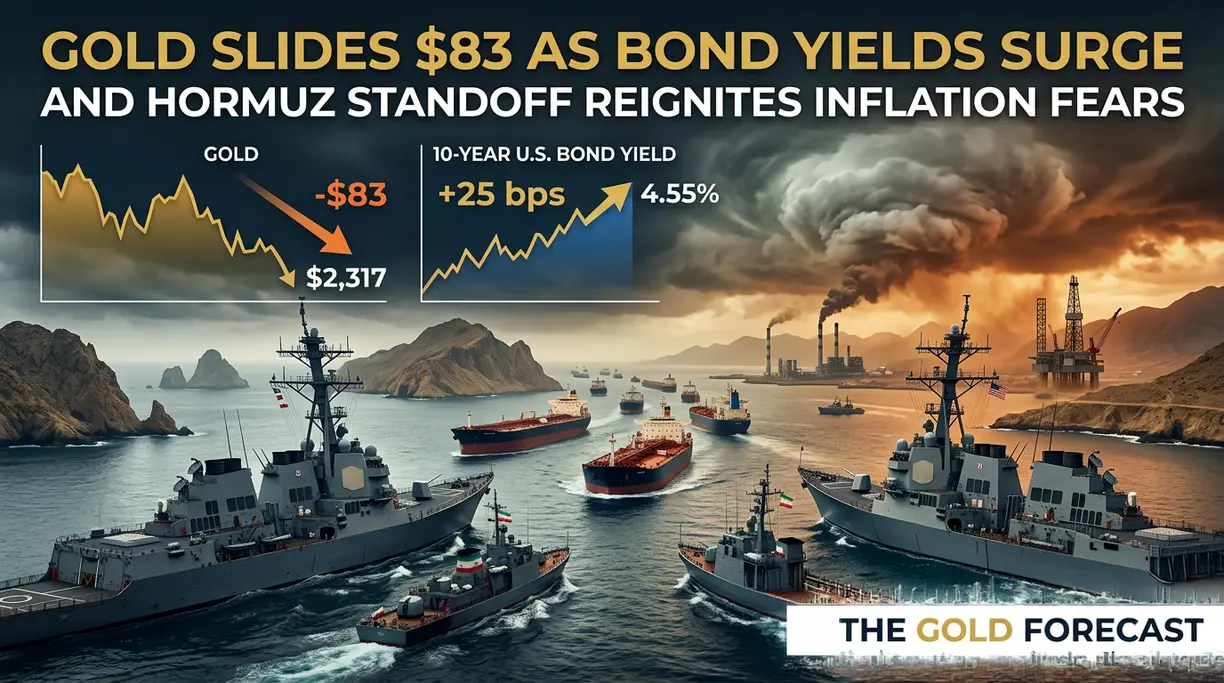
Gold futures posted a sharp reversal on Tuesday, August 18, giving back $83 from Monday’s 74-day high and snapping a two-session winning streak. December contracts, which opened at $4,473.40 per troy ounce nearly flat with Monday’s close, retreated steadily through the New York session and settled in the vicinity of $4,390, pressured by the convergence of surging Treasury yields, a firmer dollar, and a deteriorating diplomatic picture in the Middle East.
The primary driver was a broad global bond selloff that pushed the 10-year Treasury yield to roughly 4.72%, approaching a one-year high, while the 30-year climbed above 5.33%, its highest reading since the global financial crisis. For a non-interest-bearing asset like gold, rising yields carry a direct opportunity cost: as bonds become more attractive on a relative-return basis, capital rotates away from bullion. The U.S. Dollar Index edged higher to 99.67, providing an added headwind for dollar-denominated commodities. Both forces converged on gold just as the metal was bumping against its 100-day simple moving average near $4,384.
Compounding the selling was a breakdown in Iran diplomacy. Jared Kushner, President Trump’s special envoy, indicated that Tehran remained unwilling to accept Washington’s terms, and the 60-day memorandum of understanding expired without renewal. Iran’s newly appointed naval chief declared the Strait of Hormuz to be under Iranian control, rattling energy markets and sending WTI crude near $85 a barrel. The British military separately confirmed that a vessel was struck by an unknown projectile inside the strait on Tuesday.
Fresh data reinforced the week’s contradictory signals. Housing Starts for July fell 12.4% month-over-month to an annualized 1.239 million units, well below June’s 1.415 million. Industrial Production for July rose only 0.2%, missing the 0.3% estimate. Those numbers extend a string of soft reports—July nonfarm payrolls contracted by 23,000 against an expected 80,000 gain, July CPI registered 0.1% monthly with core at 2.5%, and retail sales fell 0.6%. That has pushed the implied probability of a September Federal Reserve rate hike down to roughly one-in-three from above 55% three weeks ago. That softening in rate expectations had been the engine of gold’s recent advance, so Tuesday’s pullback reflects the recognition that energy-driven inflation could undercut the reprieve.
Market participants were also positioning cautiously ahead of Wednesday’s release of the FOMC minutes from the July 28–29 meeting, which produced an unusually contentious 9-to-3 vote to hold rates steady, with three dissents in favor of an immediate hike.
Despite Tuesday’s loss, gold remains up more than 10% on the month and more than 33% year-over-year, underpinned by central bank demand that reached 244 tonnes in the first quarter of 2026, the strongest quarterly total since Q4 2024. China’s central bank added 19.9 tonnes in July, its 21st consecutive month of accumulation. ANZ Research maintains a $5,200 year-end target. The week’s central event is now Wednesday’s minutes; beyond that, Fed Chair Kevin Warsh delivers his first major keynote at the Jackson Hole Symposium on August 28, arriving just 19 days before the September 16 FOMC decision.
For ongoing session-by-session analysis and technical commentary, visit thegoldforecast.com.
Wishing you, as always, good trading.
