

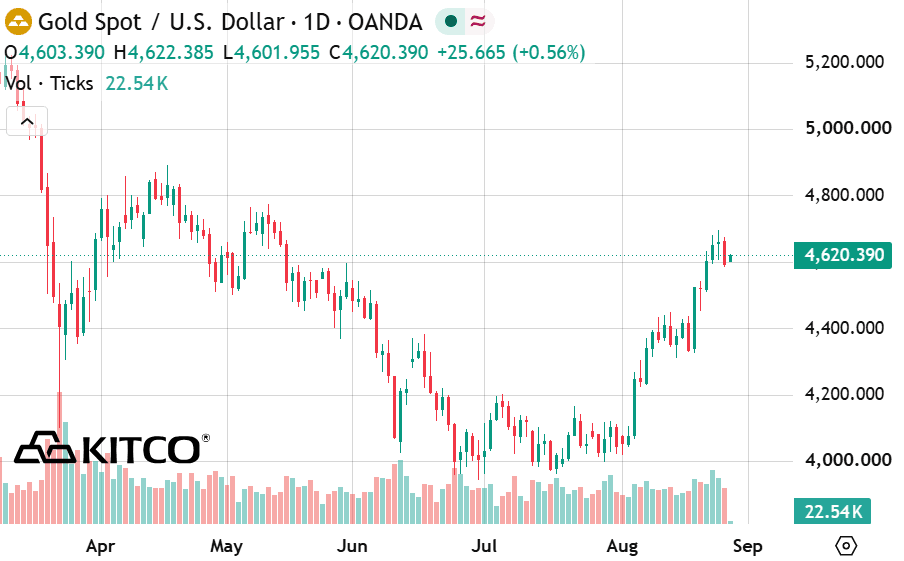
(Kitco Commentary) - Yesterday, we outlined how gold was positioning itself for a potential three-river evening star candlestick pattern, contingent on a strong red candle to close out the session. We also discussed gold's recent reclaim of the 200-day simple moving average and noted that, if that bullish technical development continued to hold, that key level should serve as meaningful support — helping to contain drawdowns following such a powerful and extended rally.
Today, both of those scenarios came to fruition. Gold completed the three-river evening star formation, though it bears repeating that this pattern still requires additional confirmation before it can be treated as a verified bearish reversal signal. At the same time, gold futures were trading right at the 200-day SMA at the time of writing — sitting just $3 below that pivotal moving average. Whether that level holds will be the defining technical question heading into the next session. Despite the narrow margin, the overall technical picture suggests gold has a reasonable case for finding support at that line and holding it.
The catalyst behind today's selloff was squarely fundamental. July's Personal Consumption Expenditures (PCE) report landed hotter than Wall Street had anticipated, reigniting concerns about the stickiness of inflation. The PCE price index rose 0.2% in July, exceeding the consensus estimate of 0.1%, while the annual reading came in at 3.7% — a tick above forecasts of 3.6%. Core PCE, which excludes food and energy, increased 0.2% month-over-month and 3.3% year-over-year, both in line with expectations. Consumer spending and income data also nudged slightly above forecasts. Rounding out a busy data session, separate figures confirmed that U.S. GDP expanded at an annualized rate of 1.5% in the second quarter, matching the initial estimate, while durable goods orders surged 1.1% in July — more than double the 0.5% increase analysts had projected.
Despite the hotter-than-expected headline inflation print, the CME FedWatch tool barely moved in response. The probability of a September rate hike is currently pegged at around 36%, a figure that remained largely unchanged following the release. The more immediate and tangible market reaction was felt in the U.S. dollar, which strengthened notably on the data. A firmer dollar acted as a direct headwind for the precious metals complex, pressing both gold and silver lower through the session.
It is also worth noting that silver, while it did decline alongside gold today, managed to hold up slightly better on a relative basis. This is a subtle but meaningful observation. Silver has historically been known to lead price moves in both directions — amplifying gains in rallies and outpacing losses in downturns. The fact that silver has not been playing that leading role in recent sessions is a divergence worth monitoring as we move into the next phase of this market cycle.
Going forward, all eyes will be on whether the 200-day SMA can hold as support and whether the evening star pattern receives the confirming price action it needs to validate a near-term bearish reversal. As always, we will keep a close watch on both and report back.
For more daily market commentary and analysis, visit thegoldforecast.com.
Wishing you, as always, good trading.
