
Gold and Bitcoin have become increasingly prominent features of institutional portfolio discussions. According to the World Gold Council, Central banks have accumulated an average of around 1,000 tonnes of gold annually over the past four years (2022–2025), significantly above the roughly 500-tonne average of the preceding decade and helping drive the metal to successive record highs. Alongside this trend, Bitcoin has continued its evolution from a niche digital asset into an increasingly institutional asset class, supported by the launch of spot ETFs, growing corporate treasury adoption, and broader participation from institutional investors and traditional financial institutions.
Comparisons between the two assets are not new. For more than a decade, Bitcoin has been described as "digital gold," often prompting debates about whether it could eventually rival or even replace gold as a store of value. But as the macroeconomic and geopolitical backdrop has evolved, that framing has become less useful.
The more relevant question today is not whether gold or Bitcoin is superior. It is why an increasing number of investors are finding reasons to own both. This article examines the forces driving renewed interest in hard assets, the characteristics that connect gold and Bitcoin, and how their differing maturity profiles increasingly support complementary rather than competing portfolio roles.
Why the Comparison Matters More Today
A rapidly shifting macroeconomic backdrop has forced a re-evaluation of the “gold vs. Bitcoin” relationship. Over the past decade, ballooning sovereign debt and structural fiscal deficits have become permanent fixtures of developed economies, with the IMF projecting an average debt as a percent of GDP of 123.7% for G7 economies in 2026 (Figure 1). Concurrently, escalating geopolitical tensions have forced a sharp focus on reserve diversification and sovereign counterparty risk, breaking the assumptions that anchored portfolio construction for much of the post-crisis era.
Figure 1: G7 Sovereign Debt Trajectories and Structural Projections
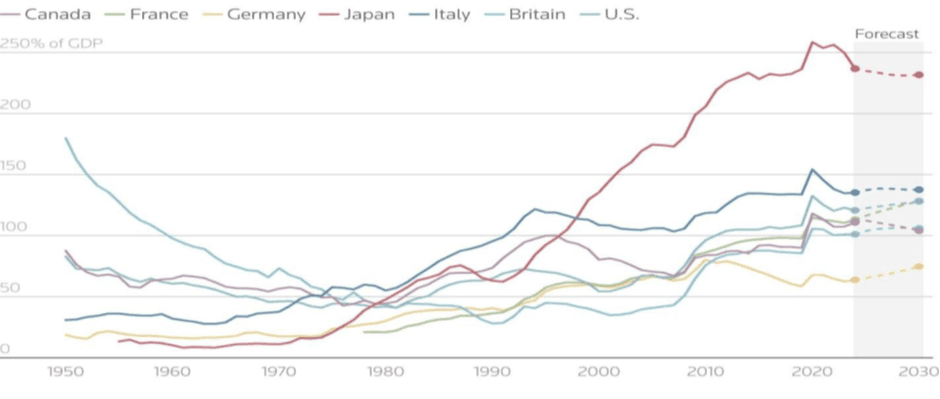
Source: IMF, Reuters. Data as of September 2025.
This environment has accelerated the flight toward assets outside traditional sovereign liabilities, a shift that highlights the growing importance of convexity within portfolio construction. Most traditional assets are designed to perform under expected economic conditions. Convex assets, by contrast, derive much of their value from responding disproportionately to unexpected outcomes.
Gold has historically fulfilled this role as a reserve asset during periods of monetary instability, but Bitcoin is increasingly viewed through a similar lens, demonstrating a more volatile, yet significantly more pronounced, version of the same dynamic. Accordingly, allocators are evaluating gold and Bitcoin within a common hard-asset allocation framework by isolating the structural characteristics that connect the two assets, despite their distinct characteristics.
Different Assets, Shared Monetary DNA
Despite vastly different historical and technological origins, gold and Bitcoin are converging within the same hard-asset allocation framework. This co-location is driven not by identity, but by a shared set of scarce, non-sovereign structural traits that are difficult to replicate elsewhere in modern finance.
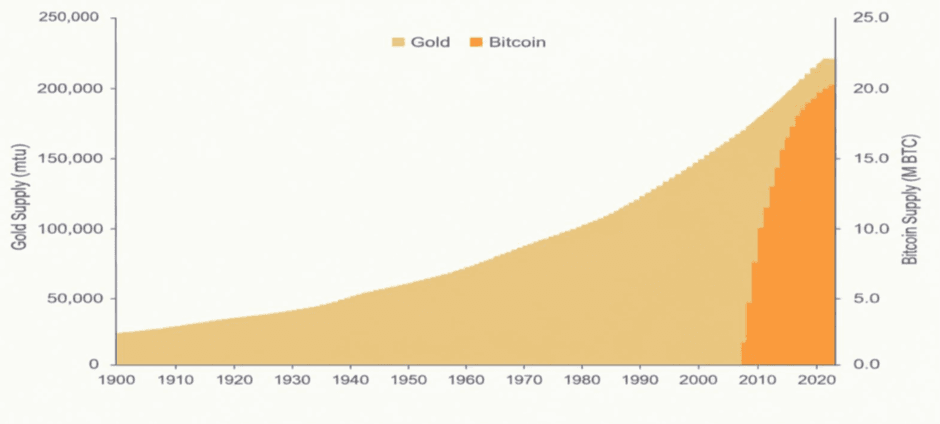
• Absolute Scarcity: Gold’s supply is physically constrained by geology, with above-ground stocks growing at a predictable 1–2% marginal rate via mining on an annual basis (Figure 2). Conversely, Bitcoin enforces scarcity through algorithmic code, operating on a transparent issuance schedule capped strictly at 21 million units with 95.5% of Bitcoin's eventual supply already having been mined. While the mechanisms differ, both enforce a strict supply discipline that contrasts sharply with fiat monetary systems.
• Zero Counterparty Risk: Unlike bonds (claims on governments) or bank deposits (dependent on institutional solvency), gold and Bitcoin are held directly rather than owed by an intermediary. This lack of credit risk makes them structurally isolated from systemic financial failures.
• Monetary Premium: Neither asset's valuation can be explained by utilitarian demand alone. Gold’s industrial applications represent only a fraction of its multi-trillion-dollar capitalization, just as Bitcoin’s transaction throughput does not fully account for its network value. In both instances, allocators assign a substantial premium to the asset's structural capacity to preserve purchasing power over time.
Figure 2: Annual Supply Comparisons of Gold & Bitcoin
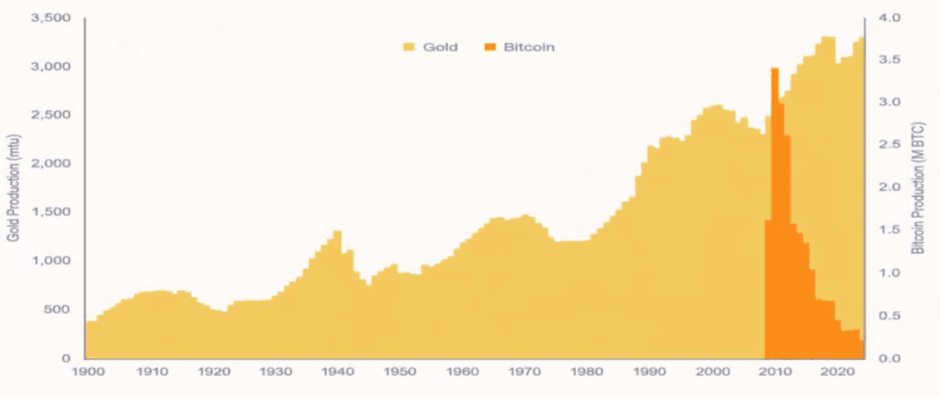
Source: Glassnode, USGS, Gold.org, NYDIG. Data as of 2026.
These shared characteristics explain why gold and Bitcoin increasingly occupy the same investment conversation. Yet monetary similarities explain only part of the relationship. Their differing maturity, volatility, and adoption profiles ultimately determine the distinct roles each plays within institutional portfolios.
Asymmetric Volatility vs. Systemic Stability
While their shared monetary properties draw gold and Bitcoin into the same conversation, their differing maturity profiles serve entirely distinct structural purposes within a portfolio.
Gold's position as a foundational reserve asset with deep central bank liquidity has been codified over centuries. With sovereign institutions alone holding over 36,000 tonnes of physical gold valued near $5 trillion, gold operates primarily as a defensive portfolio anchor. It serves as a reliable ballast against systemic shocks and currency debasement, maintaining a predictable annualized volatility profile typically hovering around 12% to 15%, with drawdowns rarely exceeding 30% in modern regimes.
Bitcoin occupies a different position on the maturity curve. Its annualised volatility typically ranges between 40% and 50%, with historical drawdowns of 70–80%, making it a fundamentally different portfolio instrument from gold despite their shared monetary characteristics.
Figure 3: Gold vs. Bitcoin Volatility Profiles Compared, 2019–2025
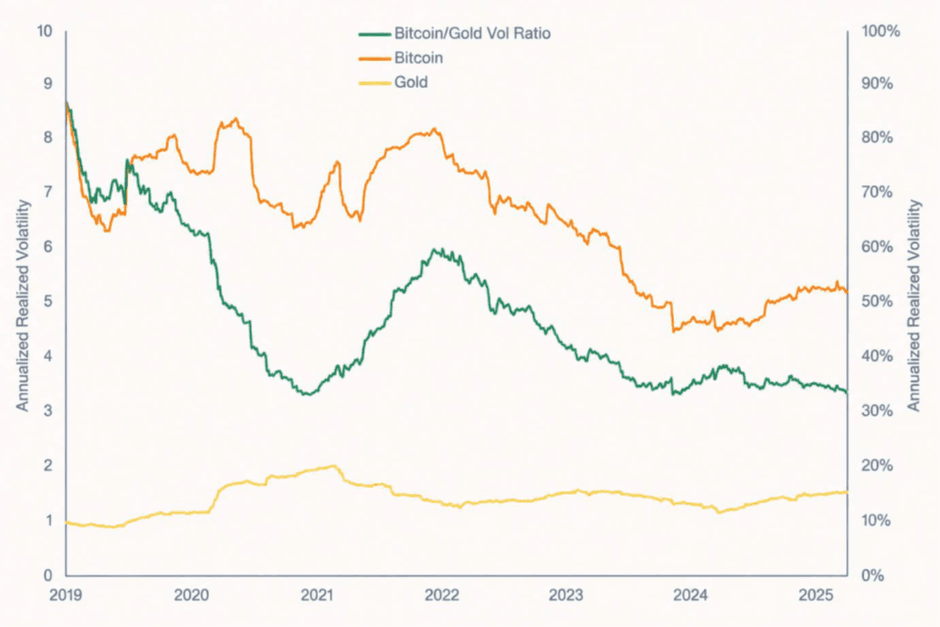
Source: NYDIG, Bloomberg. Data as of Q1 2025.
This stark volatility variance changes how the two assets must be sized and managed. Gold offers deep, liquid stability to the hard-asset sleeve of a portfolio. Bitcoin, by contrast, operates as a high-convexity vehicle with asymmetric upside potential if network expansion continues.
At their core, the economic models for both assets are highly comparable, with each functioning as a trust-dependent, supply-capped monetary network driven entirely by user adoption. The structural divergence is not a matter of design, but simply a reflection of network maturity.
The Valuation Challenge
Evaluating gold and Bitcoin requires a different approach from traditional, cash-flow-based valuation models. Whereas equities are valued on future earnings, bonds on coupon payments, and real estate on rental income, gold and Bitcoin generate no cash flows at all. Investors must therefore rely on alternative valuation frameworks.
Gold has traditionally been valued using a fluid mix of real interest rates, inflation expectations, and macroeconomic regimes. Yet, macro variables alone fail to explain its capitalization and much of its value is a premium reflecting its institutional role as a non-sovereign store of value. Bitcoin presents a similar challenge. Allocators use a range of frameworks, including stock-to-flow mechanics, commodity cost-of-production floors, and network-growth metrics, but none serves as a definitive valuation anchor.
Figure 4: Asset Network Trajectories: Global Sizing Comparison
Source: Glassnode, USGS, Gold.org, NYDIG. Data as of early 2026.
Both assets derive much of their value from monetary adoption. The core challenge stems from the fact that both assets derive their terminal value from monetary network effects and adoption curves. Their worth is a direct function of the depth to which individuals, corporations, and sovereign entities integrate them into reserve strategies.
This reality highlights the asymmetric structural gap between the two. Gold's valuation reflects a monetary network that has developed over centuries, supported by widespread institutional acceptance and official reserve demand. Bitcoin is building a comparable monetary network far more rapidly, with institutional adoption accelerating through global Bitcoin ETPs (currently $105-130 billion in AUM), corporate treasury strategies, and regulated custody infrastructure. The valuation challenge for both assets therefore lies less in forecasting cash flows than in assessing the continued expansion of those monetary networks.
From Time to Space: The Infrastructure Convergence
The convergence between gold and Bitcoin increasingly extends into market infrastructure. Historically, gold’s primary strength has been preserving purchasing power over long periods which is unmatched across centuries and monetary regimes. Its core limitation, however, has been its scalability across space due to the heavy operational friction of moving, settling, and collateralizing physical bullion across borders.
Bitcoin solved this spatial challenge at its inception. Its true structural innovation was not merely digital scarcity, but the architecture to clear and settle value globally on digital rails without reliance on traditional intermediary clearinghouses.
Today, these two systems are beginning to merge. The rise of tokenized commodity asset, principally Tether Gold (XAUT) and Pax Gold (PAXG), allows allocators to secure direct title to physical, vault-secured bullion while exploiting blockchain-native settlement speeds. This infrastructure transition enables 24/7 liquidity and fractional ownership of gold as on-chain collateral across digital asset ecosystems.
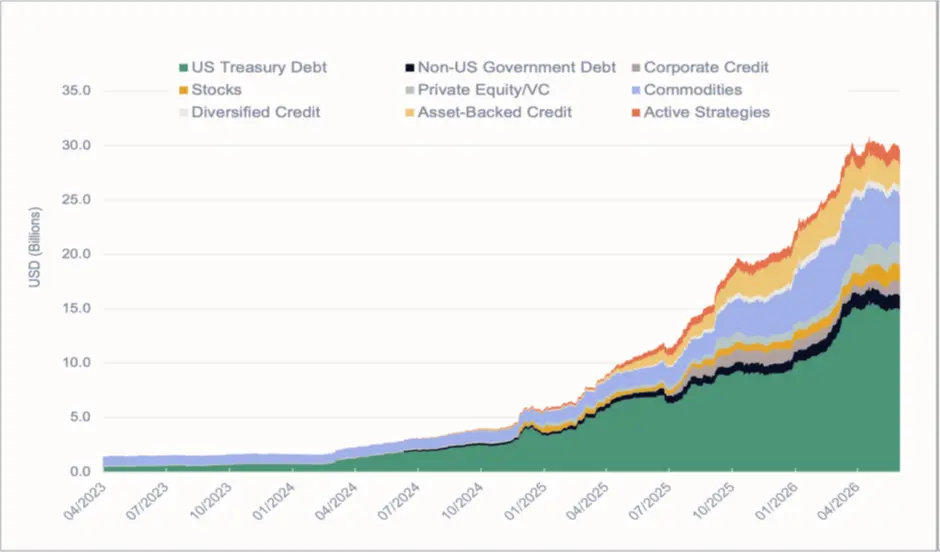
Figure 5: The Growth of Tokenized Real-World Gold Assets (all chains), 2023-2025
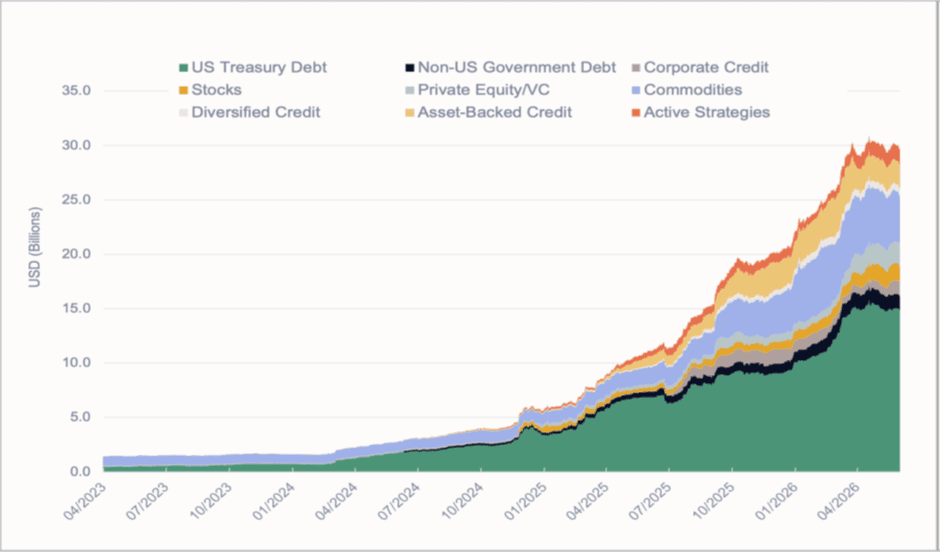
Source: RWA.xyz. Data as of June 25,2026.
While the tokenized gold footprint remains a small fraction of the broader approximately $30 trillion above-ground gold market, it is gaining meaningful traction. In early 2026, the aggregate market capitalization of tokenized gold surged past $6 billion, led by Tether Gold (XAUT) reaching approximately $3.6 billion and Pax Gold (PAXG) around $2.3 billion in on-chain supply. This expansion underlines that gold is actively absorbing the infrastructure rails originally engineered for digital assets, allowing an asset that scales perfectly through time to finally scale through space.
The convergence is not one-way. As gold adopts digital settlement infrastructure, Bitcoin is simultaneously moving closer to traditional finance through spot ETFs, regulated custody, and institutional market infrastructure as mentioned above.
The result is that gold and Bitcoin are becoming increasingly connected through both the role they play in portfolios and the infrastructure that supports them. Bitcoin remains a digital-native monetary network. Yet, by sharing interconnected financial rails, they are proving to allocators that the relationship is far more sophisticated than a simple, zero-sum competition between old and new stores of value.
This same convergence is beginning to erode one of gold’s oldest disadvantages: unlike a bond or a dividend-paying equity, a bar in a vault pays nothing while costing its owner storage and insurance.
Because tokens such as XAUT and PAXG are composable, the same ounce of gold can now be put to work rather than left idle. Holders can supply tokenized gold to on-chain lending markets, post it as collateral to borrow stablecoins, or provide it to liquidity pools, while centralized desks offer comparable yield-generating strategies and earn products. Both PAXG and, more recently, XAUT have been onboarded as collateral on lending protocols such as Aave, though on-chain markets remain small and utilization caps are quickly reached.
This mirrors the way Bitcoin generates return through lending, wrapped-asset collateral, and basis or options-overlay strategies: in each case the yield is manufactured on top of the asset rather than intrinsic to it. That distinction matters. The yield introduces smart-contract, counterparty, liquidity, and deep risks that physical bullion does not carry, and rates are variable, incentive-driven, and far from guaranteed.
Even so, the ability to earn a return while retaining gold price exposure narrows a gap that once cleanly separated the metal from income-producing assets and from Bitcoin.
This is precisely the model 3iQ already applies to Bitcoin, and the same architecture extends naturally to tokenized gold. In our BTC accumulation strategy, investors subscribe in the asset itself; the holdings are secured with an institutional custodian under a tri-party arrangement and posted as collateral so that their value can be deployed into market-neutral and trading strategies, while the underlying coins remain off-exchange.
The resulting profit and loss is realized and converted back into the asset, so a successful strategy increases the investor’s holdings measured in the asset itself, independent of its price. Applied to XAUT or PAXG, the same approach would let an allocator accumulate gold – growing the number of ounces they own rather than merely the dollar value – while retaining full gold price exposure and mitigating on-exchange counterparty risk through the same collateral structure. In effect, the accumulation framework that turns idle Bitcoin into a growing stack can now do the same for gold.
Why Portfolio Construction Favors Both
Once allocators move past the zero-sum debate of which asset is superior, the portfolio construction case for holding both becomes compelling. While gold and Bitcoin respond to similar macroeconomic anxieties, they behave differently within a multi-asset framework.
This divergence is clearly captured by their correlation dynamics. Historically, the relationship has been inconsistent, but data from early 2026 suggests an increasing decoupling. The one-year rolling correlation between gold and Bitcoin dropped to -0.17, confirming that the market treats them as distinct macro expressions rather than a synchronized "mirror trade."
Figure 6: One-Year Rolling Correlation Between Gold vs. Bitcoin
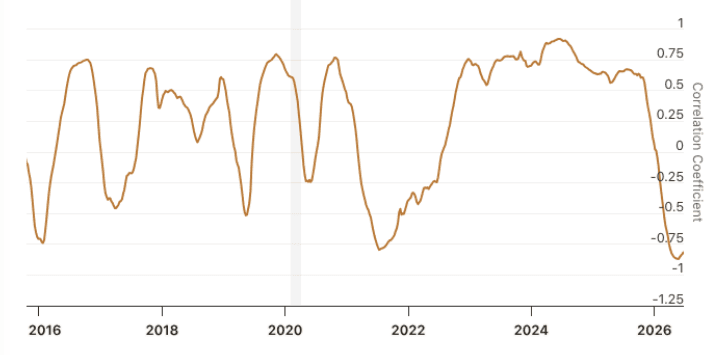
Source: LongTermTrends. Data as of June 25, 2026.
For portfolio managers, this non-correlated behavior makes the assets highly complementary within a modern barbell strategy:
• The Defensive Anchor (Gold): Operates as a low-volatility (~12–15%), deeply liquid strategic reserve. It provides a reliable cushion against geopolitical shocks and periods of monetary or market stress.
• The Convex Growth Engine (Bitcoin): functions as a higher-volatility allocation that offers exposure to expanding institutional adoption. When appropriately sized, its asymmetric return profile has the potential to enhance overall portfolio efficiency without dominating portfolio risk.
Ultimately, the investment landscape has evolved beyond the traditional stock-and-bond framework. Persistent fiscal deficits, escalating sovereign debt, and a more fragmented geopolitical environment means that each plays a more distinct role within a modern hard-asset allocation.
Against this backdrop, gold and Bitcoin are increasingly viewed as complementary rather than competing assets. Gold offers the stability and liquidity of a mature monetary asset, while Bitcoin provides exposure to a monetary network that continues to institutionalise through expanding market infrastructure and growing institutional participation.
For institutional allocators, the debate is now about understanding the distinct role each plays within a modern hard-asset allocation, not about maintaining a false and outdated binary framework of gold versus Bitcoin. The most resilient portfolios may be those that recognise the complementary strengths of both.
