
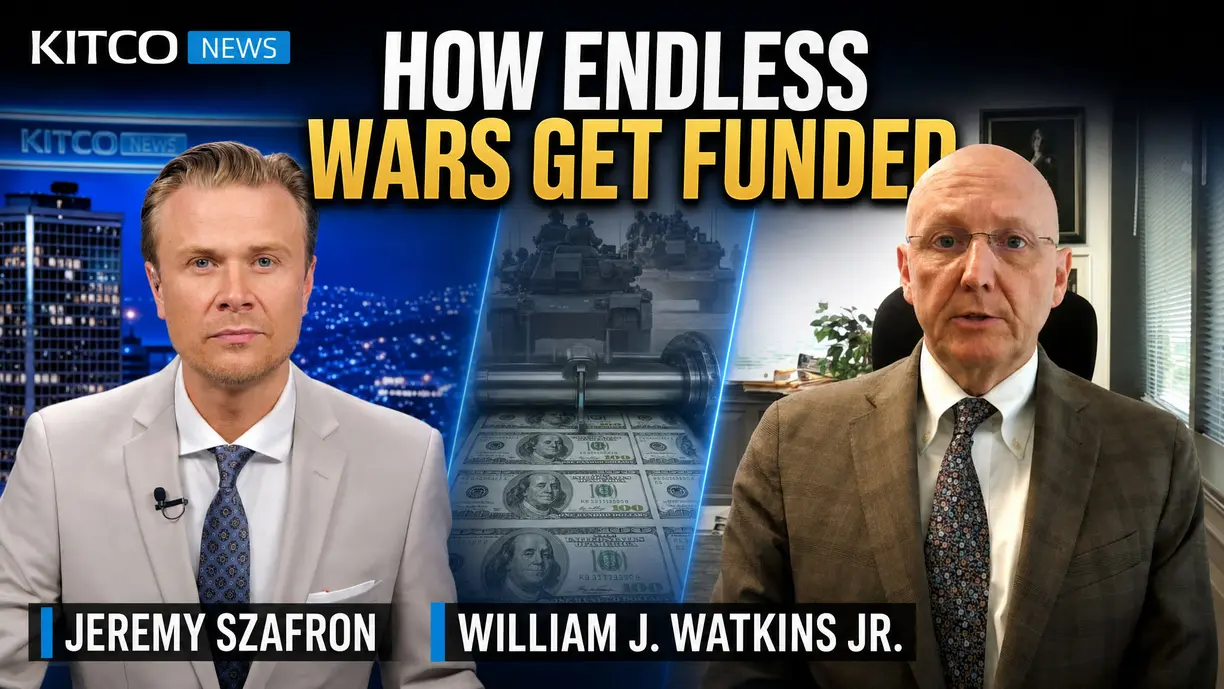
(Kitco News) - As the national debt nears $40 trillion, the Independent Institute's William J. Watkins, Jr. argues the country drifted from the founders' hard-money design, and that paper money now rests on little more than government power.
The U.S. national debt is closing in on $40 trillion, and the interest alone now rivals what the country spends on its military. To constitutional scholar William J. Watkins, Jr., that is not simply a story of overspending. It is the bill for a country that walked away from the limits its founders wrote down, and, he argues, a sign that the dollar today is backed by little more than the government's power to compel.
"We have a Constitution of few and defined powers given to the national government," Watkins, a research fellow at the Independent Institute, told Kitco News. "The national government cannot act; it should not be able to spend absent pointing to a specifically enumerated power." Over time, he said, elastic readings of the Constitution's spending and commerce clauses turned those limits into "what the founders would call a general police power," and "as it has done so, it has piled up debt upon debt, and that's truly why we're in the fix that we're in."
The debt stood near $39.6 trillion, roughly $115,000 for every American and about 120% of the size of the economy, according to the U.S. Treasury. Net interest is on track to top $1 trillion in fiscal 2026 and has already climbed above what the government spends on national defense, according to the Congressional Budget Office, leaving interest as one of the largest single items in the federal budget. Watkins' reading of the Constitution reflects an originalist view of federal power that other legal scholars dispute.
From "few and defined" powers to the New Deal
Watkins traces the design to the founding debate over replacing the Articles of Confederation. Supporters of the Constitution, he said, promised a limited federal government, citing James Madison in Federalist No. 45, who wrote that the states would keep "numerous and indefinite" powers while the national government's would be "few and defined." His argument, Watkins said, "is simply to go back to those promises that the Federalists made and hold them to it."
The enforcement, he said, was meant to run through voters and the states, which then had direct representation in the Senate, and ultimately through the people, an idea he traced to the Kentucky and Virginia Resolutions of 1798.
The turning point in his telling came in 1936, when the Supreme Court decided United States v. Butler. "What changed that day is the New Deal," Watkins said. For years the spending power had been read narrowly, he said, but the court "rejected the Madisonian interpretation" and allowed Congress to spend in the name of the general welfare, "simply because if they did not, they would be in a pitched battle with Roosevelt and imperil the New Deal."
Hard money, and the drift to paper
The Constitution, Watkins noted, gives Congress the power to coin money and bars the states from making anything but gold and silver coin legal tender. "The founders understood real money to be hard money, gold and silver," he said, adding that in the ratification debates many framers spoke of a chance to "banish paper money, fiat money now and forever."
That design, in his account, began to erode with the Civil War greenbacks issued under the Lincoln administration. "Once you sort of build on that paper foundation, it's a house of cards," he said. "You just keep on building until it falls." The 1860s, not the better-known episodes that followed, are where he starts the story: "If you don't start with the war in the 1860s and the Lincoln administration's monetary policy, you're missing the full picture."
On the 1933 order that called in Americans' gold and then revalued it from about $20 to $35 an ounce, Watkins was blunt. "It's absolutely not constitutional," he said. "A true reading of that document, you can find no power where government can take the people's money in that regard." Two years later the Supreme Court upheld voiding gold-payment clauses in contracts, and in 1971 the United States stopped letting even foreign governments convert dollars into gold.
The result, he said, is a currency resting on authority rather than anything tangible. "Paper money is really only tied to the coercive power of the federal government," Watkins said. "It's a bit of a shell game that we just smile and keep playing, but it is but a game. There's nothing of real value behind it." Gold was $35 an ounce when the last link was cut in 1971 and traded above $4,100 on Wednesday, according to the Kitco spot price.
Foreign creditors and a check on war
Watkins pushed back on the idea that the debt is harmless because it is owed domestically. Foreign investors held about $9.5 trillion in U.S. Treasuries as of early 2026, close to a quarter of the debt, with Japan, the United Kingdom and China the largest holders, according to Treasury data. "If foreign governments acted in a concerted manner to cash in their chips, that could absolutely bring a financial crisis," he said, warning it could produce "a Weimar situation." The Weimar reference, to Germany's 1920s hyperinflation, is his characterization.
Many economists do not share that level of alarm. Because the United States borrows in its own currency and the dollar remains the world's dominant reserve currency, a forced default or runaway inflation is widely seen as unlikely in the near term, and large-scale foreign selling would more likely push yields up gradually than trigger a sudden collapse. Watkins' argument is that the longer-term erosion, not a single crash, is the real cost.
He also framed sound money as a brake on war. Drawing on Jefferson, Watkins argued that when a government cannot simply print, "to pay for it, you would have to tax the people. They would feel that bite immediately," and could push back at the ballot box. "We've lost that now with paper money and inflation," he said.
Asked who ultimately pays for the debt, Watkins said governments "ought to reach for taxes first," but tend instead "to inflate the currency," pointing to pandemic-era stimulus. Left unchecked, he said, the endpoint is a reckoning "like we're some third world banana republic defaulting on our debts." Persistent spending, he added, tends to stick: "It's a ratchet effect."
The takeaway
For an ordinary saver, Watkins said the lesson is that decades of paper money have left savings exposed. "You can work all your life and accumulate all this paper money," he said, "whereas if you had used that paper to buy hard assets or gold and silver, you would have something tangible there." His hard-money argument arrives during a historic run in the metals, with central banks among the steadiest buyers in recent years.
He said he remains hopeful, pointing to grassroots civic movements, and argued the path back runs through the founding document itself. "Keep our eyes on that beacon, which is the Constitution," he said. "That will tell us how far we have strayed. That will tell us also how to get back home."
William J. Watkins, Jr. is the author of "The Independent Guide to the Constitution." Watch the full conversation in the video at the top of this page.