

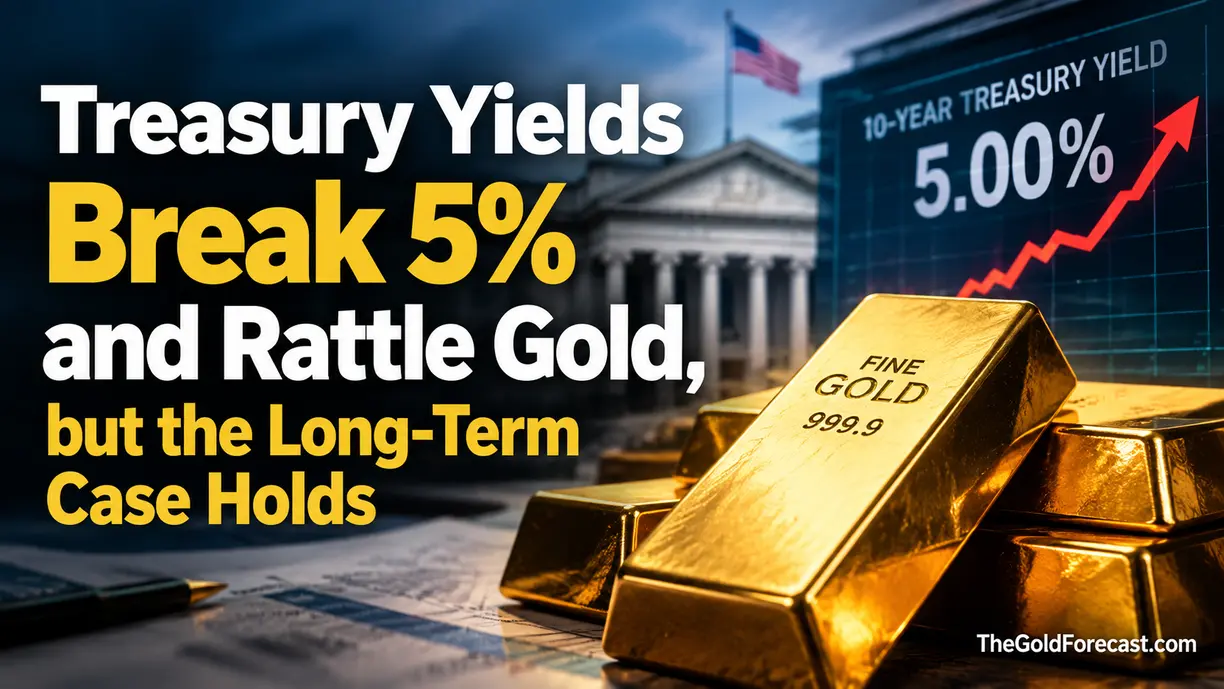
Today the inflationary outlook heated up, causing a sharp rise in yields on 10-year bonds and a sudden sell-off in gold as well as the stock market. The 5% level is widely watched. For years, 5% on the benchmark US 10-year Treasury yield was viewed as the point at which global financial markets would start to unravel. Today’s spike in 10-year US bonds was the largest single-day spike this year, rising by 3.13% and breaking above the key 5% threshold to end the session at a near 20-year high of 5.11%.
The spike in yields can be traced back to the start of the war with Iran, which has had a huge impact on oil prices, which, like bonds, directly or indirectly affect every market, asset class, and commodity on Earth. Since the beginning of March, when the conflict began and 10-year bonds were sitting at 3.92%, yields have risen an astonishing 30% to today’s alarming level. The rise is accelerating, too. Yields have risen for seven consecutive weeks and seven consecutive months, 7.49% so far this month alone.
As most of our readers are aware, gold and yields compete for capital. Gold pays no yield, so when investors can get a guaranteed 5% return, it draws dollars out of gold and stocks, where no financial gain is ever guaranteed. The move could also be hinting at a cautionary environment in which traders perceive US fiscal policy as unsustainable and the looming debt as out of control, bringing into question the dependability and solidity of the Treasury issuing those bonds. That forces the Treasury to pay more to finance its own debt, as traders see it as more of a risk. Investors ultimately set the price of these bonds because they are subject to the open market, so a rise in yield can represent a fall in demand. This ties into the debasement of the dollar as the world dials back its exposure to US debt.
None of this spells a complete sell-off in gold. Rather, the yield spike is the canary in the coal mine. At the start of 2026, for the first time since 1996, global central banks held a higher percentage of gold than US Treasuries. Purchases by emerging markets such as Turkey, India and China in particular have been supporting gold prices, as they buy fewer Treasuries and more gold than ever before.
The initial knee-jerk reaction to today’s spike in yields sent gold futures $73, or 1.67%, lower. However, I believe that once traders digest this news and begin to ask why this is happening and what it really means, gold will resume its rise.
Consider what a 5% yield actually offers. With oil-driven inflation reaccelerating, the real return on a 5% Treasury may be far smaller than the headline number, and it shrinks further if inflation keeps climbing. Central bank accumulation, meanwhile, is a strategic shift away from dollar assets rather than a short-term trade, and it does not reverse because the 10-year had a bad afternoon. Higher yields also make it more expensive for Washington to fund its deficits, feeding the very debt concerns that draw investors to gold in the first place.
Traders should watch the 5% level closely in the coming sessions. If the 10-year fails to hold above it and gold steadies, that would be an early sign the sell-off has run its course. A sustained climb in yields would keep pressure on gold and equities in the near term, and that risk should not be dismissed. But today’s weakness looks to me like a reaction to the headline, not a change in the underlying case. War-driven inflation, swelling deficits and eroding confidence in US debt are pushing yields higher, and they are the same forces that have driven gold’s advance. I expect the metal to reassert itself once the dust settles.
