

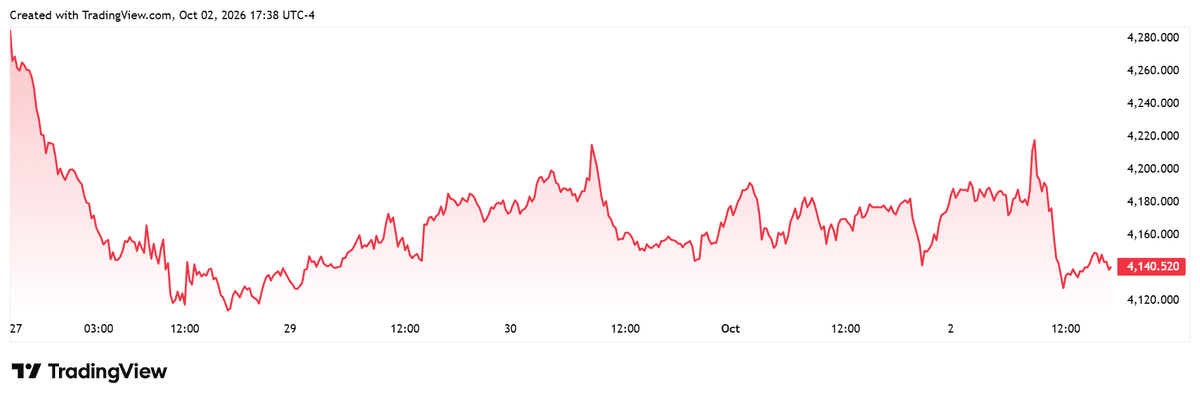
(Kitco News) – Gold prices fell sharply this week as early pressure from rising Treasury yields, a stronger U.S. dollar, and renewed Fed rate-hike expectations overwhelmed safe-haven demand, and even Friday’s weak payrolls report couldn’t deliver a sustainable boost.
Spot gold kicked off the week trading at $4,277.90 per ounce on Sunday evening, and the yellow metal saw a brief burst of momentum to push to its weekly high at $4,280.56 per ounce on Monday before sellers took control. The decline accelerated as higher oil prices tied to the U.S.-Iran conflict kept inflation concerns alive, while rising long-term Treasury yields and a firmer dollar reduced demand for non-yielding assets.
Gold attempted to stabilize Tuesday after U.S. job openings showed signs of cooling and consumer confidence weakened, but the rebound remained limited as markets continued to price in the risk of another Federal Reserve rate hike. Selling resumed Wednesday as the dollar stayed near two-month highs and Treasury yields remained elevated, keeping spot prices pinned near the lower end of their recent range.
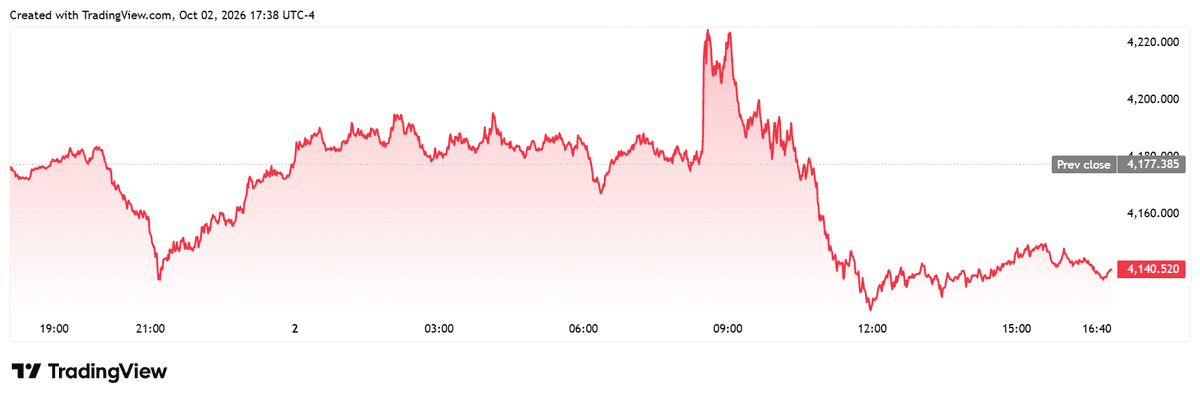
The metal found only limited support during Thursday’s session, then dropped to its weekly low at $4,110.95 per ounce as traders positioned themselves ahead of the September employment report. Friday’s payrolls data delivered the week’s first meaningful relief for gold, with the U.S. economy adding just 29,000 jobs, the unemployment rate rising to 4.2%, and July and August payrolls revised lower, cutting October Fed-hike odds and pushing the dollar and yields lower.
But after failing to hold above $4,200, spot gold slid sharply lower as Friday’s trading continued, and the yellow metal finished just $15 off session lows heading into the weekend.
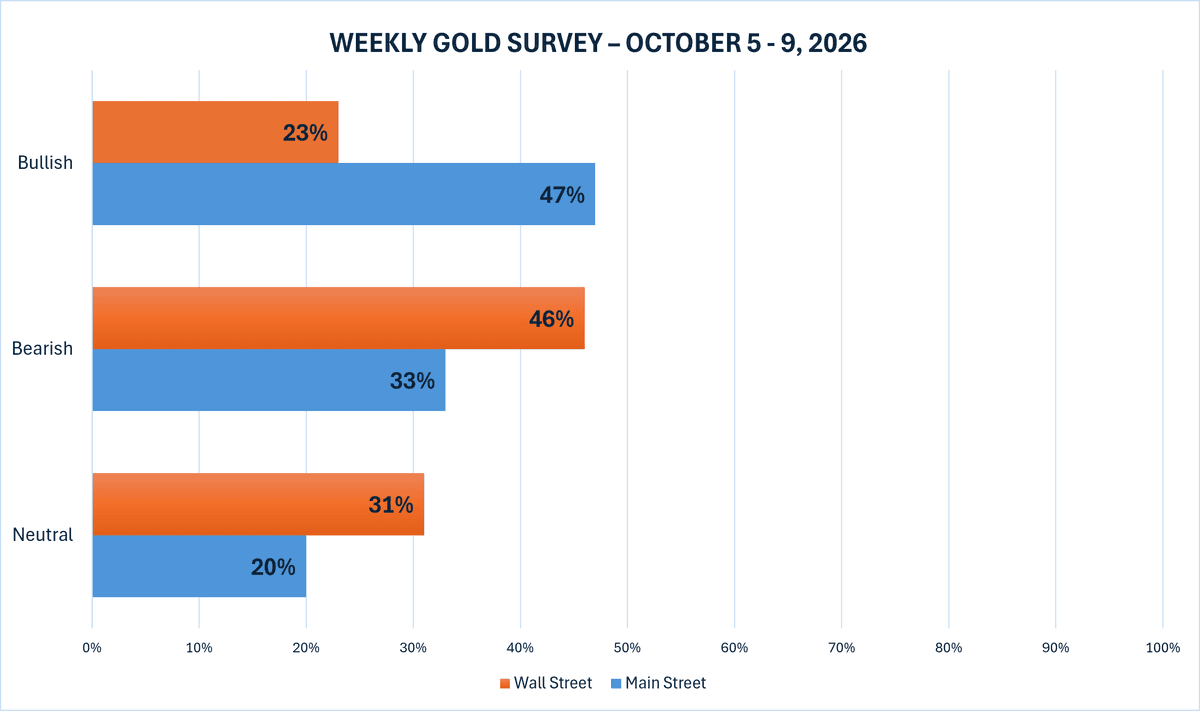
The latest Kitco News Weekly Gold Survey showed Wall Street teetering on the brink of a bearish majority, while Main Street surrendered the bullish bias it had maintained since the end of July.
“I like gold higher next week,” said Marc Chandler, managing director at Bannockburn Global Forex. “The signal from the Fed’s leadership, Jefferson, Vice Chair of Federal Reserve Board, and William, the Vice Chair of the FOMC signaled greater patience than the market in terms of a rate hike in October was driven home by the disappointing US jobs report. The pullback in rates saw constructive price action ahead of the weekend, and the yellow metal recaptured the $4200-level. A move above the $4280-$4300 area would boost confidence that a low is in place.”
“Neutral,” said Adam Button, head of currency strategy at investingLive. “I'm looking for a buying opportunity in October before the strong seasonals of Nov-Jan kick in.”
“Down,” said Adrian Day, president of Adrian Day Asset Management. “Gold is showing remarkable resilience in the face of higher yields and strong oil prices and the dollar, a combination that would normally be devastating headwinds. For the immediate term, we will likely see gold a little lower but not for long. An end to the war will see the dollar resume its downward move amidst impossible U.S. deficits, while a pause in the Federal Reserve’s rate hiking will give gold some relief.”
“But the next move will likely be down.”
“Up,” said Rich Checkan, president and COO of Asset Strategies International. “The stronger dollar and higher Treasury yields are keeping the gold price down. But weaker jobs numbers put a little wind in gold’s sails due to the fact that market participants interpreted that – along with NY Fed President Williams’ comments about no urgency to hike rates – to mean we would not see a rate hike in October. Gold should soar a little as a result.”
Sean Lusk, co-director of commercial hedging at Walsh Trading, was puzzled and disappointed at gold’s lack of follow-through after the weak payrolls numbers reduced the chances of a Fed rate hike.
“I thought, with crude being down and equities being up and the dollar under pressure, we'd be up,” Lusk said. “Initial reaction was positive, but now we're negative, and you just can't get any traction. The stock market's way up, but so are yields, and that's really what's doing it to the metals here. I don't know what else it could be.”
“It's illogical,” he added. “If this is the reaction you're getting, it's probably a pause in rates until next year… I'm surprised we're negative here. The only thing up in the metals complex is really copper, and that's for different reasons; that has nothing to do with gold or silver.”
“This is, I would say for now, a disappointing reaction,” Lusk said. “All the love is in equities right now, and that's been it.”
Lusk said he’s worried that the gold rally may have run out of steam for the time being. “Gold just ran its course for a couple of years for now,” he said. “While it's not turning over, it's just that rallies are hard to sustain. That's really been the issue. You want to bottom-feed down here, and it looks okay for a day or two, and then boom: You react bearishly to bullish news… not good if you're long.”
And while he sees some potential relief coming during the month, he doesn’t have a lot of conviction.
“There's a bullish seasonal in October. It's about three or four weeks long, and maybe that'll win the day, and we pop back to $4,400, $4,500,” he said. “I've got a neutral stance right now, neutral to higher, but only because October's usually a pretty good performer seasonally.”
“Let the dust clear for the weekend, see what happens geopolitically, and then size it up into next week.”
This week, 13 analysts participated in the Kitco News Gold Survey, with nearly half of Wall Street turning bearish after gold’s failure to sustain any forward momentum. Only three experts, or 23%, expected to see gold prices gain ground during the week ahead, while six others, representing 46%, saw the yellow metal falling further. The remaining four analysts, 31% of the total, said they couldn’t predict gold’s direction, or expected sideways churn next week.
Meanwhile, 182 votes were cast in Kitco’s online poll, with Main Street investors losing their bullish majority for the first time since July. 85 retail traders, or 47%, looked for gold prices to rise next week, while 60 others, or 33%, predicted the yellow metal would lose ground. The remaining 37 investors, representing 20% of the total, expected to see sideways price action during the week ahead.
Next week is a light one for economic data, but traders will still be watching key measures of the services sector and consumer sentiment, as well as the minutes from the September FOMC where the Fed voted unanimously to raise rates.
With little economic data to be released next week, economists expect headline geopolitical risks to dominate price action. Key economic reports that could create some market volatility include the ISM Services PMI, the minutes from the Federal Reserve’s September monetary policy meeting, and the University of Michigan’s preliminary consumer sentiment survey.
Monday morning will see the release of the ISM Services PMI for September, with economists analyzing the employment component with particular interest following the weak payrolls numbers.
Then on Wednesday afternoon, traders will be poring over the minutes from the Federal Reserve's September monetary policy meeting for clues about the balance of hawks and doves on the committee.
Thursday morning will see the publication of weekly jobless claims, and the week wraps up with the Friday morning release of the University of Michigan Preliminary Consumer Sentiment survey for October.
Daniel Pavilonis, senior commodities broker at StoneX Group, said he believes the U.S. government’s announcement that they would release strategic petroleum reserves to help moderate diesel and gas prices was the main reason gold failed to rally following nonfarm payrolls.
“With their statement on the way that they're going to release strategic reserves, I think the market started to move,” he said. “Rates started to move higher again, and you saw commodities across the board pull back. It wasn't just the metals; it was everything, from the grains, to the currencies versus dollar; it was just everything across the board. I think that was the catalyst there.”
Pavilonis doesn’t have a lot of optimism about gold’s ability to push higher with Treasuries continuing to sell off the way they are.
“I don't think the coast is clear for metals to move higher again until we really see a break of yields,” he said.
For next week, Pavilonis thinks it’s more than likely that markets will see further declines in the gold price. “At least softer,” he said.
Alex Kuptsikevich, senior market analyst at FxPro, sees gold prices trending lower next week.
“Gold has fallen in five of the last six weeks, dipping to just under $4,100 at the start of the week, whilst subsequent attempts to recover have been met with a sell-off near $4,200,” he wrote. “It appears that investors have waited for the most intense sell-off in US and European government bonds, followed by France, to run its course and are now shifting from gold into bonds.”
“Unfortunately for these profit-seekers, the sorts of movements in the debt markets we have been seeing in recent weeks and months rarely end so simply,” Kuptsikevich said. “Even worse are the parallels with the Greek and eurozone debt crisis of 2011–2012. For gold, those were the years leading up to the peak (September 2011) and a bear market for the following four years. If history teaches us anything, it is that what is needed now are substantial capital injections and promises from governments. It is therefore quite likely that demand for risky assets will continue to wane, potentially dragging gold back towards a test of $4,000.”
“If the negative scenario plays out in the short term (rising bond yields, a strengthening dollar and a weakening equity market), we may see gold come under pressure,” he warned. “On the other hand, timely measures taken by Europe could quickly restore speculators’ and investors’ interest in the markets, triggering a new global wave of growth in gold prices, as was the case in 2020.”
At the time of writing, spot gold last traded at $4,140.52 per ounce for a loss of 3.09% on the week and 0.88% on the day.
See live precious metals prices for gold, silver, platinum and palladium — in USD, CAD and 12 more currencies.
