
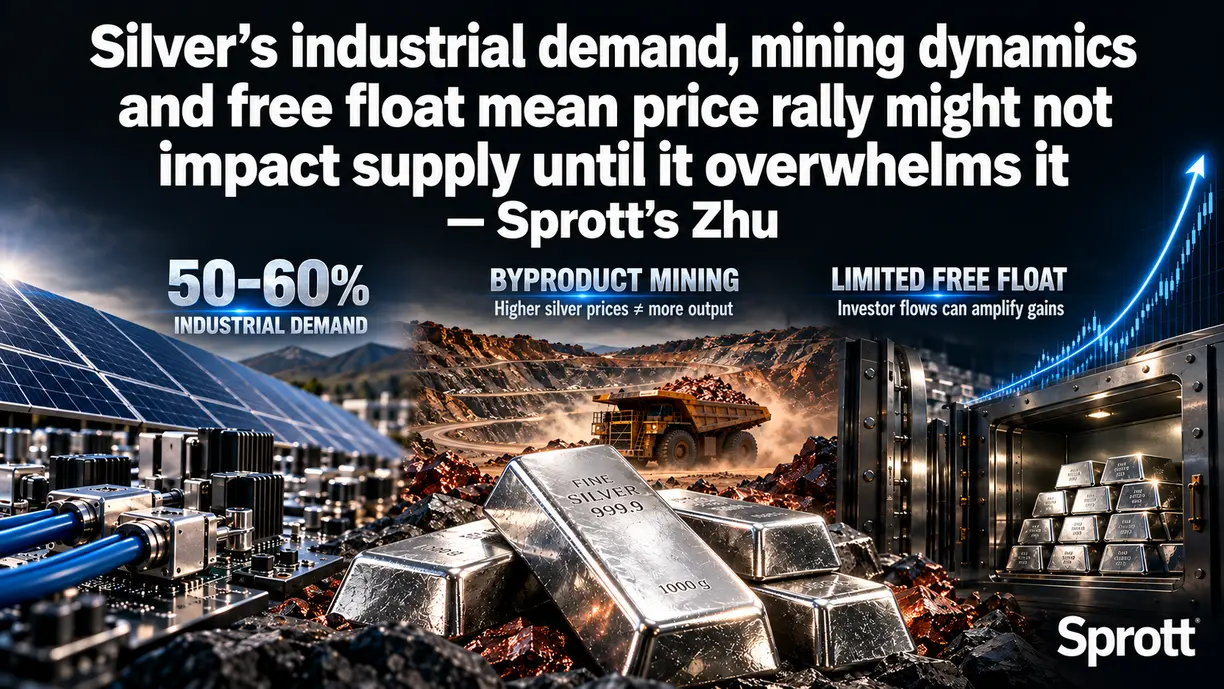
(Kitco News) – Silver has key differentiators that insulate the impacts of the price action from the underlying supply and demand dynamics – but when investors do pile into silver, the grey metal’s constrained physical supply means the market can go parabolic in a way that gold is unlikely to ever do, according to Kenny Zhu, Director of Research and Investment Strategy at Sprott.
In a recent interview with Kitco News, Zhu discussed three factors that cause silver to behave quite differently from gold. First, he said that because 50% to 60% of silver demand comes from industrial applications, silver prices don’t impact supply the same way gold prices impact supply for the yellow metal.
“Gold pretty much drives the underlying trend for the whole segment, like it or not,” he said. “But silver, palladium, and platinum, there's a supply-demand factor at play, but there's also the industrial factor. And that's something that gold isn't really impacted by in the direct way that those other metals are.”
“If you're talking about silver demand, 40% to 50% of it is monetary, similar to gold,” Zhu said. “50% to 60% of silver demand is accounted for by industrial purposes – Folks that are trying to buy silver to build solar panels, or electrical components, things like that. Those industrial demand cycles are running somewhat independently of what might be a monetary driver. The reaction function is a little different; arguably it's less flexible. So that's one factor that leads silver to not really behave in the same way.”
The second factor Zhu pointed to is the way silver is mined: with so much silver production coming about in the course of mining other metals, silver’s rising price doesn’t translate into increased mining.
“The majority of silver is still produced as a byproduct of other mines,” he said. “I might own a gold mine, I might own a copper mine. The nature of ore is that you have a bunch of metals mixed in. You refine and produce that ore, and you're going to have some component of silver. That's not your core revenue, but you're going to sell it and profit off of it nonetheless.”
“The problem is, if I'm making my decisions on how much copper I want to mine, that's not necessarily correlated with how much demand there is for silver,” Zhu said. “If silver shoots to the moon, copper's still the core driver of my revenue. I'm going to make my production decisions based on copper even though I do make money from silver as well.”
This illustrates the reaction function – or relative lack thereof – from the supply side. “Even if silver shoots to the moon, the miners are not necessarily going to produce more,” he said, “nor are they able to produce more.”
The third key factor that differentiates silver’s price action from that of gold’s is the free float – the amount of silver that’s actually physically available for purchase in reality, rather than just on paper.
“When you have a tremendous price rally that really sparks investor interest, you have the potential for a squeeze like we saw during the period leading up to when it went essentially parabolic, up to January 2026,” Zhu said. “I would argue that's a factor that still could be a feature of the industry.
He said that when investor excitement hits a limited free float, the impact on silver prices can be dramatic. “An analyst on any given day when silver's not going parabolic will see sufficient inventories, but when you see these price trends kick into gear and really accelerate, it amplifies the move,” Zhu said. “That flow factor, the fact that there's greater ETF flows, greater assets held in ETFs, and these accelerating trends, is when those factors might come into play.”
“We saw that happen last year,” he added. “The flow factor could be an amplifier for these price moves.”
See live precious metals prices for gold, silver, platinum and palladium — in USD, CAD and 12 more currencies.
