

(Kitco NewsWire) - Spot gold prices were lower and spot silver prices were higher in late U.S. trading Tuesday, as weakening housing activity and lower Treasury yields failed to overcome persistent inflation concerns and expectations for additional Federal Reserve tightening. Crude oil prices reversed sharply from their morning highs amid conflicting reports about possible renewed U.S.-Iran negotiations, easing some inflation pressure and helping U.S. equities recover from early losses. At the time of the latest afternoon price reading, spot gold was trading near $4,122.50 an ounce, down $17.40, or 0.42%, while spot silver was trading near $57.800, up $0.825, or 1.45%.
Tuesday's U.S. economic reports provided further evidence that elevated interest rates are weighing heavily on the housing market. September housing starts declined 5.2% to a seasonally adjusted annual rate of 1.221 million units, below expectations for approximately 1.305 million and down from an upwardly revised 1.288 million in August. Single-family construction fell 4.6% to an annual rate of 859,000 units, while building permits declined 0.2% to 1.400 million units. Housing demand weakened more sharply, with September pending home sales plunging 7.3% from August and 11.3% from a year earlier, reaching their lowest level since the index began in 2001. The declines followed Monday's drop in the NAHB housing market index to 29 from 32, reflecting deteriorating buyer traffic, elevated mortgage costs and weakening builder confidence.
Market positioning remains divided between evidence of slowing economic growth and persistent inflation pressure. September consumer prices increased 0.6% on the month and 3.7% annually, while producer prices rose 1.3% and 6.3%, respectively. Despite those inflation surprises, futures markets assign approximately an 83% probability that the Federal Reserve will leave interest rates unchanged at its Oct. 27-28 meeting, with expectations for additional tightening concentrated in December. The probability of a December increase remains near 92% to 94%, suggesting that traders view the October meeting as a likely pause rather than the end of the tightening cycle. Tuesday's weak housing data and retreat in crude oil prices helped Treasury yields decline, with the benchmark 10-year yield falling approximately 1.9 basis points to 5.116%. However, gold remained under pressure as traders continued to favor interest-bearing assets over non-yielding bullion.
The Federal Reserve remains in its premeeting communications blackout, shifting attention toward incoming economic releases and developments in energy markets. Wednesday brings the weekly U.S. petroleum inventory report at 10:30 a.m. EDT and a 20-year Treasury bond auction at 1 p.m. EDT. Thursday's calendar includes weekly initial jobless claims at 8:30 a.m. EDT, followed Friday by preliminary October manufacturing and services purchasing managers' indexes at 9:45 a.m. EDT and the final University of Michigan consumer sentiment survey at 10 a.m. EDT. Traders will be particularly sensitive to indications of deteriorating employment conditions and changes in inflation expectations ahead of next week's Fed decision. Softer labor-market and business activity readings could reduce December tightening expectations and provide support for gold through lower yields and a weaker dollar, while persistent price pressures would reinforce the current monetary policy headwinds.
The Strait of Hormuz and U.S.-Iran situation remained a major source of volatility Tuesday, although the immediate impact on energy markets shifted considerably during the session. Crude oil initially surged toward five-month highs following additional attacks on vessels in the Persian Gulf and renewed Houthi strikes against Saudi Arabian energy infrastructure. Brent futures climbed as high as $111.99 a barrel before retreating sharply after reports suggested that mediators were exploring a diplomatic framework to revive negotiations between Washington and Tehran. Subsequent reporting disputed suggestions that an agreement was imminent, and no confirmed diplomatic breakthrough emerged. The underlying security situation remains unresolved, with tanker attacks, elevated shipping insurance costs and continuing military tensions threatening the reliability of Gulf energy exports. Crude shipments through Hormuz remain substantially below prewar levels, while uncertainty over U.S.-Iran relations continues to support a geopolitical risk premium in oil prices.
For gold, the decline in crude prices and Treasury yields reduced some of the inflation and interest rate pressure that had weighed on bullion earlier in the session, but the metal failed to attract sustained buying interest. The reaction underscores the market's continuing focus on the Fed's longer-term policy outlook rather than immediate safe-haven demand. Silver outperformed gold as the retreat in oil prices and yields improved sentiment toward industrially sensitive metals, although weaker housing activity and uncertainty surrounding broader economic growth remain potential headwinds.
North American equity markets finished mostly higher after recovering from early losses, supported by stronger corporate earnings and the sharp retreat in crude oil prices. The Dow Jones Industrial Average gained 529.85 points, or 1.02%, to close at 52,495.88, while the S&P 500 rose 21.84 points, or 0.28%, to 7,712.57. The Nasdaq Composite slipped 6.07 points, or 0.02%, to 26,424.82, as weakness in major technology stocks offset broader market gains. The Russell 2000 advanced 45.12 points, or 1.65%, to 2,773.42, reflecting stronger participation among smaller companies. Canada's S&P/TSX Composite Index gained 179.33 points, or 0.50%, to finish at 36,107.96, supported by financial and telecommunications shares as lower oil prices weighed on the energy sector. Better-than-expected corporate earnings helped offset concerns about artificial intelligence-related financing and elevated equity valuations.
European equities closed mostly lower, although major benchmarks recovered substantially from their intraday lows as crude oil prices retreated and government bond yields eased. The pan-European Stoxx 600 declined 0.14%, while Germany's DAX slipped 0.06% to 25,304.42. France's CAC 40 lost 0.38% amid continuing political unrest, fiscal uncertainty and pressure on French government bonds. The U.K.'s FTSE 100 declined 0.29%, while Switzerland's SMI outperformed with a 0.76% gain. Concerns about elevated energy costs, artificial intelligence investment valuations and European fiscal conditions weighed on investor sentiment. French government borrowing costs remained elevated, with the country's 10-year yield approaching 5% and the spread over equivalent German debt near 150 basis points.
The key outside markets see Nymex December WTI crude oil futures lower, settling at $97.82 a barrel, down approximately 0.7%, while December Brent crude futures settled at $108.79, also down 0.7%, after reaching $111.99 earlier in the session. The yield on the benchmark 10-year U.S. Treasury note declined to around 5.116%. The U.S. dollar was softer against a basket of major currencies, although the decline provided limited support for gold as expectations for additional Fed tightening remained elevated. (Kitco Global Index shows how much of today's gold move is the dollar versus the gold market itself.)
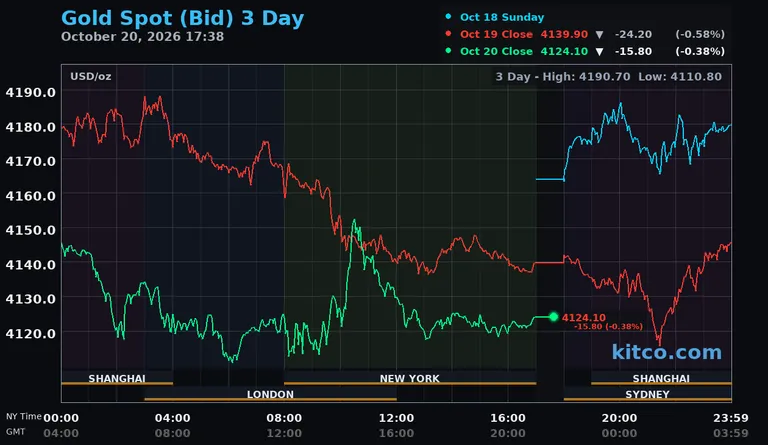
Technically, spot gold bulls' next upside price objective is to push prices back above the $4,147.00 to $4,176.00 resistance zone, with a sustained move targeting $4,201.00 and then the recent high near $4,218.00. Bears' next near-term downside price objective is a break below $4,119.00, with deeper downside targets at $4,100.00 and then $4,074.00. First resistance is seen at $4,147.00 and then at $4,176.00. First support is seen at $4,119.00 and then at $4,100.00.
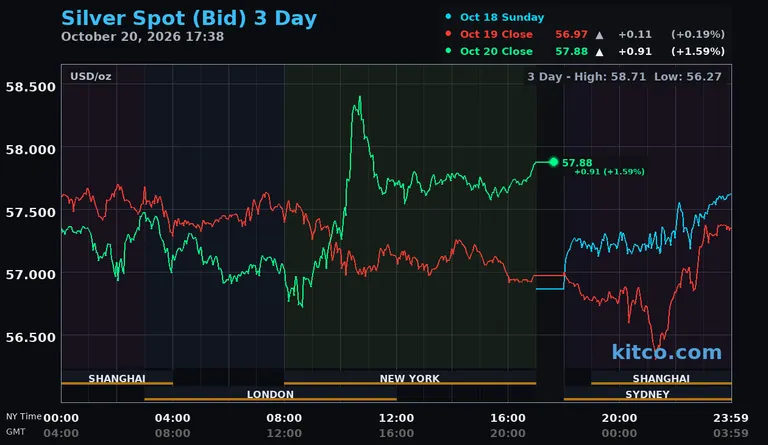
Spot silver bulls' next upside price objective is to drive prices back above the $57.390 to $57.860 resistance zone, with a sustained move targeting $58.700 and then $59.370. The next downside price objective for the bears is a break below $56.920, with deeper downside targets at $56.340 and then $56.000. First resistance is seen at $57.860 and then at $58.700. Next support is seen at $57.390 and then at $56.920.
See live precious metals prices for gold, silver, platinum and palladium — in USD, CAD and 12 more currencies.

