
(Kitco NewsWire) – Spot gold and silver prices were sharply lower in early U.S. trading Friday, as renewed attacks on commercial shipping in the Strait of Hormuz pushed crude oil prices higher and reinforced inflation concerns despite fresh evidence of moderating U.S. wage growth. Precious metals remained under selling pressure following Thursday's declines, with gold slipping below $4,000.00 an ounce and silver falling to its lowest levels of the year. Spot gold was trading near $3,958.80 an ounce, down $61.34, or 1.32%, while spot silver was trading near $50.080, down $2.120, or 4,06%. Gold was heading toward a second consecutive monthly decline, while silver continued to underperform amid concerns about industrial demand and restrictive monetary policy.
The latest U.S. employment cost figures provided some evidence that labor-related inflation pressure is moderating, although wage growth remains elevated. The employment cost index increased 0.8% in the third quarter, matching expectations and slowing from 0.9% in the second quarter. Wages and salaries increased 0.7%, compared with 0.9% in the previous quarter, while benefit costs rose 0.9%, down from 1.0%. Total compensation costs increased 3.4% from a year earlier, unchanged from the annual rate recorded in June, while wages and salaries rose 3.1% and benefit costs increased 3.9%. The slowdown in quarterly wage growth provides some relief from concerns about persistent labor-cost inflation, although annual compensation growth remains above levels consistent with the Federal Reserve's longer-term inflation objective.
The employment report followed Thursday's stronger-than-expected third-quarter gross domestic product figures and another increase in the Federal Reserve's preferred inflation gauge. The U.S. economy expanded at a 3.4% annualized pace in the third quarter, accelerating from 2.2% in the second quarter, supported by resilient consumer spending and business investment. September headline personal consumption expenditures inflation increased 0.5% on the month and 3.6% annually, while core PCE inflation rose 0.3% and 3.1%, respectively. The combination of accelerating economic growth and persistent underlying inflation continues to complicate the case for easier monetary policy, even as Friday's wage figures suggest some moderation in labor costs.
Market positioning remains focused on the possibility of another Federal Reserve interest rate increase in December following Wednesday's decision to leave the benchmark federal funds target range unchanged at 3.75% to 4.00%. The Federal Open Market Committee voted 10-2 to maintain rates, with two policymakers favoring an immediate 25-basis-point increase. Futures markets assigned approximately an 83% probability to a December increase following Thursday's GDP and inflation releases, with the latest wage data providing some counterweight to those expectations. The benchmark 10-year Treasury yield declined 7 basis points Thursday to approximately 4.98%, as weakness in major technology shares encouraged demand for government bonds. However, gold continued to fall despite lower yields, reflecting the influence of persistent inflation concerns, expectations for further tightening and broader precious metals liquidation.
The Strait of Hormuz and U.S.-Iran situation deteriorated further Friday following another attack on a commercial tanker in the strategic waterway, highlighting the continuing risks to Middle Eastern energy supplies. Maritime security authorities confirmed that a tanker was struck by explosive devices attached to its hull by a small boat, although responsibility for the incident had not been established. The attack came amid persistent threats to regional shipping and uncertainty about the prospects for renewed negotiations between Washington and Tehran. Diplomatic initiatives involving Qatar and other regional mediators have yet to produce an agreement, while disagreements over sanctions, maritime security and the broader conflict continue to prevent a lasting settlement.
Crude oil prices rose sharply following the latest attack, with December Brent futures climbing toward $117.15 a barrel and WTI advancing to approximately $103.79. Brent was heading toward a monthly gain of approximately 13%, while WTI was on course for an increase of around 15%, reflecting sustained concerns about Gulf energy supplies and the possibility of further military escalation. The risk of renewed confrontation has become particularly important ahead of the Nov. 3 U.S. midterm elections, with uncertainty surrounding the next phase of U.S.-Iran relations adding to the geopolitical premium embedded in crude prices. Although alternative export routes have helped mitigate some of the disruption to Gulf petroleum shipments, continued tanker attacks and elevated maritime security costs remain significant obstacles to restoring normal commercial flows through Hormuz.
For gold, the continuing confrontation supports defensive demand, but the inflationary consequences of elevated crude oil prices have reinforced expectations that the Federal Reserve may need to maintain restrictive monetary policy for longer. The metal's continued decline despite geopolitical instability and lower Treasury yields suggests that liquidation pressure and the interest rate outlook remain dominant influences on near-term price action. Silver has suffered significantly greater losses as the broader precious metals decline coincides with concerns about industrial demand, elevated energy costs and restrictive borrowing conditions. Its break below previously established technical support has added to selling pressure, leaving the metal increasingly vulnerable to further liquidation.
Global equity markets were weaker before the U.S. open as disappointing corporate earnings and renewed concerns about artificial intelligence investment weighed on technology shares. S&P 500 futures declined approximately 1.0%, while Nasdaq futures dropped 2.3% and Dow futures were little changed. Alphabet's sharp decline Thursday was followed by additional pressure on major technology companies after cautious earnings guidance from Amazon and Intel. European equity markets were mixed, while Asian markets were mostly lower as investors assessed corporate earnings, higher energy prices and the outlook for global monetary policy. The combination of rising crude prices, elevated financing costs and uncertainty surrounding large-scale artificial intelligence investment continued to undermine risk appetite, although the resulting demand for government bonds provided limited support for precious metals.
The key outside markets see Nymex WTI crude oil prices higher and trading near $103.79 a barrel, while December Brent crude futures were near $117.15, reflecting renewed concerns about Gulf energy supplies. The yield on the benchmark 10-year U.S. Treasury note was trading near the 5.0% area following Thursday's decline. The U.S. dollar remained comparatively firm, while persistent expectations for additional Federal Reserve tightening and elevated energy prices continued to limit gold's ability to benefit from geopolitical uncertainty. (Kitco Global Index shows how much of today's gold move is the dollar versus the gold market itself.)
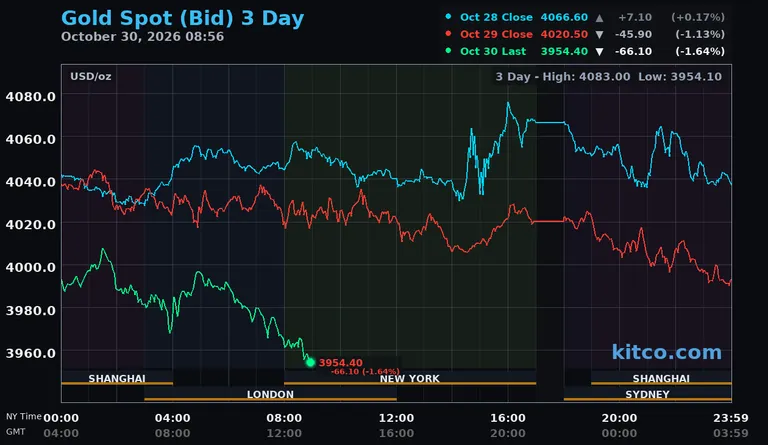
Technically, spot gold bulls' next upside price objective is to push prices back above the $4,015.00 to $4,039.00 resistance zone, with a sustained move above the upper boundary needed to ease the prevailing bearish technical pressure. Bears' next near-term downside price objective is a break below $3,975.00, with a deeper downside target at $3,943.00. First resistance is seen at $4,015.00 and then at $4,039.00. First support is seen at $3,975.00 and then at $3,943.00.
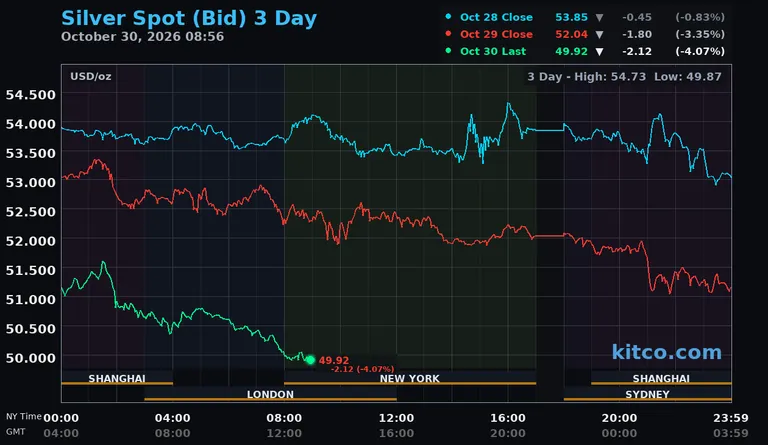
Spot silver bulls' next upside price objective is to drive prices back above the $52.690 to $54.680 resistance zone, with a sustained recovery through that area needed to improve the near-term technical outlook. The next downside price objective for the bears is a break below $50.710, with a deeper downside target at $49.510. First resistance is seen at $52.690 and then at $54.680. Next support is seen at $50.710 and then at $49.510.
See live precious metals prices for gold, silver, platinum and palladium — in USD, CAD and 12 more currencies.

