
(Kitco News) – Gold prices staged a late-week recovery after coming under heavy pressure from hotter-than-expected U.S. inflation data, rising Treasury yields, and a firmer dollar, as falling bond yields and reduced expectations for an October Federal Reserve rate hike helped the precious metal recover much of its losses.
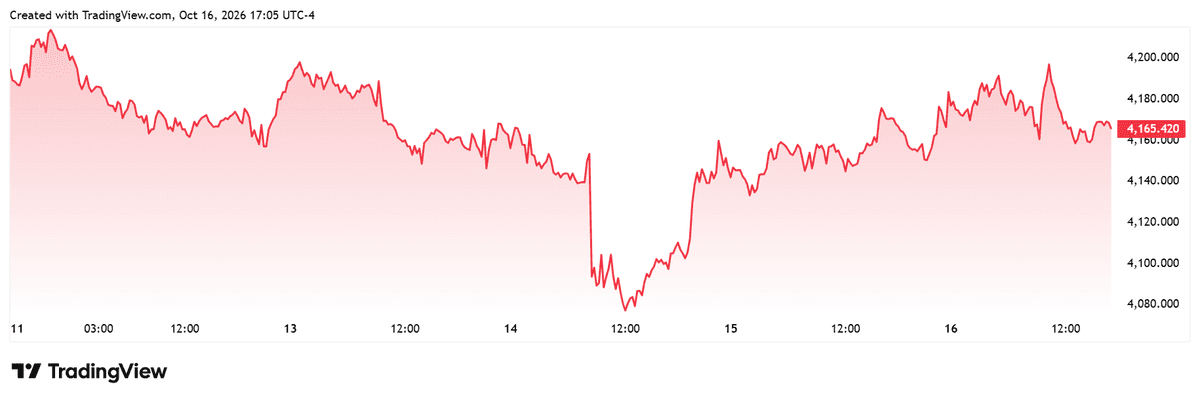
Spot gold kicked off the week trading at $4,193.59 per ounce on Sunday evening, and the yellow metal briefly climbed above $4,200 as traders continued to monitor the U.S.-Iran conflict and inflation risks from elevated energy prices. The advance quickly faded, however, with gold setting its weekly high at $4,216.91 per ounce on Monday before a stronger dollar and rising Treasury yields pushed prices lower through Tuesday’s trading session.
The selling accelerated Wednesday after September CPI rose 3.7% annually, exceeding expectations and reinforcing concerns that energy-driven inflation could force the Fed to tighten monetary policy again. Gold broke below $4,100 and set its weekly low at $4,073.35 per ounce at noon on Wednesday, as traders increased bets on an October rate hike and the dollar strengthened.
Gold rebounded Thursday despite another hotter-than-expected inflation reading from the Producer Price Index, as Treasury yields retreated sharply from recent highs while the dollar weakened. The recovery carried into Friday after Fed Chair Kevin Warsh on Thursday evening refrained from signaling an October rate increase, helping reduce immediate tightening expectations even as markets continued to anticipate another hike before year-end. Gold briefly approached $4,200 once again before stopping short and surrendering some of its gains to trade marginally lower on the week and the session heading into the weekend.
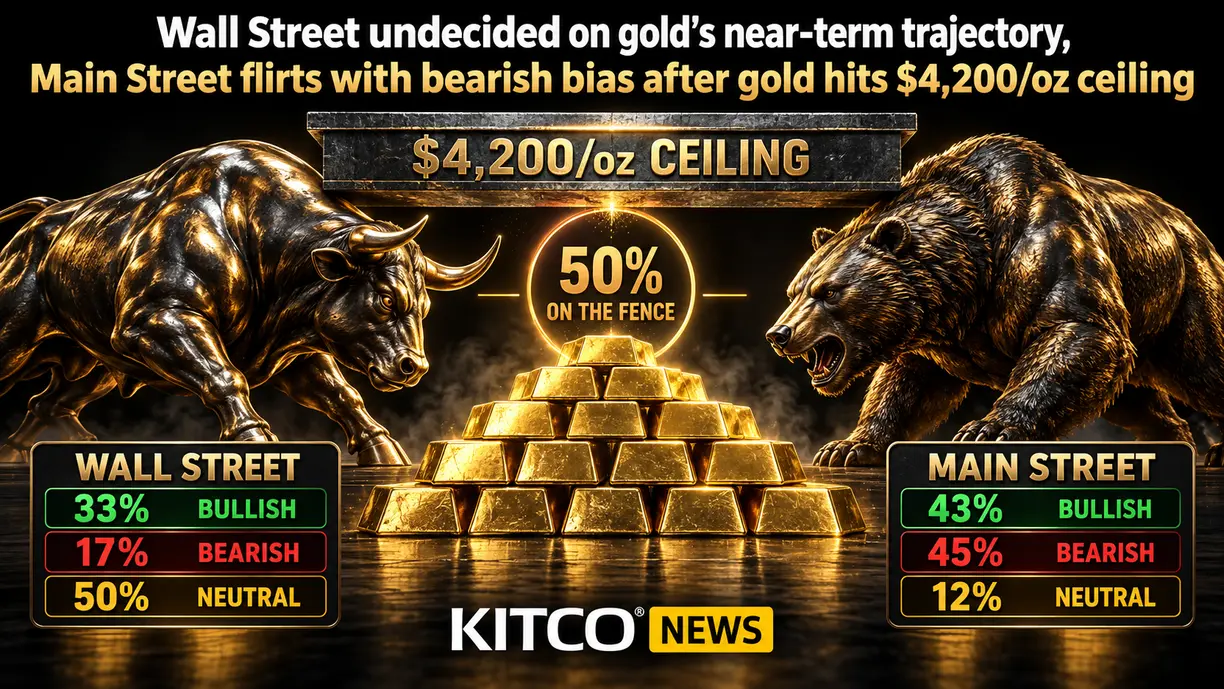
The latest Kitco News Weekly Gold Survey showed half of Wall Street on the fence on gold’s near-term price direction, while less than half of Main Street sentiment creeped closer to a bearish majority after another failed breakout.
“I am neutral on gold for the coming week,” said Colin Cieszynski, chief market strategist at SIA Wealth Management. “Gold appears to be hanging around the $4,200 level at the moment and there is less economic data due next week to move it as focus turns to corporate earnings.”
“Up,” said Darin Newsom, senior market analyst at Barchart.com. “I don’t care about technical (Dec gold is in an intermediate-term uptrend on its weekly chart) or fundamental (central banks around the world continue to buy gold) analysis at this point. What got my attention was the US president reportedly saying he ‘won’t use nuclear weapons or send ground troops to Iran.’ Which means he is likely planning on doing just that. Given this, long-term investors might get interested in gold again if everything else is destroyed over the weekend. I’ll spend this weekend watching the 1964 classic ‘Dr. Strangelove’ and listening to R.E.M.’s ‘It’s the End of the World as We Know It.’”
“Unchanged,” said Adrian Day, president of Adrian Day Asset Management. “I remain in the camp that sees some more back and forth before gold breaks out. It is coming soon, however. Gold’s resilience in the face of a run-up in yields, and relatively strong dollar and oil prices, is telling. Gold is well supported on the downside, so it’s now a matter of time before it breaks out. But an end to the war – which would bring with it a lower dollar and lower oil price leading to reduced inflation and rate hike expectations – is the likely catalyst.”
“Up,” said James Stanley, senior market strategist at Forex.com. “Strong late-week response, and while there’s still a case for continued digestion as price is building in a falling wedge pattern, I still want to bias this as ‘up’ until I have reason not to. The $4k level in spot remains the major level of note, and until there’s a convincing breach of that, I’m probably going to remain bullish.”
Fawad Razaqzada, market analyst at StoneX Bullion, said that despite gold’s midweek rebound, he remains doubtful prices have seen a bottom.
“Yes, the US dollar has eased a bit and the reversal in Treasury yields are also helping,” he said. “But while the immediate pressure has eased, I would be reluctant to interpret [Thursday’s] gains as a clear signal that the correction is over. For now, at least, my near-term gold outlook remains modestly bearish, even if I have a strong long-term bullish bias towards gold and especially silver.”
Razaqzada said he is waiting for confirmation that gold has formed a low. “The metal has tried to hold key support around $4,100, but the resistance zone overhead has held firm,” he said. “I would need to see a move above that zone before turning bullish at current levels. Thus, the technical gold outlook still hangs in the balance.”
“Up,” said Rich Checkan, president and COO of Asset Strategies International. “With the U.S. dollar weakening for the first time in five weeks, gold should benefit. Buyers of gold in currencies other than the U.S. dollar will find their gold ultimately cheaper with the more favorable exchange rate.”
Naeem Aslam, chief investment officer at Zaye Capital Markets, believes gold’s outlook will depend on whether persistent inflation outweighs the pressure from potentially elevated interest rates.
“Thursday’s retreat in Treasury yields and the dollar provided support for bullion despite stronger wholesale inflation, demonstrating that gold responds to changing real-yield expectations rather than inflation figures alone,” he said. “Analysts should monitor the $4,154 price area as near-term support and $4,179 as immediate resistance, alongside Treasury yields, dollar strength, central bank guidance and developments affecting global energy supplies. A sustained decline in real yields could encourage additional institutional diversification into gold, while renewed monetary tightening expectations may trigger consolidation. We therefore see inflation uncertainty, geopolitical hedging and shifting monetary policy expectations as the principal forces shaping gold’s price direction through the remainder of 2026.”
“Lower,” said Adam Button, head of currency strategy at investingLive. “I struggle to see how the Fed only hikes by the 70 bps that's now priced into the curve. This week's inflation data was a big problem that's being overlooked because of the worries about AI debt.”
Daniel Pavilonis, senior commodities broker at StoneX Group, told Kitco News that gold remains an inverse 10-year Treasury yield play, with the rise and fall of the yield determining whether investors should be long or short the precious metal.
“We're seeing something similar to what we saw in the seventies, with high interest rates and sticky inflation,” he said. “Certain sectors of the markets or the economy do well... and other ones don't. Right now, it seems like AI is pretty strong with the infrastructure buildouts. But maybe there's some truth to [the idea] that it's not just the energy sector that's driving inflation, but also this demand structure from the AI boom, and instead of money going into buying U.S. Treasuries or something like that, they're spending the money on AI infrastructure.”
Pavilonis said the limited inverse response of yields and gold to this week’s inflation data was interesting.
“We had CPI out, we had PPI out, and CPI was a big number,” he noted. “Ten-year yields did not break the highs, right? They went up to 5.299%, and the previous high was like 5.32% or something like that. If you're looking at candlesticks on the 10-year yield, and you're looking at candlesticks on the gold market, it literally looks just flipped, identical but flipped.”
“Yesterday, we saw a continuation of a breakdown in yields, and gold seemed to be having a good day.”
Looking ahead, Pavilonis said he’ll be watching these key thresholds in both yields and the gold price for indications of where the precious metal could be headed.
“I think if rates can continue to sell off… maybe the Fed is just going to keep yields higher at the front end of the curve and then the back end just starts to unwind due to the uncertainty in the economy,” he said. “I think that's what's going to drive the metals here.”
“Zooming out and looking at some of these markets, if yields run up to 8% then where does that leave gold? I would say at the very least $3500,” he said. “Same thing with silver, where would silver be? I would say maybe below $40. So that's really what we're looking at here.”
Pavilonis said many of the things that were driving gold and silver’s price gains at this time last year are not there anymore.
“The headlines, the market drivers, interest rates were lower… this was all pre-Iran,” he said. “Now we have the Iran situation, and it's causing inflation, but the metals are not that big of an inflation hedge. Even geopolitically, it was kind of strange how gold didn't make new highs when the Iran war started, and it really hasn't done anything now either.”
“I think the market could have a leg up, but really that's going to be determined on if rates can go lower,” Pavilonis said. “If rates can break below 5% on the 10-year, I think that could be pretty positive for gold.”
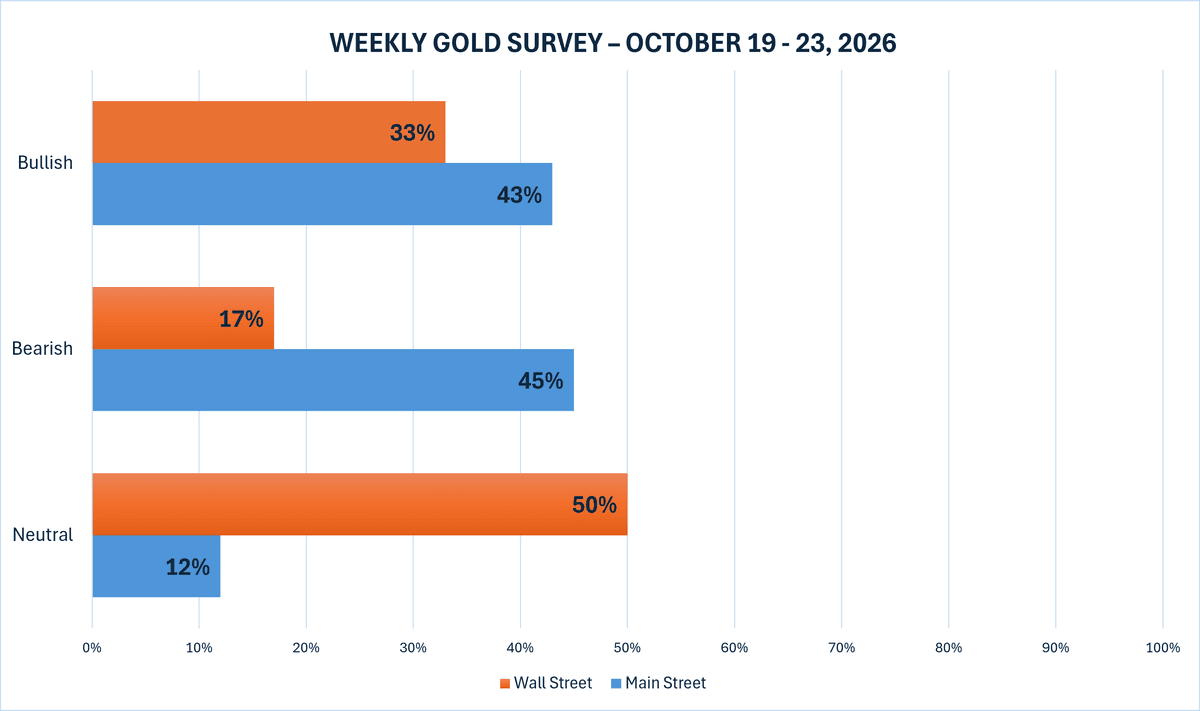
This week, 12 analysts participated in the Kitco News Gold Survey, with half of Wall Street now on the fence after gold’s volatile but rangebound weekly performance. Four experts, or 33%, expect to see gold prices gain ground during the week ahead, while only two, representing 17%, saw the yellow metal declining. The remaining six analysts, 50% of the total, said they couldn’t predict gold’s direction, or expected more sideways churn next week.
Meanwhile, 139 votes were cast in Kitco’s online poll, with Main Street investors now approaching a bearish majority after gold hit the $4,200 ceiling once again. 60 retail traders, or 43%, looked for gold prices to rise next week, while 63 others, or 45%, predicted the yellow metal would lose ground. The remaining 16 investors, representing 12% of the total, expected to see further consolidation during the week ahead.
The coming week is a relatively light one in terms of economic news releases, with housing data, weekly jobless claims and Friday's PMI and consumer sentiment reports the highlights.
The U.S. calendar kicks off Tuesday morning with Housing Starts and Building Permits, followed by Pending Home Sales, all for September.
On Thursday, traders will be watching weekly jobless claims for a timely snapshot of labor market conditions.
Then Friday morning brings the week's most important releases, this month’s Flash S&P Global Manufacturing, Services and Composite PMIs, followed by the University of Michigan's final Consumer Sentiment reading for October.
David Morrison, senior market analyst at Trade Nation, said gold appears to have come out of this week’s wild prices swings relatively unscathed.
“The story behind this week’s dramatic selloff is well known, coming as it did from a set of dreadful US inflation numbers on Wednesday,” he said. “The unexpectedly hot CPI data triggered a surge in the US dollar and a collapse in Treasuries, as yields flew higher on the prospect of a Fed rate hike later this month. Gold dropped back towards last week’s lows while silver slumped to levels last seen three months ago.”
“Then everything reversed after some senior Fed officials insisted that the US central bank wouldn’t be rushed into making a second successive rate hike at its FOMC meeting later this month,” Morrison noted. “The dollar sold off, bond yields plunged in the most dramatic fashion, and gold is once again closing in on significant resistance around $4,200 per ounce.”
Alex Kuptsikevich, senior market analyst at FxPro, sees gold prices trending higher once again next week.
“For the seventh week running, gold has followed the same pattern, with increased selling in the first half of the week and a rally from Wednesday onwards,” he wrote. “Although selling pressure has intensified over the past three weeks, the price continues to hold firm against resistance at $4,200 by midday on Friday. We remain bullish, this time drawing on the dollar’s weakening, which was in full swing on Thursday and Friday.”
“Given the sell-off in big tech stocks, this does not appear to be a revival of risk appetite, but rather an attempt to rebalance large portfolios after weeks of heightened demand for major companies,” Kuptsikevich said. “Furthermore, there is little time left before the midterm elections. Investors often prefer to reduce political risk during this period, which should also work in gold’s favour in the coming weeks, potentially pushing it into the $4,400-$4,500 area. A move higher will take much more political change, for example, from the Fed or White House.”
Simon-Peter Massabni, Head of Business Development at XS.com, told Kitco News that gold remains trapped within the broad consolidation range it set in late September.
“Precious metal gains face severe headwinds because the Middle East conflict remains entirely unsolvable,” he said. “Maritime shipping targeting has escalated sharply in the Strait of Hormuz recently, driving freight costs higher. At the same time, zero signals point toward any near-term return to diplomatic resolution.”
Massabni said the downward correction in Treasury yields has given gold prices a temporary foothold. “However, prolonged warfare raises the risk of wide scale, multifront targeting of regional energy and oil infrastructure before year-end,” he said, with persistent regional conflict feeding directly into rising U.S. inflation.
“This combination of surging inflation, a resilient economy and an intractable Middle East crisis ensures that any gold recovery remains fundamentally unsustainable and highly vulnerable to severe pullbacks when broader conditions deteriorate,” he said.
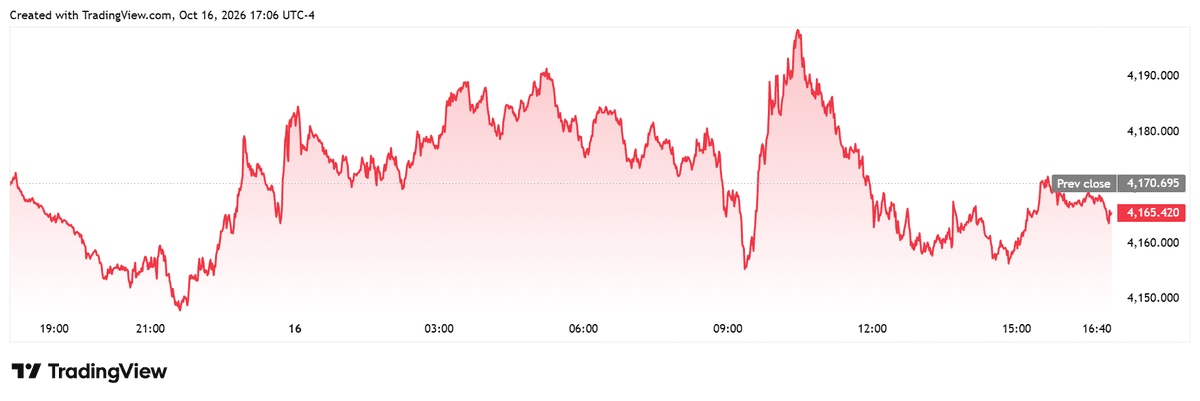
At the time of writing, spot gold last traded at $4,165.42 per ounce for a loss of 0.58% on the week and 0.13% on the day.
See live precious metals prices for gold, silver, platinum and palladium — in USD, CAD and 12 more currencies.
