

Precious metals pull back after bullion's historic surge past $4,600, though geopolitical turmoil and tariff threats keep bullish sentiment intact
Gold prices edged lower on Tuesday as investors locked in gains following the precious metal's surge to an unprecedented $4,600 per ounce, though analysts say the pullback may prove temporary amid escalating geopolitical tensions and policy uncertainty.
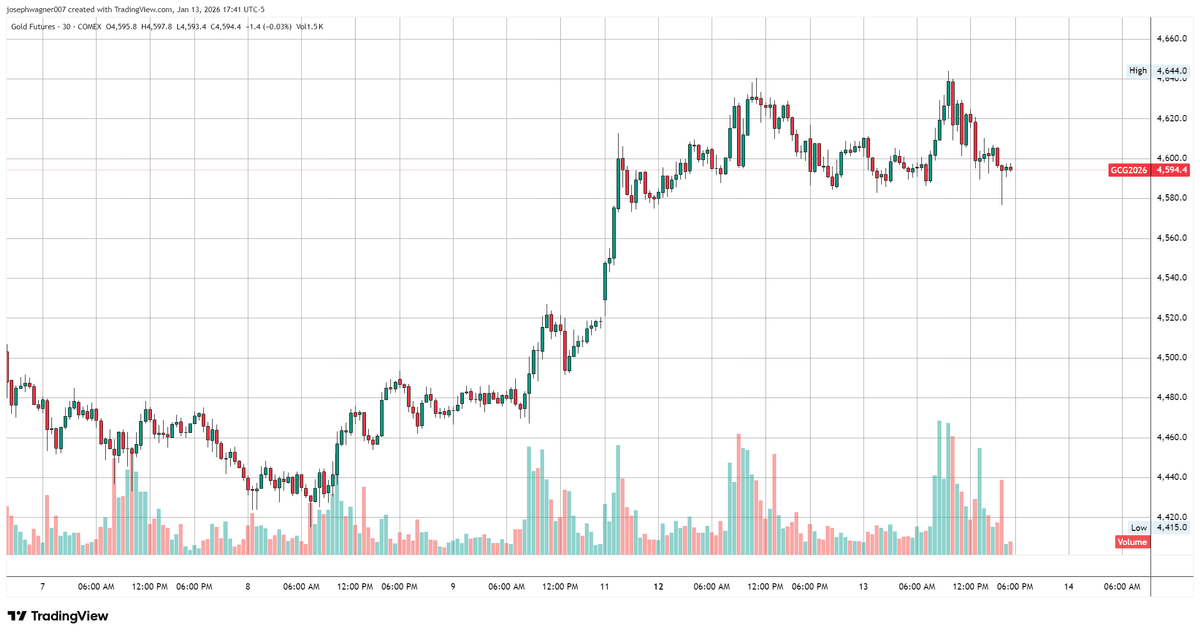
Spot gold traded 0.3% lower at $4,593.81 per ounce as of 0646 GMT, while U.S. gold futures for February delivery slipped 0.6% to $4,587.10. The retreat comes after bullion climbed more than 2% in the previous session to hit an all-time high of $4,629.94, driven by a confluence of factors that have rattled financial markets and sent investors scrambling for safe-haven assets.
The rally was sparked by the Trump administration's decision to open a criminal investigation into Federal Reserve Chair Jerome Powell, an extraordinary move that has injected fresh uncertainty into monetary policy expectations. The unprecedented action against the central bank chief has amplified concerns about the independence of the Federal Reserve and its ability to manage inflation without political interference.
Adding fuel to gold's ascent, President Trump announced Monday that any country conducting business with Iran will face a 25% tariff on all trade with the United States. The levy, which Trump declared "effective immediately" on social media, represents the administration's response to Tehran's crackdown on the largest anti-government protests in years.
The scope and implementation details of the Iran-related tariffs remain unclear, but the announcement underscores the administration's willingness to deploy trade policy as a geopolitical weapon. Iran's unrest unfolds against a backdrop of aggressive U.S. foreign policy moves, including the capture of Venezuelan President Nicolas Maduro and ongoing discussions about acquiring Greenland through purchase or force.
The tariff threat poses particular complications for global trade relationships. The average U.S. tariff rate on Chinese goods had dropped to 30.8% from 40.8% following an October truce, according to Bloomberg Economics. Fresh tariffs could upend that agreement and cast doubt over Trump's planned April visit to Beijing. Questions remain whether the administration will layer the Iran-related tariffs on top of existing rates or announce carve-outs for China, particularly after officials previously acknowledged that higher fees could inflict domestic economic pain.
President Trump's sweeping use of tariff powers faces a landmark legal test, with the U.S. Supreme Court poised to rule on the implications and legality of his global trade duties. The high court's first opportunity to issue a verdict came and went last week, with the next opinion day scheduled for Wednesday, January 14.
The case carries significant ramifications for both trade policy and corporate America. Companies including Costco have filed lawsuits against the U.S. government seeking refunds on import duties should the court reject Trump's authority to impose tariffs. The president invoked a 1977 law intended for national emergencies to implement his most extensive duties, a legal mechanism that drew skeptical questions from both conservative and liberal justices during arguments in early November.
Trump has repeatedly expressed concern over the potential ruling, characterizing a loss of tariff authority as a "terrible blow" to the United States. On Monday, he intensified his rhetoric on the matter, though the outcome remains uncertain.
Despite Tuesday's modest retreat, bullish sentiment on precious metals remains robust. Citi raised its three-month price targets to $5,000 per ounce for gold and $100 per ounce for silver, citing strong investment momentum and multiple favorable drivers expected to persist through the first quarter.
The investment bank highlighted ongoing physical market shortages for silver and platinum group metals, conditions that could deteriorate further in the near term due to potential delays in Section 232 tariff decisions. These delays pose significant risks to trade flows and pricing, according to Citi's analysis.
"The multitude of bullish drivers now likely to remain intact during the first quarter" supports the elevated price targets, Citi noted, pointing to geopolitical uncertainty, monetary policy questions, and supply constraints as key factors underpinning the precious metals rally.
Gold's ascent to record territory reflects investors' search for stability amid a turbulent global landscape characterized by aggressive trade policies, geopolitical confrontation, and unprecedented challenges to central bank independence. The precious metal has long served as a hedge against economic and political uncertainty, and the current environment has provided ample justification for that traditional role.
Silver's trajectory has similarly benefited from safe-haven demand, though industrial applications and supply dynamics add complexity to its price drivers. The physical shortages noted by Citi suggest that demand is outpacing available supply, a fundamental imbalance that typically supports higher prices regardless of shorter-term profit-taking.
While Tuesday's pullback indicates some investors are content to realize gains after gold's historic run, the underlying factors supporting precious metals remain firmly in place. Whether the Supreme Court constrains presidential tariff authority, how aggressively the administration pursues trade confrontations, and what actions the Federal Reserve takes in response to political pressure will likely determine whether gold continues its march higher or consolidates recent gains.
For now, the retreat from record highs appears to be a pause rather than a reversal, with Wall Street's elevated price targets suggesting the bull market in precious metals has further room to run.
For those that would like more information about our services click here.
Wishing you as always good trading,
