
Strengths
- Tether bought a $150 million stake in Gold.com, a digital precious-metals platform, to expand tokenized gold distribution. By acquiring a 12% stake and integrating its gold-backed token XAUT, Tether strengthens its position in a segment where XAUT accounts for over 60% of the $5.5 billion tokenized gold market. The partnership also allows users to buy physical gold using USDT and USAT, linking digital dollars directly to real bullion.
- Y Combinator is now allowing startups to receive funding in stablecoins, validating them as reliable, institutional-grade financial infrastructure. By offering USDC payouts across major blockchains to all YC-backed startups, not just crypto-native firms, YC reduces friction for cross-border founders. Transfers settle in under one second at near-zero cost, embedding stablecoins into the startup funding lifecycle.
- Sovcombank, a major private Russian bank, has launched Bitcoin-backed loans for corporate clients, increasing Bitcoin’s role as accepted financial collateral. Loans have maturities of up to two years, priced at the central bank’s key rate plus 7 percentage points, with a 50% collateral haircut to manage volatility. This allows companies to access liquidity without selling Bitcoin, signaling growing institutional confidence and integration of digital assets into regulated credit markets.
Weaknesses
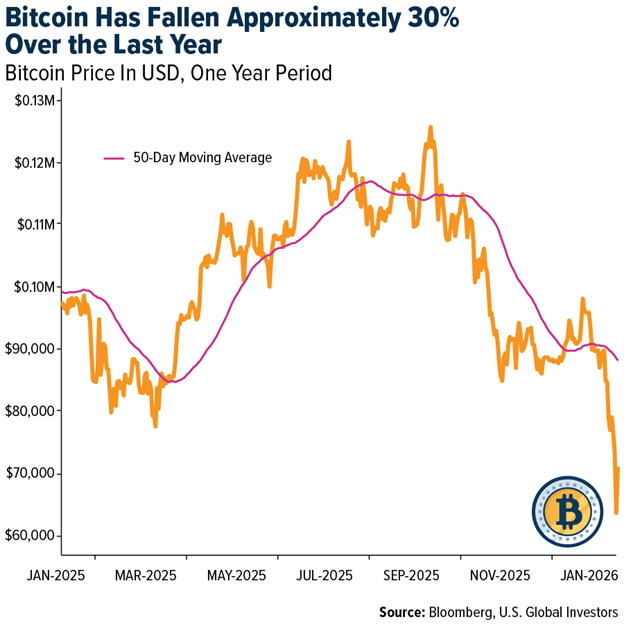
- Spot Bitcoin ETFs show that institutional demand remains highly sensitive to short-term market stress rather than long-term conviction. Over two consecutive days, investors withdrew $816.9 million from U.S. spot Bitcoin ETFs, including $544.9 million in a single session, as Bitcoin briefly fell below $71,000, its lowest level since October 2024. Despite $54.75 billion in net inflows since launch, these sharp outflows highlight that ETF investors de-risk quickly during macro uncertainty.
- Bitcoin is facing sharp loss of demand and forced deleveraging, amplifying downside pressure across the market. The price fell below $70,000, about 45% below its October peak, while more than $1 billion in crypto futures positions were liquidated in 24 hours. U.S. spot Bitcoin ETFs have seen roughly $2 billion in outflows over the past month and over $5 billion in the last three months, removing key institutional support and leaving Bitcoin vulnerable to wider risk-off moves.
- Gemini, a U.S.-based cryptocurrency exchange founded by the Winklevoss twins, is pulling back from the U.K., EU, and Australia while cutting 25% of its workforce, highlighting strain in the global crypto exchange model. Exiting major international markets and placing accounts into withdrawal-only mode signals that revenues outside the U.S. are insufficient to cover rising regulatory and operating costs. For investors, this retrenchment points to weaker growth prospects, reduced geographic diversification, and lower trading volumes, reinforcing concerns that core exchange businesses are struggling to scale profitably in the current risk-off environment.
Opportunities
- Spanish lender BBVA has joined an EU banks’ stablecoin venture to challenge digital dollars, creating an opportunity for a regulated, euro-based on-chain payment alternative. With BBVA’s $800 billion in assets and participation from around a dozen major EU banks, including BNP Paribas, ING, and UniCredit, the initiative targets a market gap: of the $300 billion global stablecoin market, only about $860 million is euro-denominated. If approved under MiCA and launched in the second half of 2026, the Qivalis stablecoin could support euro-based blockchain payments, reduce reliance on USDT and USDC, and strengthen Europe’s financial sovereignty in digital finance.
- Solana’s evolution toward stablecoin micropayments creates a long-term growth opportunity beyond speculative trading. Its ultra-low fees, often below one cent, make it a preferred network for high-frequency, low-value stablecoin transactions, a segment where Ethereum struggles due to higher costs. Platforms like Coinbase’s x402, where the average payment is just $0.06, show real-world adoption potential, supporting Solana’s role as core payments infrastructure despite near-term price weakness.
- Tether’s open-source MiningOS is expanding its role from stablecoin issuer into core Bitcoin mining infrastructure, addressing a market where software costs and vendor lock-in impact profitability. Global Bitcoin mining energy and infrastructure spending exceeds $20–25 billion annually, and open-source alternatives can significantly reduce operating costs for smaller and mid-size miners. By removing licensing fees and proprietary dependencies, MiningOS could drive broad adoption and give Tether strategic influence across mining operations without heavy capital investment.
Threats
- Coinbase, the largest U.S.-based crypto exchange, faces pressure from weak markets and regulatory delays. Citi cut its price target from $505 to $400 after the stock fell 65% from its peak, citing lower trading volumes and softer institutional activity. Q4 2025 revenue is now forecast at $1.69 billion with a GAAP loss of $2.64 per share, highlighting how risk-off sentiment and regulatory gridlock can erode earnings.
- Sen. Mark Warner says he’s in “crypto hell” as Congress stalls on the market structure bill. Regulatory uncertainty leaves firms unclear on SEC vs. CFTC oversight, stablecoin rules, and DeFi compliance, raising costs and delaying launches. The need for bipartisan support and 60 Senate votes means delays could stretch into the election cycle.
- As corporate Bitcoin adoption matures, passive “buy-and-hold” strategies face scrutiny. Over 170 public companies hold Bitcoin, but most generate no yield, tying up capital. With regulated Bitcoin-backed yield infrastructure emerging, investors are increasingly valuing active management over static holdings, making unproductive positions a potential drag on valuation.
