
Strengths
- The UK Treasury’s partnership with HSBC’s Orion platform marks a significant technological advancement in modernizing sovereign debt markets. By leveraging a proven blockchain infrastructure that has already handled more than $3.5 billion in issuances, the DIGIT project ensures high credibility and technical reliability. This move establishes a strong foundation for faster, cheaper, and more efficient bond settlement.
- Asia is demonstrating operational leadership by leapfrogging Western markets in the real-world application of blockchain technology. While the West focuses on institutional exchange-traded funds (ETFs), Asian hubs such as Hong Kong and South Korea are driving mass-market adoption through high-frequency retail use, evidenced by Lotte Group’s 5 million on-chain vouchers and efficient cross-border stablecoin payments for small and medium-sized enterprises (SMEs). This pragmatic approach, supported by proactive regulation in the United Arab Emirates (UAE) and Hong Kong (HK), cements Asia’s position as a leader in integrating digital assets into the global economy.
- The recent accumulation of 53,000 BTC by “whale” wallets represents a key structural support amid broader market volatility. This approximately $4 billion in institutional absorption effectively shifts supply from short-term retail sellers to high-conviction, long-term holders. By absorbing significant sell-side pressure and stabilizing prices near the $70,000 mark, these large-scale participants signal institutional confidence in Bitcoin’s fundamental value, even during periods of market stress.
Weaknesses
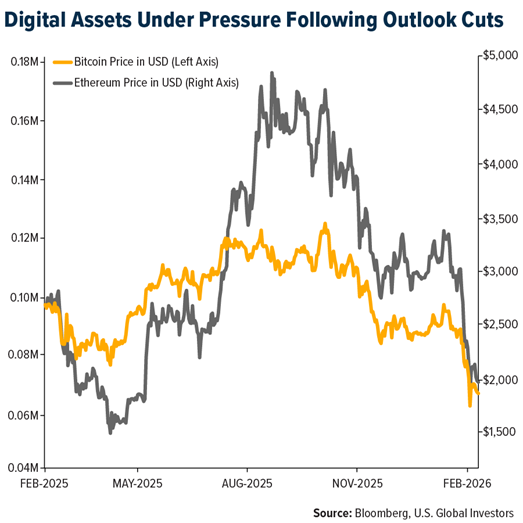
- Standard Chartered cut its 2026 Bitcoin price target to $100,000 from $150,000 (previously reduced from $300,000), citing weaker sentiment and demand, and warned prices could fall toward $50,000. Bitcoin is down more than 40% from its $127,000 peak, with roughly $8 billion in U.S. spot ETF outflows and holdings down 100,000 BTC since October.
- The "Ghost Bitcoin" incident at Bithumb, South Korea's second largest exchange, represents a significant weakness for the industry. A manual entry error that mistakenly credited $40 billion in nonexistent Bitcoin to users highlights a systemic lack of automated safeguards and multi-level approvals. This failure in internal ledger management allowed the trading of ghost assets far exceeding actual reserves, triggering a 17% local price crash and exposing the operational fragility of centralized digital asset platforms.
- JPMorgan’s 27% price target cut on Coinbase, from $399 to $290, underscores the exchange’s high sensitivity to market cycles. Lower crypto trading volumes and declining USDC growth are expected to drive a year over year revenue decline, highlighting the firm’s vulnerability in weaker operating environments and the ongoing challenge of diversifying revenue away from volatile retail transaction fees.
Opportunities
- The European Parliament's support for a dual online and offline digital euro strengthens EU monetary sovereignty and reduces reliance on non-EU payment firms. This legislative progress creates a significant opportunity for market integration and digital asset resilience. If finalized, this framework will modernize the single market's payment infrastructure by 2029.
- At Consensus Hong Kong 2026, the Chairman of the Pakistan Virtual Assets Regulatory Authority (PVARA) announced the country’s transition from a gray market to a formal Strategic Bitcoin Reserve. The initiative uses surplus electricity for Bitcoin mining and AI data centers, converting unused energy into productive capacity while providing a regulated financial system for 100 million unbanked citizens.
- Intercontinental Exchange (ICE), parent company of the NYSE, launched the Polymarket Signals tool in partnership with Polymarket, the leading decentralized prediction platform. The $2 billion investment, valuing Polymarket at $9 billion, allows institutional firms to integrate decentralized market data into professional risk modeling and global alpha strategies.
Threats
- The recent legislative impasse at the White House threatens the U.S. digital asset market. On February 10, major banks, including JPMorgan and Goldman Sachs, pushed to ban yields or rewards on stablecoins, stalling the CLARITY Act and maintaining regulatory uncertainty that discourages long-term institutional capital.
- A new cybersecurity threat emerged this week as the FBI and CISA issued an emergency alert on February 10 regarding “Zardoor,” a sophisticated malware targeting institutional digital asset custodians. This backdoor allows unauthorized access to private key infrastructure, forcing institutions to increase security spending and maintaining a high-risk profile for digital asset custody.
- The American Bankers Association (ABA) is pushing the OCC to freeze new national trust bank charters. In a February 11 letter, the ABA argued that approvals for firms like Ripple, BitGo, and Paxos should be delayed until the GENIUS Act is fully implemented, restricting use of the word “Bank” and limiting stablecoin rewards to preserve traditional bank monopolies.
