
Strengths
- Institutional adoption of digital assets continues to grow as BlackRock’s staked Ethereum ETF launched with more than $15 million in first-day trading volume. The product also debuted with roughly $100 million in initial assets, highlighting strong investor interest in regulated crypto investment vehicles. The participation of major asset managers like BlackRock further integrates digital assets into traditional financial markets, reinforcing the growing legitimacy of cryptocurrencies as part of diversified investment portfolios.
- Bitcoin remained above $71,000 this week, outperforming traditional risk assets despite rising macroeconomic pressures. The U.S. Dollar Index (DXY) climbed above 100, and the 10-year Treasury yield rose past 4.2%, conditions that typically weigh on cryptocurrencies. Even with oil near $100 per barrel and escalating geopolitical tensions, Bitcoin has held firm, highlighting its growing resilience as a macro asset. Institutional demand also remains strong, with Strategy acquiring roughly 11,000 BTC this week.
- Mastercard has launched a new crypto partner program involving more than 85 companies across the digital asset industry. The initiative aims to accelerate the integration of blockchain technology into payments, compliance, and financial services. By bringing together exchanges, fintech firms, and infrastructure providers, Mastercard is helping bridge the gap between traditional finance and the crypto ecosystem. The participation of a global payments leader highlights the growing institutional commitment to digital asset adoption and financial innovation.
Weaknesses
- OP Labs, the developer behind the Optimism Ethereum Layer-2 network, announced layoffs affecting about 9% of its workforce as part of a strategic refocus. The move underscores the operational pressures facing some blockchain infrastructure firms as they pursue sustainable growth. Despite Optimism supporting an ecosystem with billions of dollars in total value locked, companies in the sector are still adjusting cost structures and development priorities. The restructuring reflects the ongoing maturation of the crypto infrastructure industry.
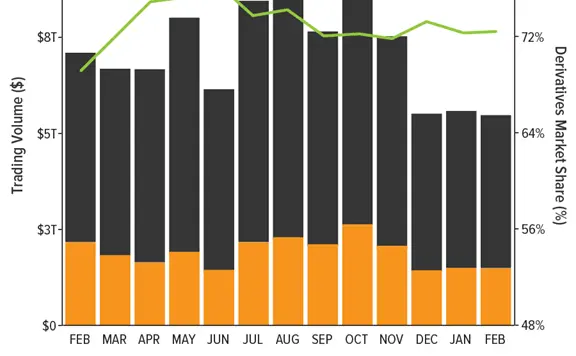
- Crypto trading volumes declined to a four-month low in February. Activity across centralized exchanges slowed, with total spot and derivatives volumes falling to $5.61 trillion, down 2.4% from January and the lowest level since October 2024. Derivatives trading continues to dominate, accounting for about 72% of total volume. The decline highlights volatility and cooling participation in crypto markets.

- Bitcoin mining companies are exploring new ways to generate revenue as profitability stays under pressure. Hashprice, a key measure of miner revenue, remains near $23 per petahash per second, close to multi-year lows following the latest Bitcoin halving. As a result, some miners are using treasury assets for lending and trading strategies, according to market maker Wintermute. The shift underscores the financial strain on the sector as companies adapt to tighter margins and rising operational costs.
Opportunities
- Nasdaq launched an equity token initiative to explore issuing and managing traditional shares on blockchain. The project aims to put issuers at the center of the process, improving transparency, efficiency, and settlement speed. Tokenized equities could reduce operational costs and simplify ownership records, highlighting the potential to modernize equity markets.
- Tether is expanding stablecoin utility by investing $5.2 million in Ark Labs, a startup enabling USDT transactions directly on the Bitcoin network. The technology supports settlements over Bitcoin and the Lightning Network, combining security with faster, lower-cost payments. With USDT supply over $180 billion, this could broaden real-world payment use cases.
- An advisory group to the U.S. Securities and Exchange Commission endorsed developing tokenized securities, urging clear rules for issuing and trading traditional assets on blockchain. The panel noted benefits such as faster settlement, greater transparency, and lower costs, while emphasizing investor protection and compliance with existing laws.
Threats
- The U.S. Senate voted to include a provision banning a U.S. central bank digital currency (CBDC) in a housing bill, reflecting ongoing political divisions over government-issued digital money. Supporters cite privacy concerns, while critics warn it could limit innovation. The measure still faces uncertainty in the House, highlighting the fragmented regulatory landscape and potential delays in digital currency development.
- Victims of an alleged $328 million crypto Ponzi scheme have filed a lawsuit against JPMorgan, claiming the bank processed transactions that helped facilitate the fraud. The scheme promised high crypto trading returns but used new investor funds to pay earlier participants. Plaintiffs argue the bank should have flagged suspicious activity, underscoring ongoing fraud risks and potential regulatory scrutiny in the crypto sector.
- ARK Invest warned that quantum computing could pose a long-term risk to Bitcoin’s cryptography, though the threat is not imminent. Bitcoin relies on 256-bit cryptography, which requires millions of stable qubits to break. Today’s quantum computers have only hundreds to a few thousand qubits, far below the level needed. The risk is distant but highlights a potential future challenge for the crypto ecosystem.
