

Bitcoin starts July below support
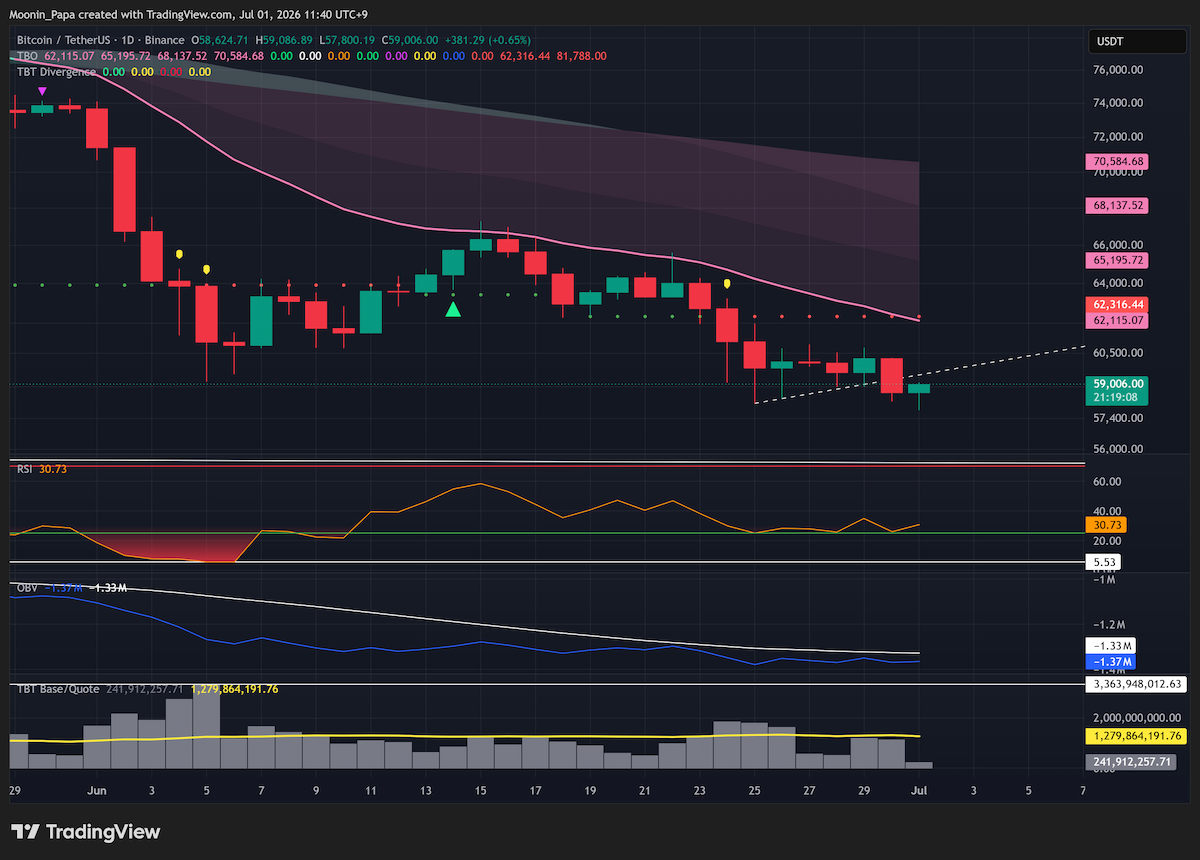
Bitcoin closed at $58,624 on Tuesday, June 30, marking the lowest daily close since September 2024. The move also took BTC below short-term support and briefly pushed price to a new local low near $57,800. That is a difficult setup to reconcile with the bullish July seasonal pattern, but it is the exact tension driving today’s market read.
The Better Crypto Calendar shows that July has historically been a green month for Bitcoin, and the prior Bottom Year Julys in 2018 and 2022 averaged a roughly 19% bounce. That path would still be consistent with an oversold relief move toward the weekly TBO Fast line, even while BTC remains strong bearish on both the daily and weekly TBO.
Ethereum and total-market signals remain bearish, but trend pressure is flattening
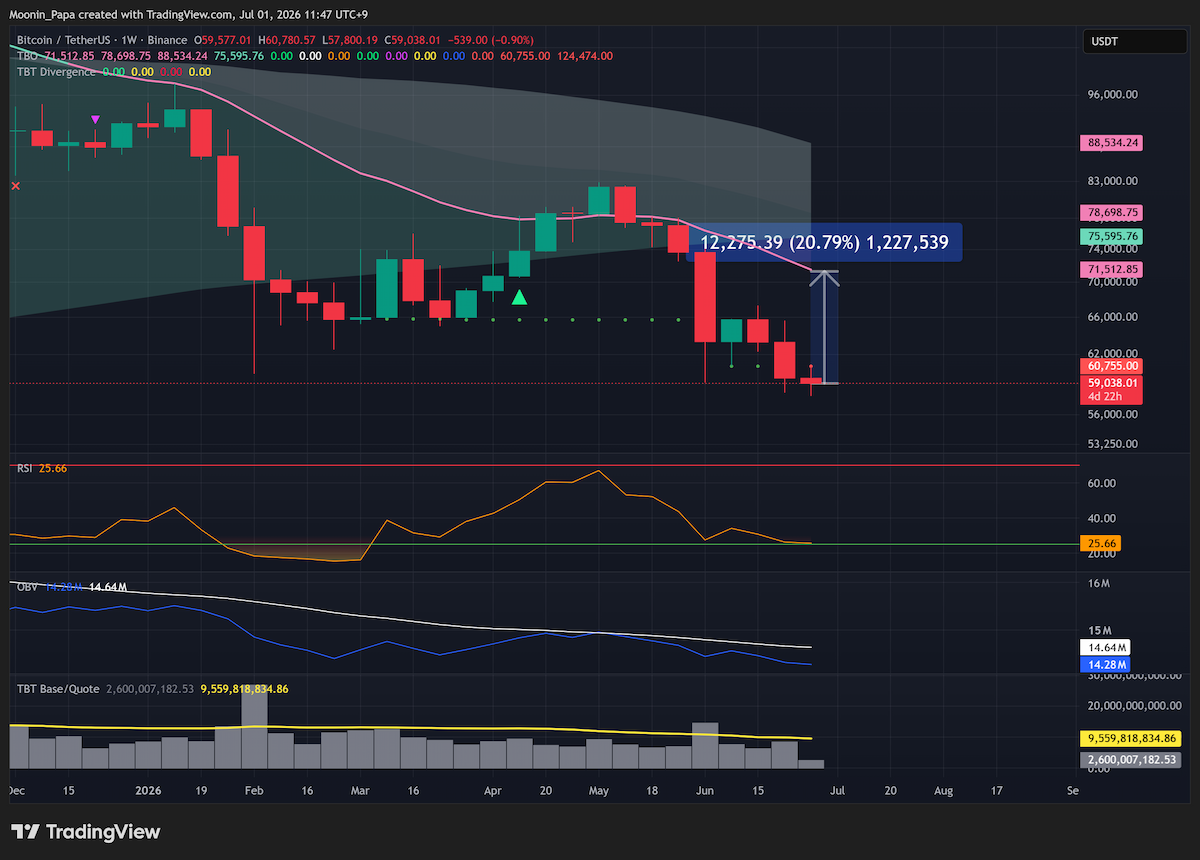
Ethereum is in the same broad position as Bitcoin. ETH remains strong bearish on the daily and weekly TBO, yet the On-balance Volume moving average lines for both BTC and ETH are flattening. That does not confirm a new bull trend by itself, but it does suggest the current downtrend may be preparing for a short-term change in character.
Total crypto excluding stablecoins is also still strong bearish relative to the daily TBO Cloud, but its OBV moving average is flattening as well. In past Bottom Year Julys, comparable dominance and total-market structures were able to bounce toward the weekly TBO Fast line before reversing lower later.
Stablecoin dominance may lose the 13% breakout window during the bounce
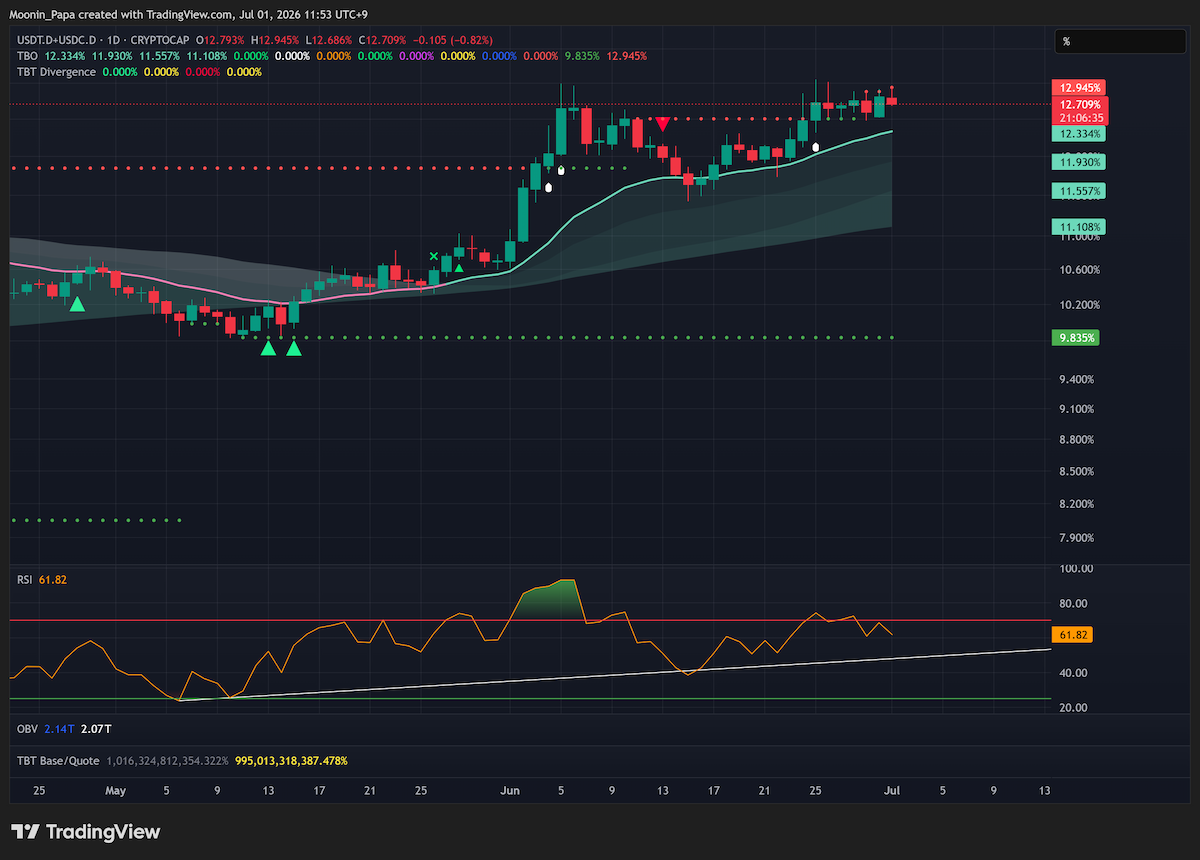
The frustrating side of a July crypto bounce is what it likely does to combined stablecoin dominance. That chart has been close to breaking above the 13% accumulation-zone target, but if BTC bounces, combined stablecoin dominance could fall back toward the bottom of the daily Cloud near 11% or even lower.
This does not remove the larger risk. A similar early-warning reversal developed before the June decline, and August and September remain historically weak months for Bitcoin and crypto. A July rally should therefore be treated as an oversold bounce first, not as confirmation that the longer-term bottom is already in.

USDJPY remains the main macro threat to a green July
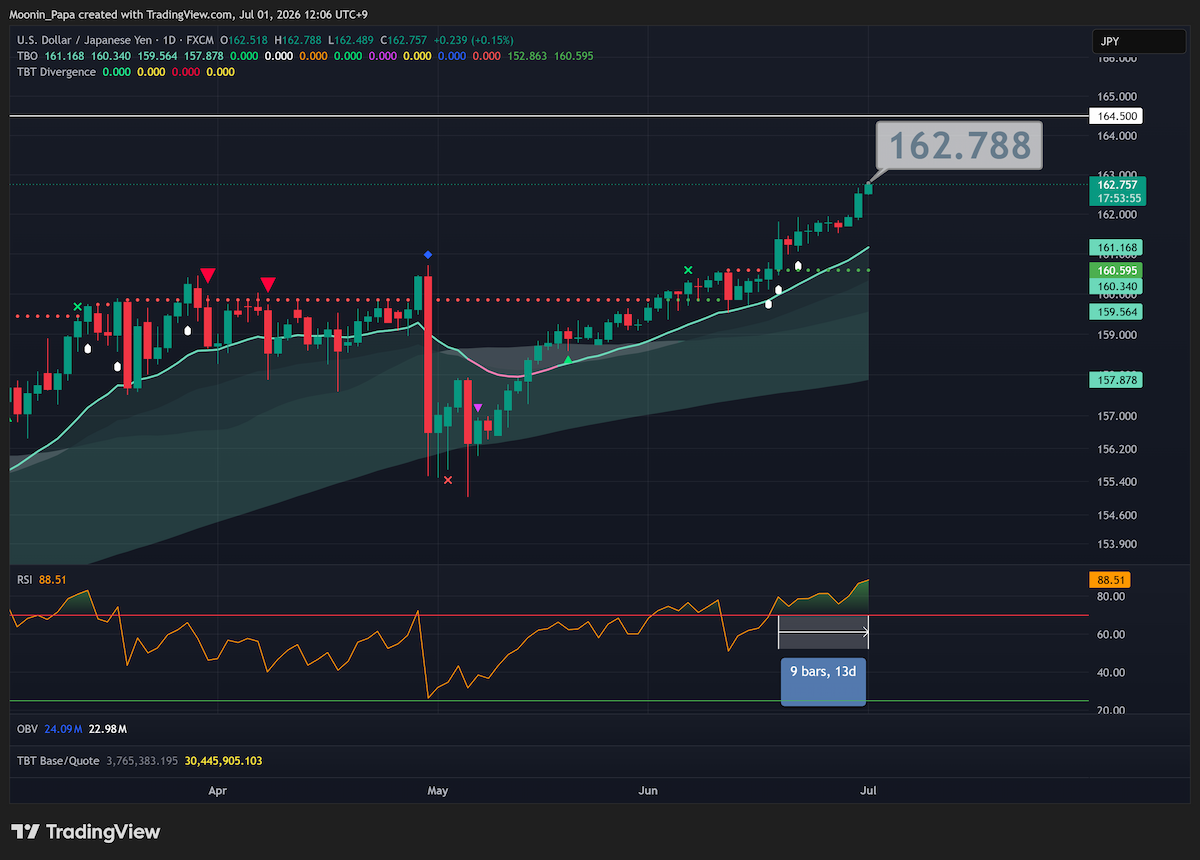
The biggest macro wrench is USDJPY. The pair continues to push into highs not seen since 1986, with the historic 164.500 area now in view. Japan has not announced fresh intervention, but officials have already signaled that they are ready to respond to disorderly moves at any time.
The last major intervention episode in 2024 briefly hit the Nikkei, broader TradFi, and Bitcoin. That is why USDJPY remains the key external risk to the otherwise constructive July seasonality setup.
TradFi stays supported while volatility cools
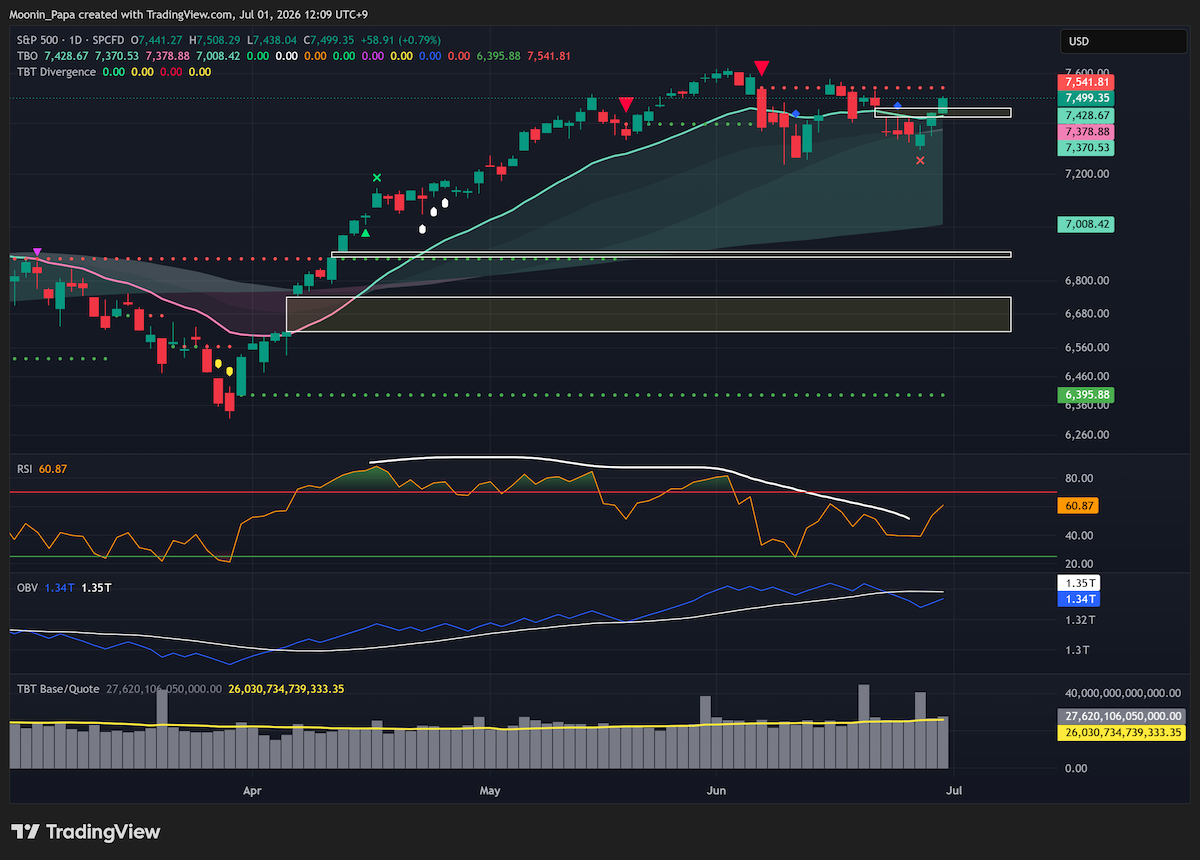
S&P futures reclaimed recently lost support, the SPX and NDX closed upper gaps, and the VIX fell 6.80% on Tuesday. With the U.S. holiday period approaching, some analysts expect policymakers and market participants to favor a stable, bullish tape in the short term.
At the same time, OBV conditions in several equity indexes still look stretched, and Asian markets remain sensitive to USDJPY. A sudden yen intervention headline could quickly change the tone across risk assets.
Altcoins offer tactical bounce setups, not a blank-check buy signal
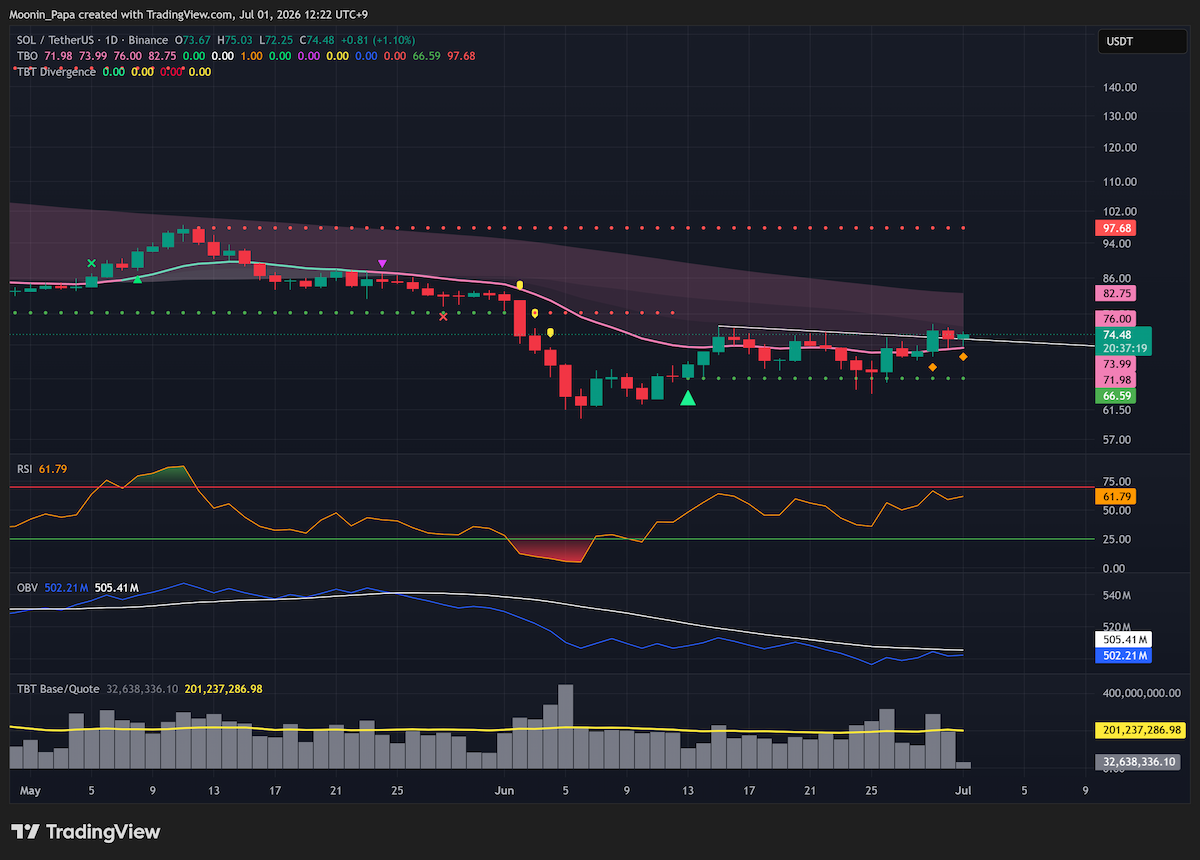
Several altcoins are now showing tactical opportunities. SOL is working on a second TBO Close Short, which would be a bullish reversal signal in the near term. HYPE has room toward the 1.272 Fibonacci extension near $79.372, BCH is working on a TBT bullish divergence, XMR could target TBO resistance at 418.60 if it pumps, and KAS is developing a second weekly TBT bullish divergence cluster.
Other names such as ICP, WLD, FET, SEI, WIF, and FARTCOIN also have bounce or reversal setups, while some recent outperformers such as LAB are already losing strength. The preferred approach is selective entries, cautious position sizing, and taking profits into July strength rather than assuming a confirmed long-term bottom.
Want the complete daily chart breakdown and trade plan? Learn more at Mastering Assets.
