
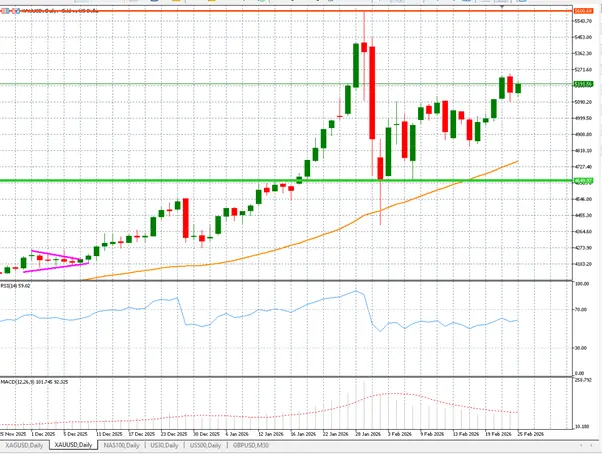
Gold prices moved higher on Wednesday, supported by renewed safe-haven flows as investors weighed the inflationary impact of tariffs and rising geopolitical tensions in the Middle East. Spot gold climbed 0.5% to trade near $5,172 per ounce, while U.S. futures for April delivery edged higher toward the $5,190 level. The advance comes as markets reassess the balance between policy-driven inflation risks and escalating geopolitical rhetoric, both of which reinforce gold’s role as a macro hedge.
At current levels, gold’s strength reflects not just short-term positioning, but a broader recalibration toward defensive allocation amid policy uncertainty and security concerns.
Tariffs and oil risks revive inflation concerns
Investor focus has shifted back toward the potential inflationary consequences of trade policy. President Donald Trump reiterated in his State of the Union address that most countries and corporations are seeking to maintain tariff and investment agreements with Washington, reinforcing the persistence of trade barriers rather than signaling relief.
Tariffs, particularly when combined with elevated energy prices, carry a clear inflationary undertone. Higher import costs filter through supply chains, while oil market volatility amplifies price pressures across transportation and manufacturing sectors. In such an environment, gold often attracts demand as a hedge against eroding purchasing power and potential policy missteps.
The prospect of sustained trade friction therefore adds another structural layer of support to bullion, particularly if inflation expectations begin to firm again after recent moderation.
Geopolitical rhetoric keeps defensive bids intact
Geopolitical tensions between the United States and Iran have also contributed to the renewed bid for safety. President Trump outlined his case for preventing Iran from obtaining a nuclear weapon, raising the possibility of more assertive policy action. At the same time, both sides are scheduled to hold a third round of nuclear talks in Geneva, underscoring the fragile balance between diplomacy and escalation.
Markets tend to respond to such developments not solely based on immediate outcomes, but on the uncertainty they introduce. Even without concrete action, the mere possibility of heightened military tension supports precautionary positioning across safe-haven assets.
In this context, gold benefits from both sides of the equation: geopolitical risk on one hand and inflation sensitivity on the other.
Limited data today, but key inflation signals ahead
With little major economic data on Wednesday’s calendar, price action has been driven primarily by macro headlines and positioning flows. However, attention now shifts toward U.S. labour market and inflation indicators due later this week.
Weekly unemployment claims are expected to rise modestly to 217,000 from the prior 206,000 reading, a figure that may offer incremental insight into labour market cooling. More importantly, Friday’s Producer Price Index (PPI) report is forecast to show a 0.3% monthly increase, down from the previous 0.5%.
Should PPI confirm easing upstream inflation pressures, it could temper some of the tariff-driven inflation narrative. Conversely, a stronger reading would reinforce concerns that trade policies and energy volatility are feeding into broader price dynamics—potentially complicating the Federal Reserve’s policy path.
For gold, the outcome is nuanced. Softer data would support expectations of policy easing, keeping real yields compressed. Stronger inflation readings, meanwhile, could simultaneously lift hedging demand even if they temporarily strengthen the dollar.
The chart below shows important price levels for shinning metal
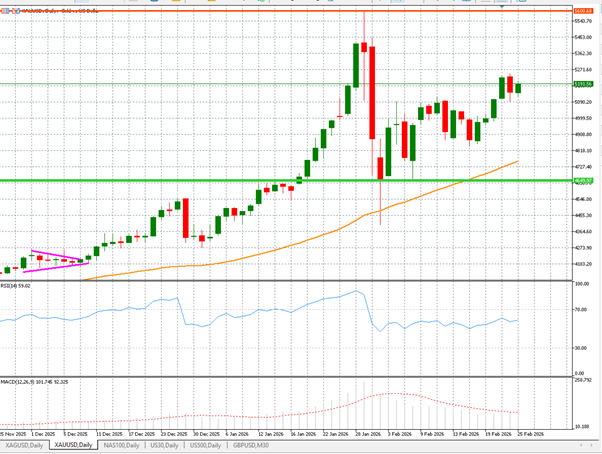
Gold price chart by Exness
Final word
Gold’s latest advance highlights the metal’s dual sensitivity to both inflation risk and geopolitical uncertainty. Tariff persistence, energy price volatility, and renewed U.S.–Iran tensions have collectively revived safe-haven flows, pushing prices back toward record territory.
With limited data midweek but key inflation signals ahead, gold’s trajectory will likely hinge on whether inflation risks reaccelerate or remain contained. For now, the metal continues to function as a strategic stabiliser—absorbing policy ambiguity and geopolitical friction while remaining anchored by its enduring role as a hedge in an uncertain macro landscape.