
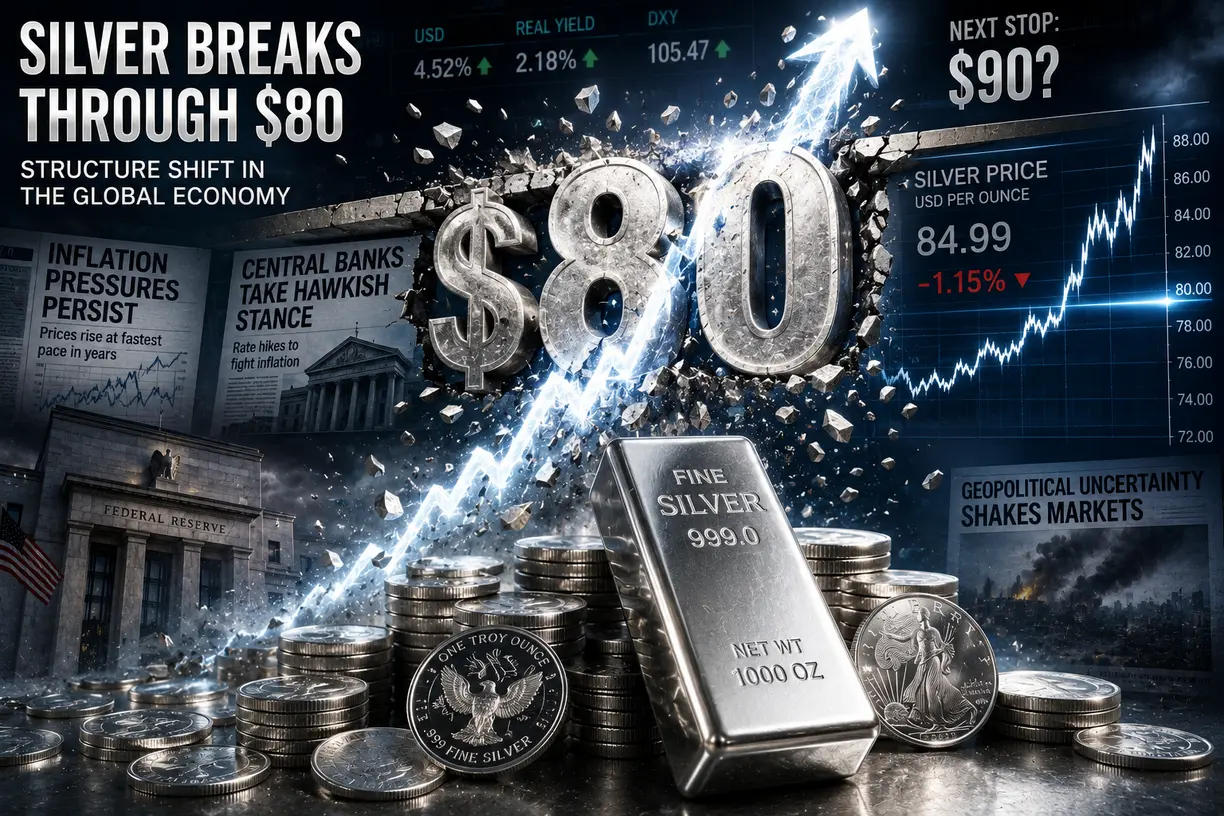
(Kitco News) - Despite the ongoing threat to the global economy posed by the war in Iran, the silver market is attracting renewed investor attention as prices push back above $80 an ounce, with growing expectations that $90 is around the corner.
The bullish view comes after silver started the week with a 7% rally that pushed prices to a nine-week high near $87 an ounce. Although prices are seeing some technical selling pressure on Tuesday, they continue to hold on to most of Monday’s gains; spot silver last traded at $84.99 an ounce, down 1.15% on the day.
According to some analysts, silver’s price action is at odds with market conditions, as inflation pressures are forcing global central banks to take a hawkish stance on monetary policy, raising the opportunity costs of non-yielding monetary assets like gold and silver. At the same time, growing economic uncertainty should be weighing on silver’s industrial consumption.
Despite the headwinds, other analysts note that there are factors that will continue to support silver prices even in a potentially volatile environment. Analysts say that the silver market’s continued imbalance is a critical factor driving prices and investor demand.
Last month, The Silver Institute published its annual Silver Survey, conducted by Metals Focus, which projected the market would see a supply deficit of 43 million ounces. This would mark the precious metal’s sixth consecutive supply deficit.
Barbara Lambrecht, commodity analyst at Commerzbank, said that weakening base metal production this year could further widen the supply deficit in silver. She added that the ongoing energy crisis caused by the war with Iran is impacting the production of base metals, of which silver is a by-product.
“The impulse for the relative strength of silver, which is more heavily influenced by industrial demand than gold, is likely to stem from the industrial metals markets,” she said.
Simon-Peter Massabni, Head of Business Development at XS.com, said that silver’s price action reflects a significant repricing of the precious metal driven by structural factors in the marketplace.
“These factors are no longer marginal; they have become a primary force reshaping silver’s position within the global financial system, not merely as a store of value, but as a multi-dimensional strategic asset,” he said in a note on Tuesday.
Massabni added that because of the ongoing supply deficit, prices have to move higher to rebalance the market.
At the same time, Massabni said that shifting economic conditions are helping silver step out of gold’s shadow and establish itself as a monetary metal in its own right.
“The decline in the gold-to-silver ratio from record levels to more balanced ranges reflects, in my view, a conscious reassessment by investors who are increasingly viewing silver as a higher-return opportunity in an environment marked by uncertainty. This shift is not random; it stems from a growing recognition that silver uniquely combines the characteristics of a precious metal and an industrial asset — a rare blend that gives it an edge during complex economic cycles,” he said.
Massabni explained that rising sovereign debt levels and persistent geopolitical tensions are pushing investors toward alternative assets like silver.
“Even with the temporary pressures resulting from expectations of higher interest rates, I believe these effects will be short-lived and unlikely to alter the broader trend,” he said. “The question is no longer whether silver will continue to rise, but how far this rally can extend in an increasingly volatile world that is becoming more dependent on strategic resources.”
