
(Kitco News) - Lackluster Western gold demand has kept a lid on prices over the last few months; however, one bank has pointed out that Asian demand, led by China, remains a key pillar of support for the global market, and the nation's stockpile and influence could be much greater than previously believed.
Although the gold market has struggled through a months-long correction, prices have managed to hold critical support above $4,000 an ounce. In their latest report, commodity analysts at BMO Capital Markets speculate that renewed Chinese demand is a key reason why gold has maintained that support. At the same time, they argue that China's influence on the gold market is much larger than many investors realize.
“Our new analysis suggests China has accumulated ~30kt of gold above ground, higher than official data, and is now driving ~1/3 of global demand flows,” the analysts said.
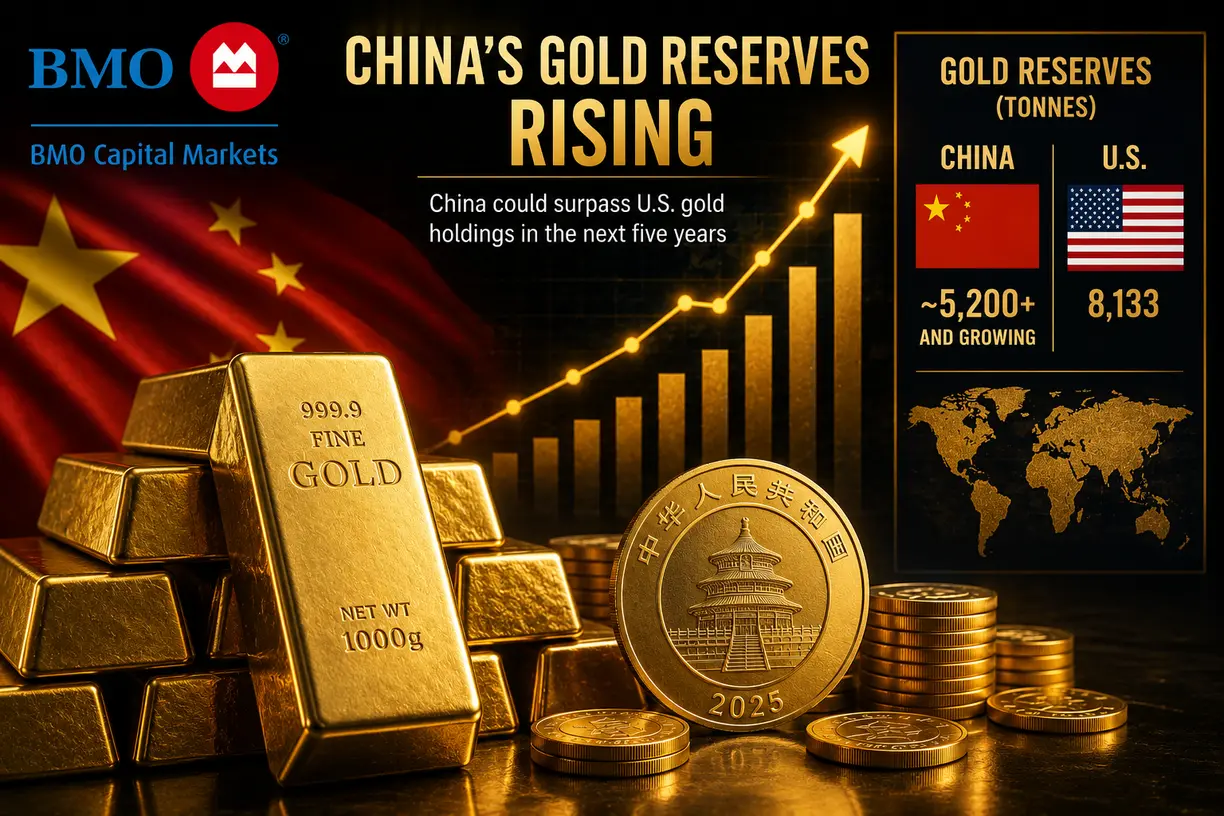
BMO also expects growing Chinese demand to be the biggest factor pushing gold prices higher in the second half of the year. The analysts noted that even with its massive undeclared stockpile, China's appetite for gold is likely to remain insatiable for the foreseeable future, eventually surpassing U.S. reserves.
“China has another ~5 years of buying at current rates for the PBoC to reach the USA's level of treasury reserves, but in total gold terms could surpass the U.S. much sooner,” the analysts said. “What's more, as achieved elsewhere, China is set to gain more leverage in global pricing, enabled by its sheer scale of demand and growing futures and OTC market liquidity."
Breaking down China's demand, BMO estimates that the People's Bank of China holds about 5,200 tonnes of gold, with the remainder held in jewelry and investment bullion. The analysts noted that China's stockpile represents about 13% of the world's above-ground gold supply, approaching the United States' estimated 15% share.
Although China's gold market is approaching several important international milestones, BMO said the nation's ultimate objective remains elusive.
“Unsurprisingly, China hasn't disclosed its ultimate gold accumulation targets, but given its stated ambitions for economic expansion and RMB internationalisation, our view is that achieving the U.S.'s level of holdings is an absolute minimum target, implying another ~2,500-3,000t of purchases, achievable in two to five years depending on method,” the analysts said. “Yet aspirations are likely higher still given the need to establish RMB credibility globally, with ongoing acquisitions (~$18bn to date) of overseas assets a key pillar of its strategy.”
Although there is no definitive target for China's gold holdings, BMO analysts said the country's money supply provides a useful benchmark. They pointed out that, at current prices, the Federal Reserve's gold stockpile represents roughly 5% of the U.S. M2 money supply. If China were to achieve the same ratio, its central bank would need to hold about 18,000 tonnes of gold, compared to the roughly 5,222 tonnes it held at the end of last year.
Although China still has a long way to go before reaching that level, analysts said its commitment has been evident in recent months as the PBoC has tactically taken advantage of the prolonged correction.
Last month, the central bank purchased 15 tonnes of gold, its largest monthly acquisition since October 2023. China's official gold reserves have increased by just over 40 tonnes so far this year.
Beyond building its stockpile, BMO said China is also laying the groundwork to become a major force in global gold price discovery. The analysts noted that Beijing is expanding Hong Kong's role as an international bullion hub through new clearing and settlement infrastructure, stronger links with the Shanghai Gold Exchange, and increased futures and over-the-counter market liquidity.
According to the report, these initiatives are designed to attract more international trading activity and could gradually shift more global gold pricing power from traditional Western centers toward China as the country's influence in the bullion market continues to grow.
