
As I wrap up Friday ahead of the holiday week, all the attention is on Nvidia, data centers, AI, and the buildout. But the more interesting story may be sitting in plain sight. For most of the last decade, metals were an afterthought. Capital flowed into technology and semiconductors, while companies extracting copper and silver from the ground saw their share prices and capital budgets squeezed. That era may be ending.
The same buildout driving the AI and data center boom, the chips, the servers, the power plants feeding them, the transmission lines carrying that power, and the solar and grid investment supporting it all, runs on physical metal. You cannot wire a data center, build a solar farm, or electrify a vehicle fleet without copper and silver. After ten years of underinvestment in new mine supply, the industry is now being asked to deliver materially more metal into a market where ore grades are falling, new projects cost multiples of what they did a decade ago, and major operations continue to face disruptions. Governments have taken notice and are stepping in to fund and de-risk critical mineral projects, a signal of how strategic these materials have become.
Before the market opens on Tuesday, see what we are watching. "Navigating the Week Ahead" is our free weekend outlook covering the key levels and events across Gold, Silver, Equities, US rates, volatility, and the Dollar: https://bluelinefutures.com/navigating-the-week-ahead/
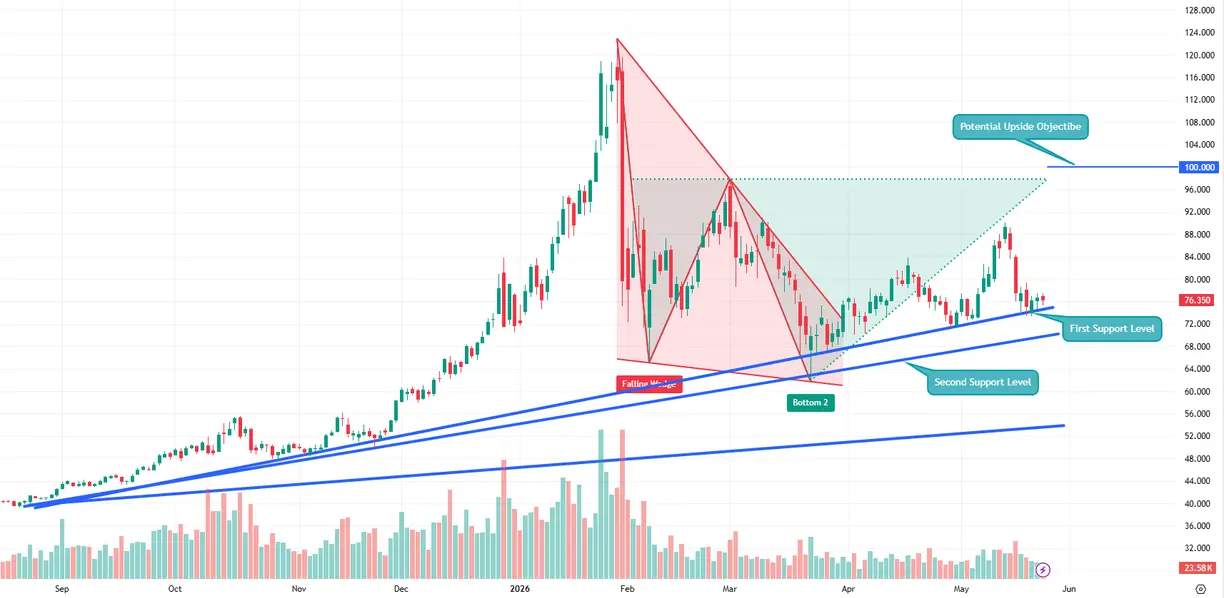
Daily Silver Chart
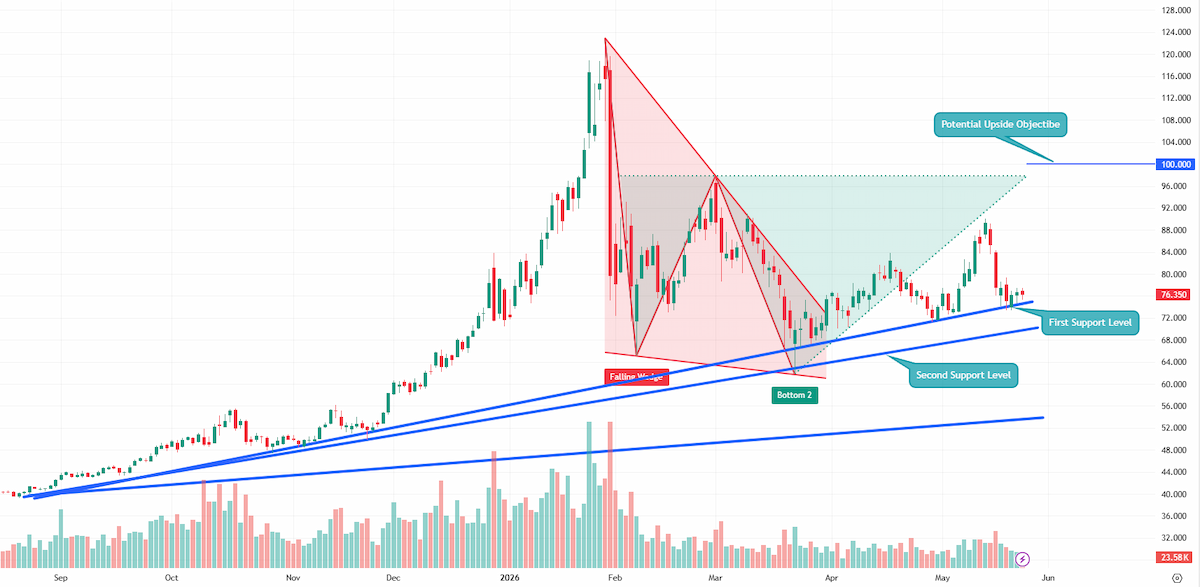
The setup is straightforward. If the hyperscalers and chipmakers build even a fraction of what they say they will, copper and silver prices could move meaningfully higher from here. In fact, we have two strategies to consider.
Example 100-ounce Silver Futures Strategy
The 100-ounce silver futures offer unique capital efficiency, meaning you can control a larger position with less capital. Traders typically need 5% to 10% of the total notional value (the dollar amount of the position) to hold a futures position, whereas holding an ETF can cost 50% to 100% of the notional.
For example, we see potential value in systematically purchasing the 100-ounce silver contract at regular intervals. This allows you to layer in over time and potentially average into the position ahead of the next rally. One approach would be to focus on the September 2026 100-ounce silver contract and use a dollar-cost averaging method by purchasing 100 ounces at $75/oz, 100 ounces at $70/oz, and 100 ounces at $65/oz, with a target of $100/oz.
If filled on all three contracts, your average price would be $70/oz. Because you control 300 ounces, every $1 move in silver from that average represents $300 in P&L. If the $100/oz price objective is reached, this could result in a gain of approximately $9,000 (300 oz times $30 rise) before commissions and fees. Traders should also consider proper risk management, such as a hard stop on all three contracts at $58/oz. Under that scenario, the loss would be approximately $3,600 before commissions and fees.
To help with the charting, we developed the Precious Metals Chart Pack, which delivers daily key levels for Gold, Silver, Copper, and Platinum, including the exact support, resistance, and trade setups I track for Blue Line Futures. Register: https://bluelinefutures.com/precious-metals-chart-pack/
Example 5000-ounce Silver Futures Options Strategy
For example purposes only, one could purchase the September 2026 silver futures $85.00 call option while selling the September 2026 $90.00 call against it. This bull call spread would cost approximately $5,000 before commissions and fees, with a maximum potential gain of $25,000 less the initial cost, if silver futures close above $90.00/oz at expiration on August 26, 2026. We believe this strategy may offer a favorable risk-to-reward profile. If you would like to discuss how a setup like this might fit your account, reach out to the team at Blue Line Futures.
Performance Disclaimer
Hypothetical performance results have many inherent limitations, some of which are described below. No representation is being made that any account will or is likely to achieve profits or losses similar to those shown. In fact, there are frequently sharp differences between hypothetical performance results and the actual results subsequently achieved by any particular trading program.
One of the limitations of hypothetical performance results is that they are generally prepared with the benefit of hindsight. In addition, hypothetical trading does not involve financial risk, and no hypothetical trading record can completely account for the impact of financial risk in actual trading. For example, the ability to withstand losses or to adhere to a particular trading program in spite of trading losses are material points that can also adversely affect actual trading results. There are numerous other factors related to the markets in general or to the implementation of any specific trading program that cannot be fully accounted for in the preparation of hypothetical performance results all of which can adversely affect actual trading results.
