Partner Content
Junior mining investors usually face a timing problem. Production stories often become obvious only after much of the early re-rating has already happened. Exploration stories can offer more upside, but they often require years of drilling, financing and technical work before the market knows whether a district has real scale.
ESGold Corp. (CSE: ESAU | OTCQB: ESAUF | FSE: Z7D) is attempting to compress that sequence at its Montauban Gold-Silver Project in Québec.
Montauban is being advanced as a fully permitted tailings reprocessing operation targeting gold and silver production in 2026. At the same time, ESGold is building a broader exploration thesis around a historic mining camp that company materials describe as underexplored for gold using modern techniques. The near-term plan is straightforward: process historic tailings first, create a pathway to early revenue potential, and use that operating base to support a larger district-scale exploration program.
What sets Montauban apart from a typical junior exploration story is that enmeshment of tailings reprocessing and exploration thesis. ESGold is not starting with bare ground and a drill target alone. The company has already invested more than $15 million into the project, secured major permits, completed the mill building and advanced plant and infrastructure installation.
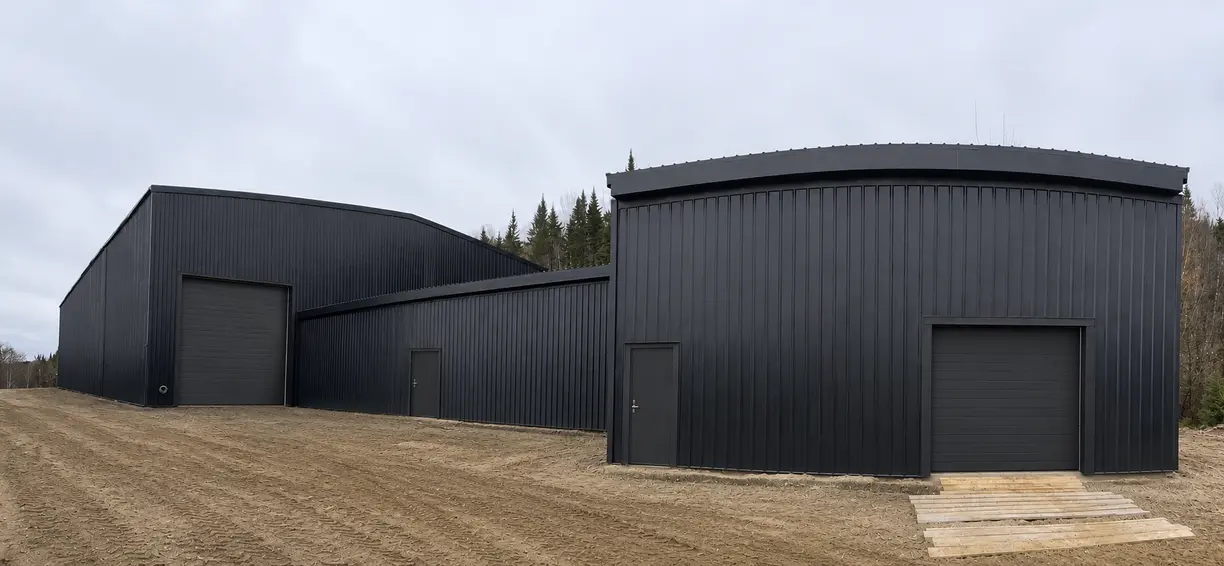
The site includes a 20,000-square-foot processing facility and laboratory, 1.3 kilometres of service hydropower, all-weather road access and a mill building rated for 1,000 t/d of processing capacity. Those details move Montauban out of the purely conceptual stage. The project already has infrastructure, permits, a defined processing plan and a 2026 operating target.
ESGold Mill facility building Notre-Dame-de-Montauban
The 2025 Preliminary Economic Assessment gives investors the economic benchmark for the first phase. ESGold’s publicly accessible materials outline a 105% pre-tax internal rate of return, C$44.5 million pre-tax net present value at a 5% discount rate and a projected payback period of less than two years. The PEA used metal price assumptions of US$2,900 per ounce gold and US$32 per ounce silver.
The PEA is the setup, not the finish line. The value test now is whether ESGold can move Montauban from a permitted plan into an operating gold-silver platform, with progress measured through commissioning, throughput, recovery performance, doré production and commercial settlement.
Recent milestones have added weight to that transition. ESGold announced the delivery of a propane-fired tilting doré melting furnace to Montauban, intended to support future onsite precious-metals handling and doré pouring once the operation is commissioned. The company also appointed Québec-based engineer Pierre-Marc Gagnon, P.Eng., as Operations Director, adding dedicated site-level leadership for execution, operational readiness, contractor coordination and technical planning.
The commercial side of the project has also advanced. In May, ESGold signed a definitive gold and silver doré purchase agreement with Ocean Partners UK Ltd., under which Ocean Partners is expected to purchase 100% of doré production from Montauban’s tailings and potential crown pillar material. The agreement also provides ESGold with access to a working-capital facility of up to C$9 million, available in two tranches and subject to applicable conditions tied to operational readiness and production milestones.
Together, those pieces create a clearer route from construction to production: infrastructure at site, operating leadership in place, doré-handling equipment delivered and a defined buyer for future production.
The technical foundation behind the tailings operation is also more developed than a simple recovery concept. ESGold reports 352 drillholes, 1,654 metres of total drilling, 1,170 sampled intervals, 35 trenches, independent QAQC work and assays completed by SGS Québec.
Company materials list total indicated tailings resources of 603,700 tonnes grading 0.40 g/t gold and 31.45 g/t silver, plus total inferred tailings resources of 319,300 tonnes grading 0.41 g/t gold and 36.93 g/t silver across the Montauban and Notre-Dame-de-Montauban tailings.
That first phase is the foundation. The larger upside comes from what Montauban may represent beyond the tailings.
The project sits in a historic polymetallic mining camp near Québec City and Trois-Rivières. Historical sources cited in company materials list production across three operating periods from 1913 to 1990, including gold, silver, lead and zinc. Based on those tables, historical production included approximately 149,429 ounces of gold and 6,970,893 ounces of silver, in addition to significant lead and zinc output.
Earlier mining was largely focused on base metals and silver. ESGold’s current materials emphasize that the broader district has seen limited modern gold-focused exploration. That distinction is central to the opportunity. Montauban is not simply a historic mine site with leftover tailings. ESGold is using modern geophysical modelling to evaluate whether the system extends beyond the areas historically mined and understood.
The company’s integrated 3D geological model combines Ambient Noise Tomography imaging with historical drilling and mine data. According to ESGold, the model has identified a mineralized corridor extending approximately 900 metres vertically and more than two kilometres along strike within the current survey footprint.
The interpreted corridor appears to widen at depth and remains open beyond current model coverage. Following those results, ESGold expanded its Montauban land position to 485 claims covering approximately 24,414 hectares, or 244 square kilometres. The expanded footprint was assembled to secure prospective ground and potential structural extensions identified through the modelling work.
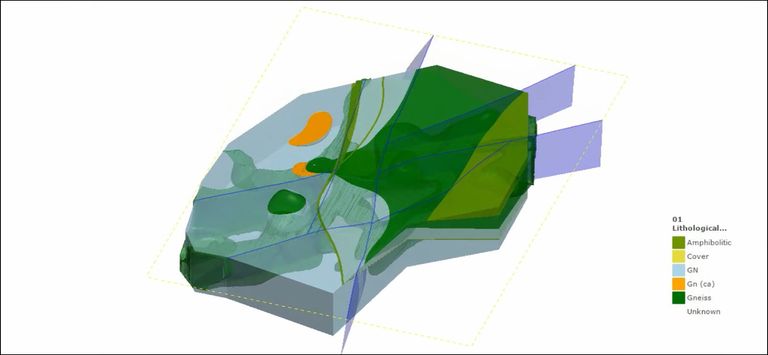
Ambient Noise Tomography top-down view
The next exploration phase is already advancing. ESGold reported in its May 26 update that field collection for the expanded 70-square-kilometre district-scale ANT survey had been completed, geophone pods had been removed and data analysis and interpretation were underway as part of the company’s evolving 3D geological model.
The company also said it was anticipating drill permits in the near term, with systematic crown pillar definition drilling and targeted step-out drilling expected to commence shortly thereafter. That work is intended to evaluate extensions of mineralization at depth and along strike, subject to permitting, logistics, technical planning and further evaluation.
That gives Montauban two parallel tracks moving through 2026: production-targeted execution from the tailings operation and exploration growth across a much larger land package.
The environmental component adds another layer to the model without needing to carry the entire story. Montauban is designed to process historic tailings, recover residual precious metals, neutralize and stabilize material, and support site restoration objectives. ESGold’s materials also describe potential reuse of neutralized material in construction-related applications such as aggregates and concrete polymer inputs.
For investors, the setup is the convergence. ESGold is approaching a 2026 production target with permits, infrastructure, PEA-supported economics, a doré purchase agreement and a defined commercial pathway. At the same time, the company is preparing to test a deeper and broader gold-silver system across an expanded district-scale land position.
That is the point of the Montauban story now. The tailings operation gives ESGold a path toward near-term revenue potential, while the expanded land package and 3D ANT model give the company a larger exploration runway still in front of it.
If ESGold executes through commissioning and advances its 2026 exploration plan, Montauban could become more than a permitted tailings reprocessing project. It could become a Québec-based gold-silver platform with production potential, remediation value and district-scale discovery upside moving forward on the same timeline.
Technical disclosure: The economic results referenced above are based on ESGold’s 2025 Preliminary Economic Assessment. A PEA is preliminary in nature and includes inferred mineral resources that are considered too speculative geologically to have economic considerations applied to them in a manner that would enable them to be categorized as mineral reserves. There is no certainty that the PEA will be realized. Mineral resources are not mineral reserves and do not have demonstrated economic viability. The ANT-based geological interpretations referenced above are conceptual in nature, are intended to guide further exploration, and do not constitute a mineral resource or mineral reserve. Historical production and historical technical data referenced in company materials are not current, have not been independently verified by ESGold, and should not be relied upon as current resource or reserve information. Any potential extraction of crown pillar material remains subject to technical evaluation, permitting, engineering review, additional drilling and, where applicable, further economic assessment. Production timing, anticipated cash flow, commissioning, recoveries, exploration plans, drill timing, permitting, and other future expectations are forward-looking and subject to risks and uncertainties. Actual results may differ materially.

Kitco Spotlight Editorial
Kitco Spotlight Editorial is sponsored content, articles and announcements paid for by our advertisers that support our journalism. Our sponsored messages are targeted and hand-curated, highlighting the best of what's happening in the mining sector.
