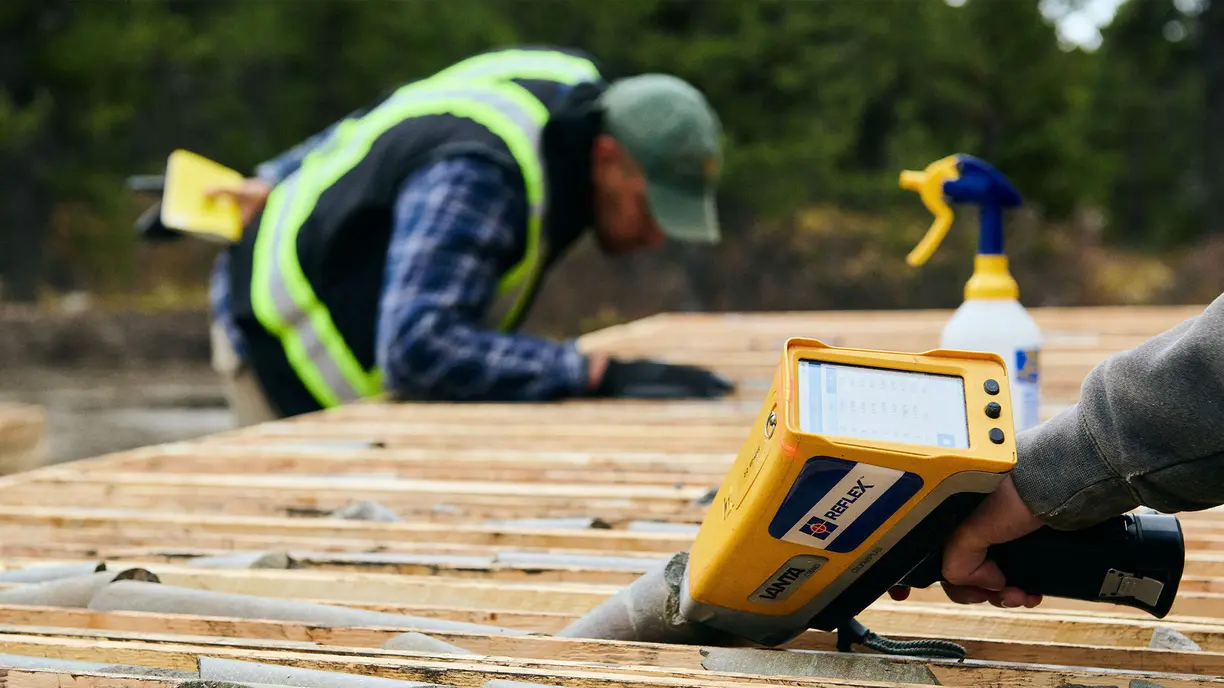
Geologists examine drill core from the 2025 drill program at the Creek Zone, JD Project.
Key Takeaways
- Sun Summit Minerals is fully funded and now drilling a 10,000-metre program at the JD Project in British Columbia's Toodoggone district, with an inaugural mineral resource estimate targeted for the first quarter of 2027.
- The Creek and Finn zones bookend a highly prospective 4.5-kilometre-long structural corridor and are the focus of delineation drilling in 2026 that will inform a mineral resource estimate for each zone.
- At the Creek Zone, drilling confirmed the presence of high-grade epithermal-related, vein-hosted and disseminated gold mineralization with successful step-out intersections demonstrating expansion potential, including the strongest interval of near-surface gold mineralization drilled to date, returned by DDH CZ-25-021: 81.0 metres of 4.80 g/t gold starting at 26.0 metres downhole, including 14.0 metres of 19.81 g/t gold.
- With a market capitalization near C$50 million against Toodoggone peers ranging from C$184 million to nearly C$5 billion, Sun Summit offers exposure to a district where AngloGold Ashanti, Centerra Gold, Freeport-McMoRan and Skeena have all deployed strategic capital, including AngloGold’s C$38.7 million investment in next-door neighbour Thesis Gold & Silver.
Disseminated on Behalf of: Sun Summit Minerals Corp.
Gold has rewritten the playbook in 2026. Prices broke above US$5,000 per ounce in January, set a record of US$5,405, and have since settled into the mid-US$4,000s with conviction. Central banks bought another 244 tonnes in the first quarter. Bar and coin demand reached their second-highest quarterly level on record.
Capital is rotating toward explorers that can show three things at once: scale, jurisdictional certainty, and the balance sheet to drill without flinching.
That is where Sun Summit Minerals Corp. (TSXV: SMN | OTCQB: SMREF) now finds itself.
The Vancouver-based company controls approximately 31,500 hectares across three Toodoggone properties in northern British Columbia, anchored by its flagship JD Project, a 15,000-hectare property hosting a 4.5-kilometre near-surface gold-silver corridor with deeper copper-gold porphyry potential underneath. The nearby Theory and recently staked Orbit projects extend the land position further.
This week, the drills are turning. The 2026 program is the largest in JD's history, designed to both convert historical and modern drilling into defined ounces at the Creek and Finn zones, and chase new discoveries in high-priority drill targets that have little or no historical drilling.
“We’re building towards putting out an initial mineral resource estimate on JD in Q1 of 2027,” said Sun Summit CEO Niel Marotta. “That is the focus this year.”
From validation to resource definition
The story heading into 2026 centred on Sun Summit's C$11.5 million December financing and the path to drilling at scale. The drill program is now in motion. Two rigs have been mobilized, and the company has shifted from exploration into resource definition.
The plan is roughly 10,000 metres across the Creek and Finn zones, weighted slightly toward Finn with a variety of step-out, down-dip and close proximity holes. The C$10 million program is built around mineral resource definition rather than exploration drilling.
"We have a lot of drill targets on the JD property, but the first priority is continued definition at the Creek and Finn zones, which are the two most developed epithermal gold-silver systems on the JD property," said VP Exploration Ken MacDonald.
Epithermal systems form when hot, mineral-rich fluids deposit metals near the earth's surface, meaning gold close enough to surface to consider open-pit, bulk-mining methods, with attendant lower mining costs and relatively faster permitting timelines than buried equivalents.
Why these intercepts matter
Hole CZ-25-021 at the Creek Zone returned 81 metres grading 4.8 g/t gold, starting just 26 metres from surface. Within that interval sat 14 metres at 19.81 g/t gold and a single metre at 155 g/t gold.
"The grade on those hits is extremely good. Those would have been good drill holes 20 years ago," Marotta said. "They're also very near surface, with very little overburden and probably a lower strip ratio as a result. This interval extends bulk-tonnage and high-grade gold mineralization to a vertical depth of approximately 150 metres from surface.”
Other holes along the corridor reinforce the picture. CZ-25-007 returned 78 metres at 3.72 g/t Au. CZ-24-004 hit 122.5 metres at 2.11 g/t Au. CZ-24-005 returned nearly 58 metres at 2.7 g/t Au.
"They demonstrate the potential for a high-grade vein-style and bulk-tonnage style deposit that may be amenable to open-pit mining methods," MacDonald said.
Creek and Finn: two zones, one resource
Creek has produced the headline numbers. Finn, less visible but more drilled historically, carries the silver story and a deeper bench of historical data heading into the inaugural resource.
Drilling at the Finn zone in 2025 returned 46.0 metres of 1.03 g/t gold with 44.9 g/t silver from 38.0 metres downhole, including 6.0 metres of 5.30 g/t gold with 157.9 g/t silver from 60.0 metres downhole. This interval is punctuated with a 1.0-metre zone that returned 784.0 g/t silver, highlighting the high-grade and historically overlooked silver potential of the Finn zone epithermal-related system.
"Finn has some tremendously high-grade silver results," MacDonald said. "The tenor of silver mineralization at Creek is a bit less than we see at Finn. That's super encouraging for future mineral resource estimation as the gold-silver ratios per zone are different but significant and mutually supportive."
Finn has more than 240 historical drill holes against roughly 20 at Creek before Sun Summit took the property. The 2026 program will validate the historical drill data at Finn so that Dahrouge USA, the independent qualified person engaged for the inaugural resource, can incorporate it, while extending Creek's footprint along strike and at depth. Independence is required under NI 43-101, and Dahrouge's track record in epithermal gold-silver systems lowers the technical risk of the milestone Sun Summit is racing toward.
A district where the majors have already arrived
Sun Summit’s pitch rests on something larger than its own drill program. The Toodoggone has quietly become one of the most actively explored mining districts in Canada, ripe for consolidation.
The list is striking. Freeport-McMoRan elected to proceed with a C$75 million Stage 2 earn-in on Amarc Resources’ JOY District, which hosts the AuRORA copper-gold-silver discovery, in September 2025. Skeena Gold + Silver invested roughly C$7 million in TDG Gold. Centerra Gold has built a 9.9% position in Thesis Gold & Silver through participation rights. And in the move that drew the most attention, AngloGold Ashanti, a top-five global gold producer, acquired a 5.0% stake in Thesis Gold & Silver for C$38.7 million in February 2026, in a deal that included Centerra’s pro rata participation for a combined C$44 million private placement.
“When a company comes from outside the country entirely and makes such a significant investment in our immediate next-door neighbour, that’s a great sign for everybody in the area,” Marotta said.
JD sits roughly ten kilometres north of Thesis Gold & Silver’s Lawyers project, the former producing Cheni mine, and about 15 kilometres south of the Ranch deposits, both of which are road accessible. “We’re sort of centre ice between these geologically very similar epithermal gold-silver systems to what we have at the Finn and Creek zones,” MacDonald said.
The valuation gap
Sun Summit’s market capitalization sits at roughly C$50 million as of May 11, 2026. The Toodoggone peer set tells a different story: TDG Gold at C$184 million, Amarc Resources at C$252 million, Thesis Gold & Silver at C$1.0 billion, and Centerra Gold at C$4.9 billion. On a market-cap-per-ounce-of-gold basis, those peers trade between C$236 and C$344 per ounce. Sun Summit, lacking a JD resource estimate, does not yet appear on the comparison.
Marotta does not frame the gap as a mispricing. He frames it as a function of time.
“It’s just time and stage of development,” he said. “Thesis put out their first resource estimate back in 2021 and over the following four to five years, put out updates to that resource and a PEA and then more recently a prefeasibility study. We will catch up over time. They’re just much further up the development curve.”
The setup is reinforced by trading liquidity that is unusual for a junior at this stage. Sun Summit trades roughly 1.5 million shares per day on the TSX Venture Exchange, with capital structure further strengthened by more than C$800,000 in recently exercised warrants on top of the December financing.
The gap closes through milestones, not narrative. Once an explorer has defined ounces under NI 43-101, a different category of capital becomes interested. The valuation conversation shifts from speculation to multiplication.
What’s ahead
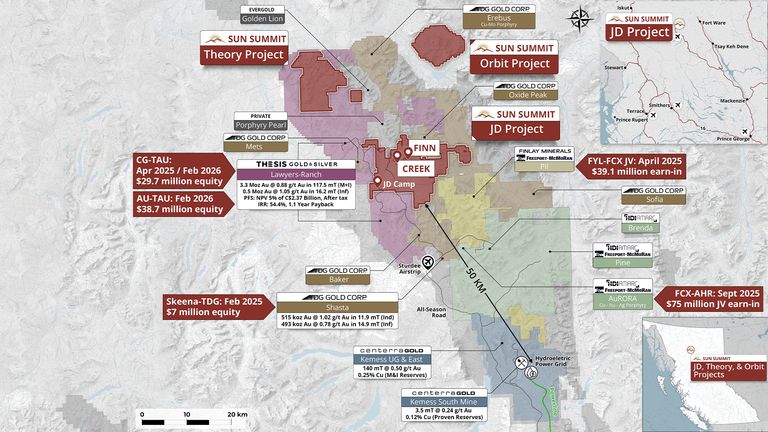
Map of the Toodoggone District showing the location of the JD Project in relation to other development and exploration projects. Data sourced from Thesis Gold & Silver Inc., TDG Gold Corp. and Centerra Gold Inc.’s respective corporate websites. The QP has been unable to verify the information and that the information is not necessarily indicative of the mineralization on the property that is the subject of the disclosure.
The catalyst sequence for the next 12 months is unusually clean for a junior explorer.
"The drills are turning," Marotta said. "Next catalyst would be drill results coming out in the fall. And then the big catalyst after that is the inaugural resource estimate in Q1 of next year."
Metallurgical test work is already underway, alongside summer field programs at both the Theory and Orbit projects, with Theory being advanced by both airborne and ground geophysical surveys toward an inaugural drill campaign in 2027.
"JD’s 10,000-metre program is fully funded," Marotta said. "We don't need to raise any money to complete this program or get through to Q1 and put out that MRE."
The compelling risk-reward
For Kitco readers, the investment case reduces to four points.
The macro is doing the work. Gold's structural bid—central bank buying, ETF inflows, real-asset rotation—is no longer in dispute. The question is which juniors capture the re-rating.
The geology is established. More than 366 drill holes, 46,000 total metres, and a 4.5-kilometre mineralized corridor make JD a defined system rather than a target-generation story.
The catalysts are mapped. Drill results in the fall, a maiden resource estimate in Q1 2027, and follow-up programs at Theory and Orbit form a 12-month sequence with clear inflection points.
The valuation is the lever. At roughly C$50 million against peers commanding C$236 to C$344 per ounce of gold in the ground, even a modest maiden resource implies meaningful multiple expansion.
"We're at that sweet, interesting spot where you go from very early prospecting days to putting out an initial maiden resource," Marotta said. "You only get to have a maiden resource once."
Sun Summit remains one of the few unpartnered juniors left in the district. The clock to Q1 2027 has started.
About Sun Summit Minerals Corp.
Sun Summit Minerals Corp. is a mineral exploration company focused on the discovery, expansion, and advancement of district-scale gold and copper assets in British Columbia. The Company’s portfolio is anchored by its flagship JD Project, alongside the Theory Project and Orbit Project in the prolific Toodoggone region of north-central BC, and the Buck Project in central B.C.
To learn more about Sun Summit, visit its website. For the latest updates, follow Sun Summit online: Facebook, X, LinkedIn, and YouTube.
The scientific and technical information contained within this article has been reviewed and approved by Ken MacDonald, P. Geo., Sun Summit Minerals Corp.’s Vice President Exploration, who is a Qualified Person, as defined under the terms in National Instrument 43-101.

Market One
Market One is a collaborative content marketing, strategy and creation agency with a stable of award winning journalists and videographers focused on providing robust solutions for Canada's capital markets.
