Kitco Spotlight
Sponsored Content
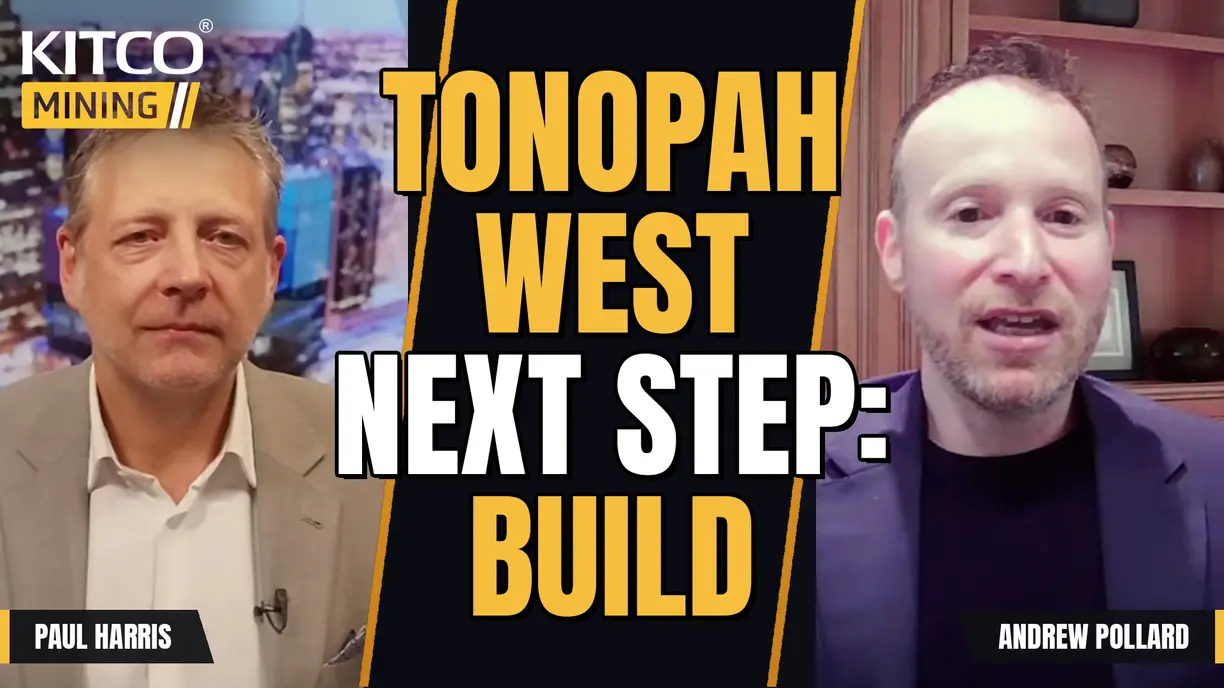
(Kitco News) - Blackrock Silver is aiming to take its Tonopah West silver-gold project in Nevada from PEA-stage economics to underground development by 2027, a transition President and CEO Andrew Pollard said will test the company’s high-grade model and its permitting advantage on private land.
The company’s 100%-owned Tonopah West project sits in Nevada’s Walker Lane, in a district that made its name on silver more than a century ago. For Blackrock, the next step is not another desk study. It is a commercial-grade exploration decline that would put the company underground and allow it to test the deposit before a full construction decision.
Pollard told Kitco Mining that Blackrock is targeting the decline for the third quarter of 2027.
The plan follows Blackrock’s March 2026 preliminary economic assessment, which outlined average annual production of 7.1 million ounces of silver equivalent over more than 11 years, with all-in sustaining costs of $7.44 per ounce and initial capital of $190 million. Blackrock filed the supporting NI 43-101 technical report in May and said there were no material differences from the March PEA disclosure.
The project is being advanced as a 1,800-ton-per-day underground operation. Pollard said the smaller-scale development plan is possible because of Tonopah West’s grade, which the PEA put at 454 grams per tonne silver equivalent.
“High-grade stories are all-weather,” Pollard said. “They work in any pricing environment.”
That grade is central to Blackrock’s pitch at a time when silver has been volatile. Speaking on June 30, Pollard said silver’s pullback had not changed the underlying case for the metal, pointing to structural deficits, industrial demand and silver’s role as a monetary metal alongside gold.
But the more immediate question for Blackrock is execution.
The planned decline would let the company access the deposit, test underground mining methods, collect geotechnical data, and compare mined material against the resource model. Pollard said it also would be larger than a typical test-mining program.
“This isn’t going to be your average test mine where we’re just going to do a 10,000-ton bulk sample,” Pollard said. “We’re going to be pulling out at minimum 50,000 tons of high-grade ore.”
The first test mining area is expected to average more than 400 grams per tonne of silver equivalent. Pollard said the material could give Blackrock the option to generate early revenue through offtake or toll-milling arrangements before the company decides whether to build its own mill and surface infrastructure. A feasibility study is targeted for 2029.
Tonopah West carries a long historical backstory, but Pollard said the point is simple: Blackrock believes the district stopped mining for financial and technical reasons, not because the veins were exhausted.
The project includes ground tied to the former Tonopah Extension Mining Company, which went bankrupt in 1930 after water-pumping issues, debt, and the onset of the Great Depression. Pollard said the historic Tonopah Silver District produced about 400 million silver-equivalent ounces over roughly 30 years.
“We’re picking up right from where the old-timers left off,” he said.
Blackrock first drilled Tonopah West in 2020. Since then, Pollard said the company has drilled about 5.5 kilometers of cohesive mineralization from the edge of the historic workings.
Permitting may be the factor that determines how quickly Blackrock can move. Tonopah West sits entirely on private patented claims, which Pollard said allow the company to avoid the federal NEPA process and work through county and Nevada state approvals.
“There’s no better setup you can have in the mining business than being on private land patented claims,” Pollard said.
Blackrock has received its air quality permit, the first of three key approvals required before it can break ground on the decline. The company is still working through its water pollution control permit, the longest-lead item because of hydrology and humidity-cell testing. Pollard said Blackrock expects to have the data needed for that submission by mid-to-late September, with a possible response from regulators by the end of the year.
The final approval would convert the company’s exploration permit into an exploitation permit tied to engineering designs for the decline.
The decline is expected to cost $20 million to $25 million USD, compared with the $190 million initial capital estimate in the PEA. Pollard said Blackrock had about $25 million in treasury at the end of the quarter ended April 30, with additional warrant proceeds received after quarter-end and more warrants expiring in January 2027.
The company is also looking at potential non-dilutive U.S. government funding. Pollard pointed to silver’s addition to the U.S. critical minerals list and said Tonopah West could help increase domestic silver supply if built.
Blackrock is also preparing for the internal shift from exploration to development. Pollard said the company has added operating experience to its board and is searching for a mine builder with narrow-vein, high-grade experience.
“At the end of the day, it always comes down to execution,” Pollard said. “Anytime a company goes from exploration to developer, obviously that’s a big turning point.”
While Blackrock is acting as though it will build Tonopah West, the project is advancing in a silver market where high-grade assets in stable jurisdictions are attracting attention. Pollard acknowledged that larger silver and gold producers are looking for projects in safer jurisdictions, but said Blackrock’s focus is to keep de-risking the asset.
The next catalysts are permits and drilling. Blackrock has a 17,000-meter program underway, including 800-meter step-outs to the northwest along multiple vein sets. The program is testing whether Tonopah West can grow beyond its current 123 million ounces of silver equivalent.
Drill hole 190, which Pollard said was drilled to more than 1,350 meters, is now in the lab. Results could arrive around the Precious Metals Summit in Beaver Creek in mid-September.
For now, the company’s clearest milestone is permitting. If Blackrock can secure the approvals needed to start the decline, Tonopah West would move from surface drilling toward underground development.
“Getting those permits in hand is going to be a huge re-rate for us,” Pollard said.
Watch the full video on the Kitco Mining YouTube channel.
This article/video was produced with support from a Kitco sponsor. The views expressed in this content do not necessarily reflect the views of Kitco Metals Inc. Kitco does not endorse or recommend any company, security, investment product, or investment strategy. This content is for informational purposes only and should not be considered investment advice.

Kitco Spotlight Editorial
Kitco Spotlight Editorial is sponsored content, articles and announcements paid for by our advertisers that support our journalism. Our sponsored messages are targeted and hand-curated, highlighting the best of what's happening in the mining sector.
