
According to Minneapolis Fed President Neel Kashkari, the Federal Reserve's inflation crusade may still not have restricted policy enough to bring down high prices. Speaking during an interview at Reuters in New York, the president of the Minneapolis Federal Reserve Bank suggested that interest rates are likely to stay where they are for an extended period. In his interview, he cited resilient housing inflation as an indication that the current policy of the Federal Reserve may not be restrictive enough. He believes that the strong housing demand suggests the neutral rate for the housing market may have risen since the pandemic.
According to Reuters, “Kashkari said in a note released on Tuesday that the housing market is surprisingly resilient in the face of tighter monetary policy, raising doubts about whether policymakers and the market are misjudging what the neutral rate may be in the near-term.”
In the note, Kashkari said, "My colleagues and I are of course very happy that the labor market has proven resilient, but, with inflation in the most recent quarter moving sideways, it raises questions about how restrictive policy really is… Perhaps that level of mortgage rates is not as contractionary for residential investment as it would have been absent these unique factors which are driving housing demand higher."
Besides Kashkari, market participants will look for clarity amongst the multiple Federal Reserve officials who have spoken or are speaking this week.
On Monday Richmond Fed President Thomas Barkin addressed the prospect of rate hikes, offering more assurances to market participants who are still hoping for rate cuts.
According to Yahoo Finance, “Williams, in fact, said at the Milken Institute Conference that ‘I think we'll have rate cuts’ while also emphasizing that ‘policy is in a very good place [now] and we have the time to collect more, so steady as she goes.’”
On Wednesday, Federal Reserve Governor Lisa Cook will deliver remarks, and on Friday, Chicago Fed President Austan Goolsbee will deliver remarks.
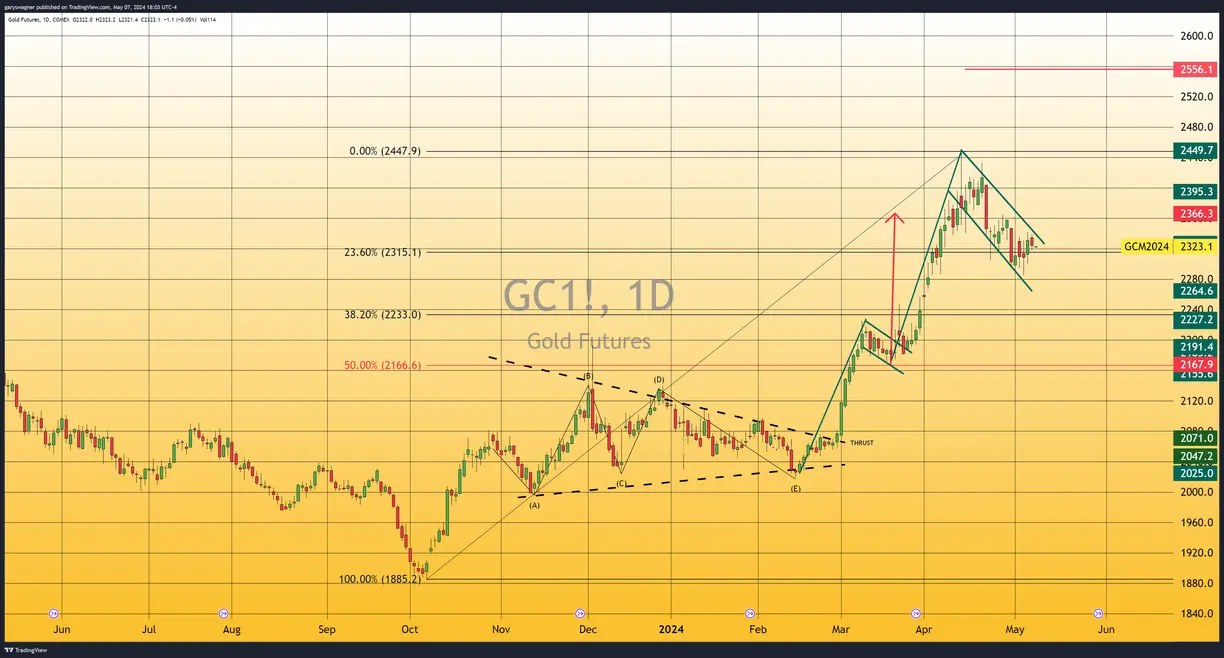
Federal Reserve statements along with dollar strength have resulted in today’s decline in gold pricing. The dollar is currently trading up 0.29%, taking the index to 105.26. As of 5:40 PM ET gold futures basis the most active June 2024 contract is trading lower by seven dollars, or 0.30%, and fixed at $2,324.20. Gold’s percentage decline is almost exactly the percentage gain of the dollar index. We can extrapolate that dollar strength was the primary force moving gold lower on the day.

For those who would like more information simply click on one of the links below:
Information, Track Record, Trading system, Testimonials, Free trial
Wishing you as always good trading,
