
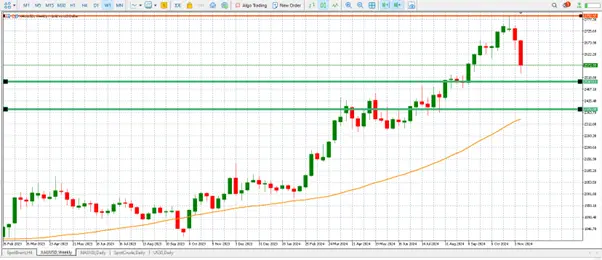
There has been substantial downward pressure on gold prices in the past few days as a result of a strengthened U.S. dollar and changing expectations regarding Federal Reserve monetary policy. On Friday, the precious metal is set to post its biggest weekly loss that we have not witnessed in several months. Traders and investors are concerned that the yellow metal could face even more challenging time in the coming period as the Fed is no rush to change its monetary policy anytime soon given the fresh economic readings. However, bargain hunters are looking at the situation from a different lens.
Market Dynamics and Recent Performance
After experiencing a five-session decline during which it lost over 4% for the week, spot gold edged up 0.1% to approximately $1,569.69 per ounce. Following a two-month low in the previous session, bullion has plummeted by over $220 from the record peak it reached last month. This trend was mirrored by U.S. gold futures, which increased by 0.1% to approximately $1,574.50.
The U.S. dollar has maintained its upward trajectory, supported by robust economic indicators and evolving monetary policy expectations. Gold prices are further pressured by a stronger dollar, which increases the cost of gold for holders of other currencies. Consequently, demand is reduced due to this.

Gold Price by XTB
The Influence of Economic Data on Federal Reserve Policy
Today, we had a mix bag in term of economic numbers. The US retail sales number which is widely considered as the most naked form of consumer confidence printed a much better reading as compared to the forecast; the actual number came in at 0.4% m/m while the forecast was for 0.3%. The bar was set lower as the previous reading printed the number of 0.8%. Further, bad news embedded in the Core retail sales m/m number where the reading fell short of expectatins and came in at 0.8% against the forecast of 0.3%.
The most recent reading of the U.S. Consumer Price Index (CPI) and Producer Price Index (PPI) is a significant factor that has influenced gold's recent performance. The Consumer Price Index (CPI), a critical indicator of inflation, exceeded expectations, suggesting that inflationary pressures continue to persist in the economy. The CPI reading exceeded expectations by increasing to 2.6%, as opposed to the anticipated 2.4%. In the same vein, the Producer Price Index (PPI) indicated an increase in inflation.
Gold is confronted with a double-edged sword when inflation exceeds expectations. One the one hand, gold is traditionally perceived as a hedge against inflation, which can increase its appeal. Conversely, persistent inflation may induce the Federal Reserve to postpone the reduction of interest rates or even contemplate additional tightening of monetary policy. This situation has the potential to exacerbate the U.S. dollar and elevate bond yields, both of which have a detrimental effect on gold prices.
Market Expectations and the Federal Reserve's Position
Jerome Powell, the Chair of the Federal Reserve, emphasised the necessity of exercising caution when reducing interest rates prematurely, citing the persistent inflation, robust job market, and consistent economic growth. The Federal Reserve's cautious stance implies that any rate reduction may be incremental and measured, with the objective of maintaining a balance between inflation control and economic growth.
Market expectations for a 25-basis-point rate cut in December have decreased to 59%, down from 83% a day earlier, according to the CME Fed Watch Tool. This change suggests that investors are revising their expectations in accordance with the most recent inflation data and the Federal Reserve's communication. A stronger dollar is bolstered by the lower number of anticipated rate cuts, as foreign investment is typically attracted to higher interest rates in search of superior returns.
The Opportunity Cost of Investing in Gold
The opportunity cost of retaining non-yielding assets such as gold increases as interest rates rise. Investors may favour interest-bearing assets, such as bonds, over gold when interest rates increase. This transition may result in diminished demand for gold, which could subsequently result in decreased prices.
Possible Future Scenarios
Although the stronger dollar and the anticipation of fewer rate cuts have had an impact on gold, there are several factors that could potentially affect its trajectory in the coming months:
1. Economic Uncertainty: Gold's allure as a safe-haven asset may be bolstered by global economic uncertainties, such as trade disputes and geopolitical tensions. Investors may seek refuge in gold in the event that uncertainties intensify.
2. Inflation Trends: The Federal Reserve may be under increased pressure to modify its policy if inflation continues to exceed expectations. Gold could ultimately benefit from persistent inflation if it surpasses interest rate increases.
3. Federal Reserve Communications: The upcoming speeches and statements of Federal Reserve officials, including Chair Jerome Powell, will be closely monitored. Gold prices could be substantially affected by any indications of a change in monetary policy.
4. Dollar Movements: The demand for gold could be increased if the U.S. dollar begins to deteriorate as a result of domestic or international factors.
Conclusion
The gold price is currently operating in a multifaceted environment that is influenced by a robust U.S. dollar, stronger-than-anticipated inflation data, and changing expectations regarding Federal Reserve policy. Although inflation remains a concern, the Federal Reserve's cautious approach to lowering interest rates may maintain the dollar's strength for an extended period, thereby exerting downward pressure on gold. This is supported by the most recent CPI and PPI readings.
Nevertheless, gold's capacity to serve as a hedge against inflation and economic uncertainty suggests that it may continue to receive support in the event of a shift in market conditions. The gold market presents both challenges and opportunities, as adjustments in economic indicators or policy decisions could rapidly alter the landscape. Consequently, investors should remain vigilant.