

The gold market experienced significant turbulence recently, with prices dropping approximately $50 following the release of the November Producer Price Index (PPI) report. This sudden movement highlights the complex interplay between economic indicators, market sentiment, and commodity pricing.
The US Bureau of Labor Statistics' latest report revealed wholesale costs rising by 0.4% from October, exceeding market expectations of a 0.2% increase. Interestingly, the core PPI, which strips out food, energy, and trade services, showed a more modest 0.1% increase, down from October's 0.3% and below consensus estimates.
Traditionally, higher wholesale costs could signal potential inflationary pressures, typically a bullish indicator for gold. As a time-honored safe-haven asset, gold has long been viewed as a hedge against inflation, theoretically becoming more attractive when economic uncertainty looms. However, the market's reaction defied this conventional wisdom, suggesting more nuanced factors at play.
The current market dynamics appear to be driven more by trader behavior than fundamental economic shifts. After a remarkable four-day rally that saw gold futures climb $97—rising from $2,655 to $2,753.80—the market seemed primed for a profit-taking correction. By 4 PM ET, the most active February gold contract had retreated to $2,705.10, down $48.80 from its recent peak.
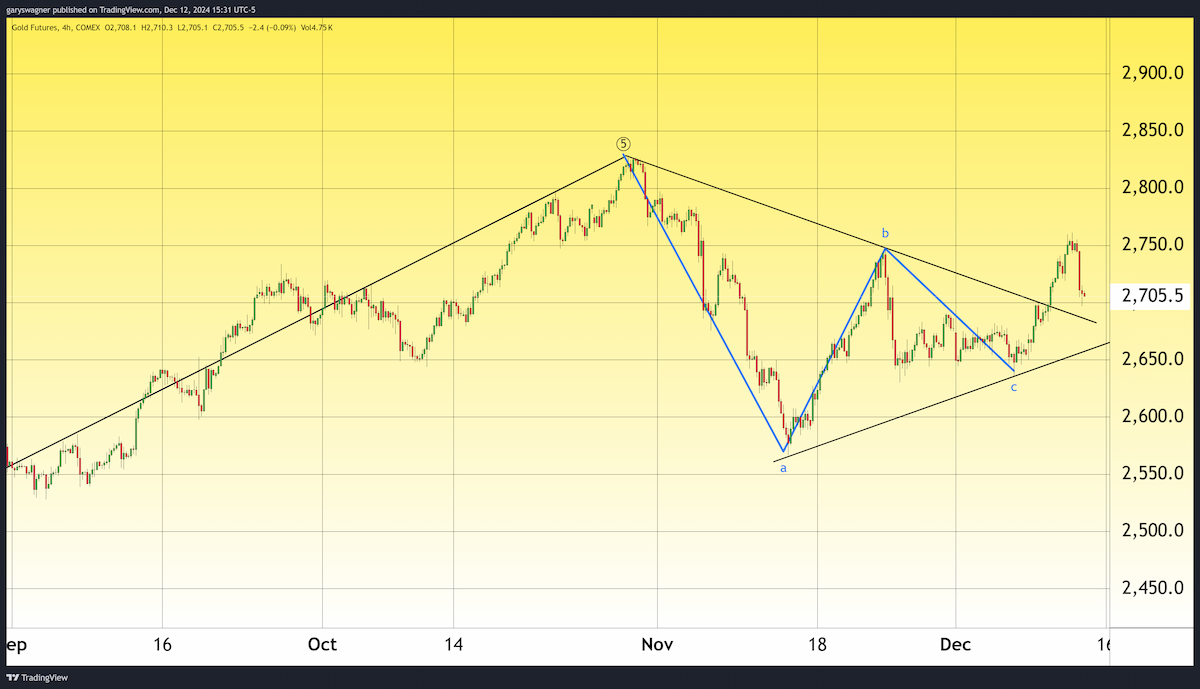
The daily gold chart reveals a triangle pattern forming since gold's October highs near $2,800. While the current pullback might appear concerning, market analysts suggest that as long as prices remain above the triangle's upper resistance line, the underlying trend remains intact.
Crucially, the broader economic context remains supportive of gold. The Federal Reserve is widely expected to announce its third interest rate cut at the upcoming December 18 FOMC meeting, potentially lowering interest rates by a full percentage point. Such monetary policy typically creates a favorable environment for gold investments.
The $2,700 per troy ounce level is emerging as a critical support point. Market observers believe this psychological and technical threshold could prevent further significant downside movement. While the recent price slam might unsettle some investors, it appears more like a healthy market correction than a fundamental shift in gold's attractive investment narrative.
For those who want more information on our premium service, please click the link Premium Service
Wishing you, as always good trading,
