

Gold prices reached unprecedented heights following President Trump's announcement of sweeping tariff revisions, reflecting immediate market response to a policy that promises to reshape America's trade relationships and consumer costs.
The precious metal climbed to a record $3,201.60 per ounce in aftermarket trading based on the June futures contract. By early evening, gold had settled at $3,190.60, representing a substantial single-day gain of $41.80. Notably, the final hour of trading coinciding with Trump's speech triggered an additional $20 surge beyond the day's earlier $20 increase.
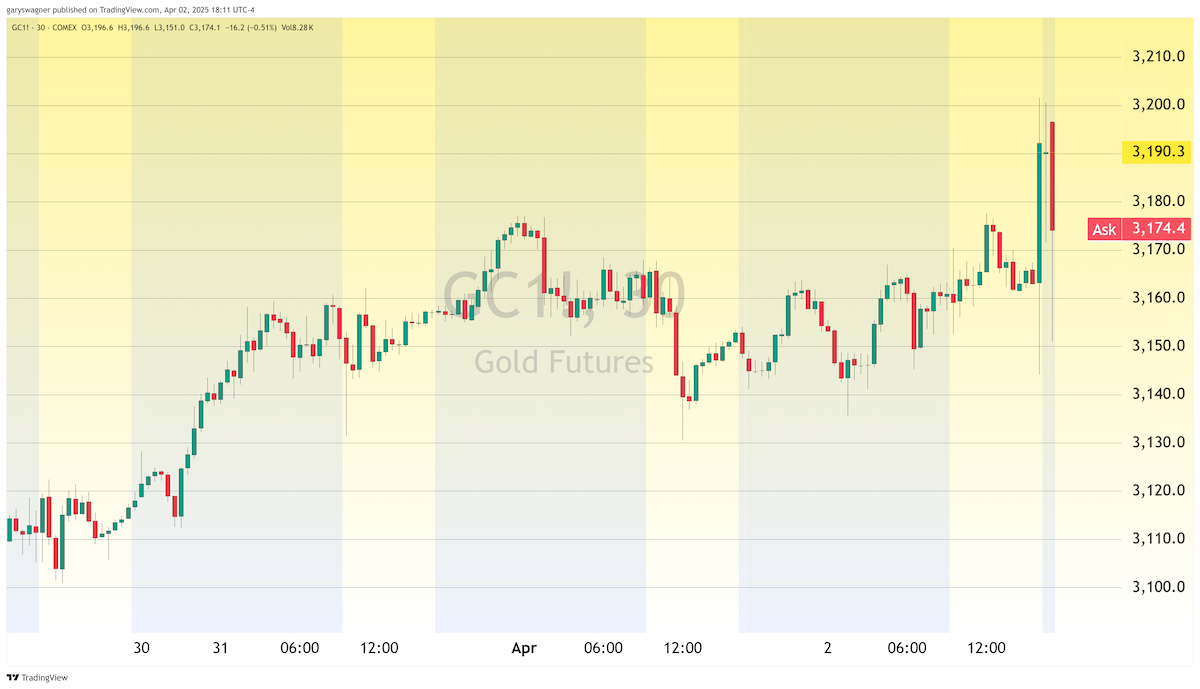
However, once gold trading opened in Australia at 6:00 PM ET, profit taking took back approximately $16.90 of the price increases during the trading session in the United States, currently June gold is fixed at $3173.60.
This impressive rally stemmed from aggressive investor buying combined with a weakening U.S. dollar, which fell 0.56% to 103.335 on the dollar index. Gold's ongoing strength has developed from what analysts describe as a "perfect storm" of supportive factors, including global geopolitical tensions, economic uncertainty, and continued accumulation by central banks worldwide.
Trump's tariff announcement significantly amplified market momentum by introducing a comprehensive restructuring of import duties. The new policy establishes a 10% baseline tariff on all imported goods regardless of origin. Additional targeted rates will apply to nations with trade surpluses against the United States: China faces a 34% tariff, Japan 24%, Vietnam 46%, and European Union countries 20%. Furthermore, all foreign-manufactured automobiles will incur an additional 25% tariff. The administration indicated these measures would take effect immediately.
The announcement sent aftermarket equity trading into disarray. Major index ETFs reflected widespread concern, with the S&P 500 ETF declining 2.47%, the Dow Jones Industrial Average ETF falling 1.37%, and the NASDAQ-tracking Invesco QQQ ETF dropping 3.45%.
Economists believe that consumers will likely bear higher costs for imported goods across multiple sectors as these tariffs reshape supply chains and pricing structures. The timing of this policy shift aligns with other economic indicators causing market uncertainty, including disappointing manufacturing data and modest employment figures from earlier in the week.
Investors are now carefully assessing the potential inflationary impact of these tariffs while awaiting Friday's nonfarm payroll report, which could provide crucial insight into the Federal Reserve's upcoming monetary policy decisions.
For those who want additional information on our premium service, Click Here,
Wishing you, as always good trading,
