
In the world of investing, three distinct styles of trading dominate: active trading (ex., timing the markets), passive investing (ex., buy-and-hold investing), and asset revesting (ex., tactical position management). Each has its own logic, approach, emotional response, and result. But as history shows time and again, only one of these paths consistently protects your hard-earned capital and gives you the ability to grow wealth without being at the mercy of market chaos.
Understanding the implications of each, especially during volatile periods, is crucial for investors aiming to protect and grow their wealth. Let's break down the dangers, behaviors, and long-term projections of each and show why tactical technical strategies like Asset Revesting offer a smarter, safer, and more empowering way to invest.
Timing The Markets: "This Has to Be the Bottom… Right?"
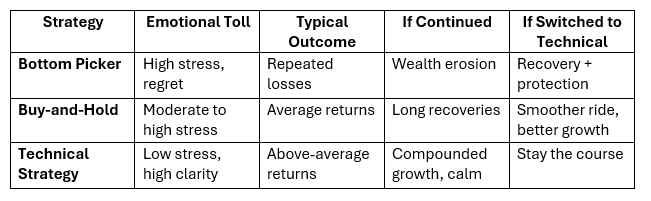
Bottom pickers, for example, try to time market reversals by "buying the dip," believing they're entering at rock-bottom prices. The idea seems seductive: buy low, sell high. But more often than not, bottom picking becomes bottom guessing — and the cost is staggering.
The Emotional Rollercoaster:
Fear when the market keeps dropping after they buy.
Hope as they convince themselves it will bounce back.
Desperation when losses grow and they freeze, unsure whether to sell or double down.
Shame and regret when they realize they've been trying to catch a falling knife.
Real-World Consequences:
Portfolio drawdowns of 30%, 40%, and even 60% are common.
Capital destruction makes recovery extremely hard. A 50% loss requires a 100% gain to break even.
Lost confidence as investors exit at the worst possible time — locking in losses.
If They Don't Change:
They'll remain stuck in a boom-bust cycle, chasing bottoms, constantly fighting uphill battles to recover. Their wealth shrinks, and emotionally, investing becomes painful and discouraging. Is this you?
The Buy-and-Hold Investor: "I'm In It for the Long Run"
Buy-and-hold investors ride out every wave. They buy broad market indexes or quality stocks and hold through thick and thin, trusting markets to recover over time.
The Emotional Drain:
Anxiety during market crashes as account values plummet.
Frustration during long sideways markets where little to no growth happens.
FOMO when other strategies seem to outperform in short bursts.
Resignation as they accept the market will "eventually" recover — even if it takes years.
Long-Term Risks:
Endure bear markets and corrections with no protection.
Time becomes the biggest variable. Many investors can't emotionally (or financially) afford to wait 5–10 years to recover losses.
Risk retiring at the wrong time — right after a major market drop, locking in losses forever.
If They Don't Change:
They'll likely achieve average returns with above-average stress. The strategy works mathematically, but emotionally and practically, many investors bail out before the benefits materialize — especially after watching their portfolios drop 30–50%. Is this you?
The Technical Strategy Follower: "Protect First, Grow Second"
Strategies like Asset Revesting are based on reading the market's behavior using price, volume, and trend indicators. This tactical approach doesn't predict tops or bottoms or blindly hold through crashes. Instead, it dynamically adjusts, moving to defensive assets or cash during danger zones and re-entering only when conditions are favorable.
The Emotional Experience:
Confidence from knowing risk is actively managed.
Calm from avoiding steep drawdowns during bear markets.
Discipline replacing emotion-driven decisions.
Empowerment because the strategy adapts to what the market is doing, not what someone hopes it will do.
Real-World Benefits:
Smaller drawdowns mean faster recoveries and less emotional damage.
More consistent growth, without the deep valleys of traditional approaches.
Cash isn't seen as dead weight — it's a protective asset that buys opportunity later.
If They Stick With It:
They'll avoid major bear market pain, grow wealth steadily, and maintain peace of mind. Over time, compounding consistent gains with minimal drawdowns outperforms both bottom pickers and most buy-and-hold portfolios — especially when the next bear market inevitably hits. Or is this you?
Projecting the Future: Choose Your Path
If you answered yes to either of the top two strategies, consider the following strategic adjustments:
Market Timers: Shifting to a more disciplined strategy, such as asset revesting, can mitigate emotional decision-making and enhance capital preservation.
Buy-and-Hold Investors: Incorporating tactical adjustments based on technical analysis may improve risk management without abandoning the core long-term perspective.
The Bottom Line
You can't grow your wealth if you're constantly repairing damage. And you can't stay confident in your plan if every market pop or drop sends your emotions spiraling.
Timing the markets is gambling. Buy-and-hold is passive faith. Tactical technical revesting is intelligent action.
If you want to not only survive the market but thrive in it — through all conditions — then it's time to prioritize capital protection over blind growth. Wealth builds faster when it's not constantly being repaired.
👉 Change your strategy. Change your future. Click Here.
