
(Kitco Commentary) - Gold prices tumbled Monday as landmark trade agreements between the United States and two major trading partners—China and the United Kingdom—significantly strengthened the US dollar and altered the economic landscape for investors.
The June 2025 gold futures contract plunged 2.62% ($87.30), settling at $3,241.80 per troy ounce as markets processed the implications of these substantial trade policy shifts. This decline represents a 50% correction from gold's April 22 peak of $3,509.90, with analysts now eyeing potential support between $3,176.50 (the 61.8% Fibonacci retracement level) and $3,157.70 (the 50-day moving average).

The primary catalyst for gold's retreat was the breakthrough in US-China trade relations following Saturday's negotiations in Geneva. Treasury Secretary Scott Bessent characterized these talks as "very productive," setting the stage for a dramatic reduction in reciprocal tariffs beginning Wednesday. The United States will slash tariffs on most Chinese imports from 145% to 30% (maintaining higher rates on steel, aluminum, and automobiles), while China will reduce duties on American goods from 125% to 10%.
This 90-day tariff reduction truce should lead to permanent implementation, marking a significant de-escalation in the trade war between the world's two largest economies. Economists anticipate this will reduce inflationary pressures on consumer goods while boosting export opportunities for American manufacturers and agricultural producers.
Simultaneously, the newly announced US-UK trade agreement provides American exporters increased access to British markets, with the White House projecting "$5 billion worth of opportunities for U.S. farmers and producers." While some details remain under development, the agreement maintains a baseline 10% tariff with special provisions for automobile imports.
Agricultural sectors stand to benefit substantially. According to ProAg, the approved provider of Federal crop and livestock insurance, "The agreement includes more than $700 [million] in ethanol exports and $250 million in other agricultural products." Secretary of Agriculture Brooke Rollins emphasized that the deal "will exponentially increase beef exports" beyond the 1,970 metric tons (valued at approximately $32 million) that the US Meat Export Federation reported exporting to the UK last year.
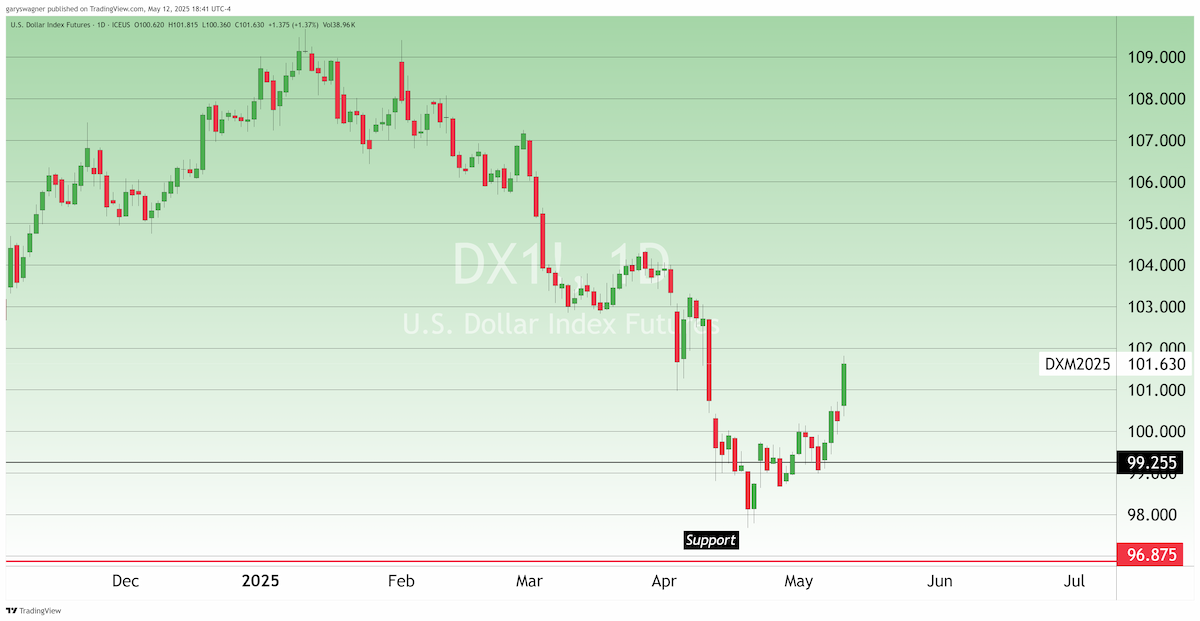
The immediate market response has been a strengthening US dollar, with the dollar index climbing 1.37% to 111.63. Approximately half of gold's price decline today is the direct result of dollar strength. Because gold is paired against the US dollar there is defined correlation between dollar strength and weakness the price of gold. Market participants actively selling gold futures provided the other half of today’s strong price decline.
For the broader economy, these trade agreements signal reduced transaction costs and expanded market access, potentially boosting GDP growth while easing inflationary pressures. Lower import tariffs should reduce prices on consumer goods, while expanded export opportunities could stimulate domestic manufacturing and agricultural production.
However, gold investors face a more complex outlook. While economic growth typically supports commodity prices, gold's traditional role as an inflation hedge and safe-haven asset becomes less attractive in an environment of reduced trade tensions. These agreements should lead to economic growth and stability, which will also serve to maintain or reduce the current levels of inflation. Sustained economic stability and controlled inflation may continue to pressure gold prices lower despite its recent multi-year bull run.
As implementation begins Wednesday, markets will closely monitor these policy changes for their impact on economic indicators, inflation rates, and central bank positioning—all critical factors in determining gold's price trajectory through the remainder of 2025.
For those who wish to learn more about our service, please go to the links below:
Information, Track Record, Trading system, Testimonials, Free trial
Wishing you as always good trading,
