
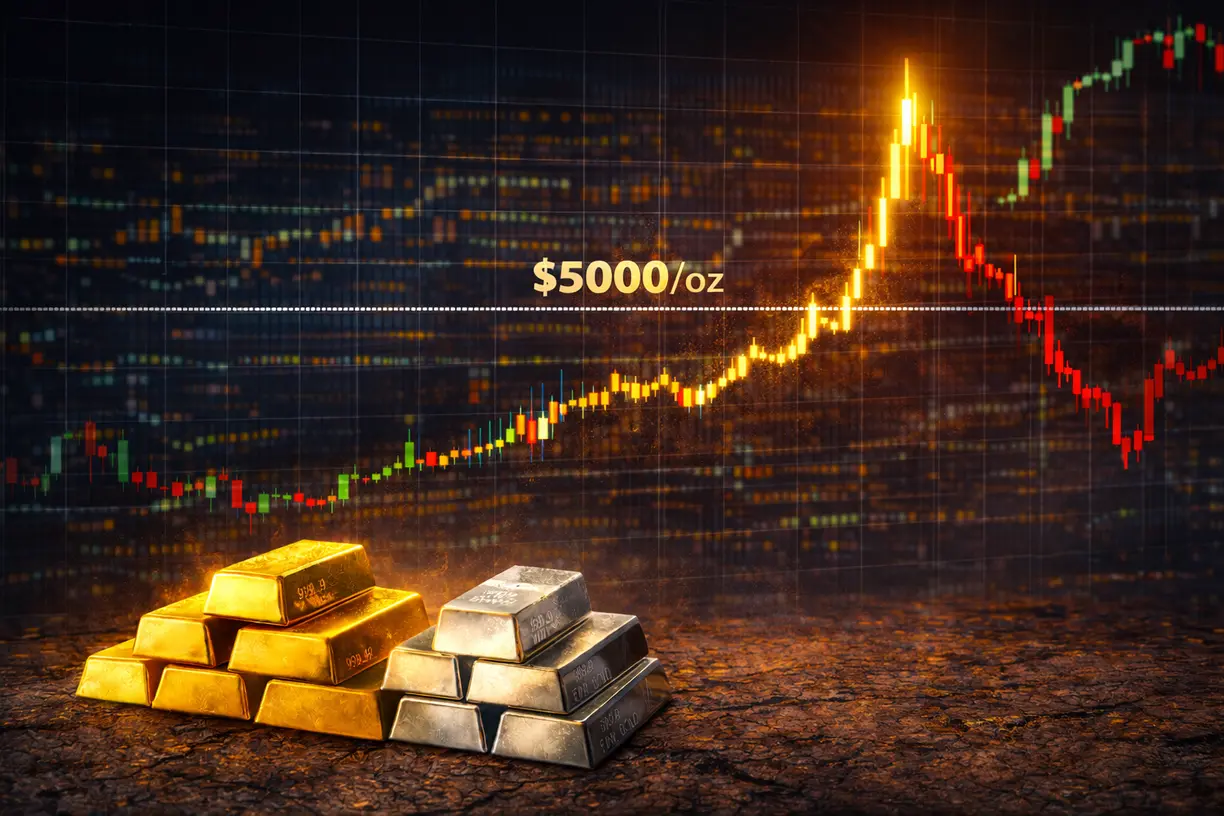
Following an unsustainable parabolic spike to the upside, Gold Futures plunged as much as 8% during overseas trading into month-end on Friday, testing the recently cleared $5000/oz level.
March Silver experienced an even more dramatic collapse following its own parabolic rise, suffering a 20% intraday collapse from Thursday's peak of over $120/oz down to $95 in what traders described as a "capitulation event". The crash represents the most severe single-day decline in 13-years for both precious metals.
This sudden reversal came mere hours after both metals tested all-time highs for the umpteenth time. The gold price had moved above $5600 and silver reached $120.45 by Thursday.
While each precious metal has recovered slightly from their intraday lows as I type this missive, gold is around $5150 and silver is hovering just above the psychological $100 level, the volatility remains extremely elevated.
After Donald Trump was sworn in as the 47th president of the United States 12-months ago, the gold price had doubled, while the silver price had quadrupled heading into the FOMC monetary policy meeting on Wednesday.
Although the Federal Reserve left interest rates unchanged, as expected, President Trump said he is weighing options against Iran that include targeted strikes on security forces and leaders to inspire protesters, multiple sources said, even as Israeli and Arab officials said air power alone would not topple the clerical rulers.
Although both gold and silver prices have likely reached an intermediate-term peak, safe-haven buying is set to continue following a healthy consolidation of recent outsized gains as the dollar is set to intentionally being devalued further by the Trump administration.
Following the announcement of the U.S. consumer confidence index plunging to its lowest level since 2014 on Tuesday, the world's reserve currency suffered its biggest one-day drop since last April’s tariff shock.
“All five components of the Index deteriorated, driving the overall Index to its lowest level since May 2014 (82.2) — surpassing its Covid-19 pandemic depths,” Dana Peterson, chief economist at The Conference Board, said in a release. “References to prices and inflation, oil and gas prices, and food and grocery prices remained elevated.”
President Trump dismissed concerns about the dollar’s slide, as it hovered near the lowest levels since 2022. “I think it’s great,” Trump told reporters in Iowa on Tuesday when asked if he was worried about the world reserve currency’s drop.
“I think the value of the dollar — look at the business we’re doing. The dollar’s doing great.” The president said he was happy for the dollar to “just seek its own level.” The market immediately heard this as permission to sell, pushing the greenback down to a 4-year low.
Trump understands that for the U.S. to bring back manufacturing, the world's largest economy needs to devalue the dollar. A weaker currency supports exports, eases financial conditions, and reduces the real burden of record government debt.
Therefore, dollar weakness is not a problem to be solved - it is a necessary plan to be tolerated when devaluation aligns with policy objectives.
Pre-Fedspeak on Wednesday, where soon to be lame-duck Fed Chair Jerome Powell was answering questions regarding Fed independence and dismissing sharply rising precious metals prices, U.S. Treasury Secretary Scott Bessent told the media that his country maintains its strong dollar policy, which boosted the greenback.
Powell reiterated the Fed left interest rates unchanged and signaled it was in no rush to cut them at upcoming meetings. Nevertheless, the USDX quickly resumed its decline to 4-year lows and gold hit fresh new highs.
The U.S. has always championed a lower dollar to reduce the trade deficit, which is what the Plaza Accord and G5 were all about nearly 40 years ago. Just ahead of the October 1987 U.S. stock market crash, the G5 officially stated that they wanted the U.S. dollar down by 40%.
Market historian and incredibly accurate economic forecaster Martin Armstong stated on his private blog this week: "The 1987 Crash was caused by a second meeting, the Louvre Accord, where they officially stated that the dollar had fallen far enough. When the dollar hit new lows, it showed the world that central banks could NOT control currencies, leading to the presumption that the dollar would fall another 40%. Wholesale liquidation began, leading to the 1987 Stock Market Crash."
The U.S. dollar has been in relative free fall since last Friday after it emerged that the New York Federal Reserve had conducted a rare “rate check” with currency traders on the dollar/Japanese yen exchange rate.
After the U.S. indicated that it could coordinate with Japanese officials an intervention in the Forex markets to support the falling Yen, the USDX sank to critical 4-year support at 96 just ahead of the FOMC policy meeting conclusion on Wednesday.
The last coordinated intervention to strengthen the Yen was in 2011, following the infamous catastrophic tsunami. There is no force majeure this time, just analyst implications that the Bank of Japan has lost control of the Japanese bond market.
The accumulation of tariff threats by the Trump Administration and Fed independence coming into question has dealt a severe blow to the U.S. Dollar, while the central bank's caving on inflation has cemented the precious metal’s position as the ultimate safe-haven, forcing Wall Street to stop demonizing the metal as a "barbarous relic" of the past.
President Trump being willing to do anything and everything it takes to influence the Fed to begin aggressively easing monetary policy, with the result being inflation remaining well above the central bank's fantasy 2% target, gained more credence this morning.
On Friday, President Trump said he had picked former Federal Reserve governor Kevin Warsh as the next head of the Federal Reserve, when Chair Jerome Powell steps down in May.
Trump confirmed Warsh’s nomination to lead the central bank on Truth Social, writing that he had “known Kevin for a long period of time, and [had] no doubt that he will go down as one of the GREAT Fed Chairmen [sic], maybe the best.”
Being deemed by analysts as a Trump “Yes Man,” Warsh has been critical of Powell’s wait-and-see approach, writing in a Wall Street Journal op-ed late last year that the Fed should “discard its forecast of stagflation in the next couple of years, as if subpar growth and inflation 40% above target is the best that can be done.”
In recent months, Warsh has aligned himself with the president by publicly advocating for lower interest rates, a shift from his long-held reputation as an inflation hawk.
Yet, the FOMC could drop rates below zero but it would not erase the trillions in deficits or offset reckless spending, while the government has no intention of paying down its massive $39 trillion debt pile that continues to add $1 trillion every 80 days.
Roughly $9–10 trillion of U.S. Treasury debt will mature in 2026, forcing markets, not policymakers, to decide what long-dated capital is worth in a country running persistent primary deficits with no political appetite for restraint from either side of the aisle.
Inflation will rise even further when the money supply expands beyond productive output. Politicians have lost all discipline because government continually votes to raise budgets and prolong a problem the Fed is powerless to stop.
The debt crisis has been rapidly snowballing in magnitude, with those in power having zero intention of stopping it from destroying the dollar’s purchasing power further.
Following the U.S. government shutdown in Q4 2025, what began to shift is not the existence of debt but how it is considered. Capital is no longer free, duration is no longer ignored, and credibility is no longer assumed. None of this is sudden, or even radical. It is simply arithmetic reasserting itself after decades of being deferred.
After deciding to research how the financial system functions over twenty years ago, I discovered that the system was living on borrowed time - financially, politically, and institutionally.
The sharply rising gold price could be telling us that 2026 may be the year when the bill comes due, while global investors simultaneously decide they need hard assets as a hedge against an obvious dollar destructive policy choice.
A weaker dollar drives more gold and silver buying, as more gold and silver buying validates the dollar diversification trade. Therefore, central banks are set to continue piling in with record purchases, and now private investors are following with Wall Street's blessing.
After spending years of mostly telling clients silver was too industrial to be considered "precious," and holding gold "paid no interest," Bank of America has a $170 silver price target, while Citi just upgraded their short-term forecast to $150 from $100. In October, BofA raised its gold forecast to $5000, then raised it to $6000 coming into the new year.
The explosive moves in the precious metals complex we are experiencing is not merely just another bull market rally. Gold blowing through $5000/oz and silver clearing $100/oz so quickly represents a fundamental breakdown in confidence in the world monetary system that has been building since the 2008 financial crisis.
The extraordinary rise in both precious metals is the marketplace screaming that the global sovereign debt spiral has reached terminal velocity intermixed with increasing geopolitical turmoil, while generalist investment institutions and retail investors have only recently returned the precious metals mining space after leaving en masse in 2012.
Their recent return to this tiny sector is evidenced by several important benchmark precious metals sector ratio trades set to break out above significant 12-year resistance levels from long-term accumulative bases.
Specifically, the GDX/Gold ratio, GDX/SPX ratio, Gold/SPX ratio, and the TSX-Venture Exchange ($CDNX) appear set to break out to 12-year high's, following the Silver/SPX ratio having already done so last month.
However, the miners had been showing signs of readiness to begin consolidating recent outsized gains this month by underperforming both gold and silver’s sharp price rises. Silver was up 70% in January alone, while the miners were barely participating.
The lagging miner action was setting the stage for some healthy profit-taking to begin from technically extreme overbought levels before a breakout to the upside can commence.
If this continues into next week, investors who have been on the sidelines watching the explosive moves higher in quality juniors and waiting for a “gentlemen’s entry” before jumping on board, the chance to do so may not last long.
After JMJ painstakingly accumulated and recommended positions in high quality gold, silver, and copper related juniors heading into 2025, the recent price action is why being right and sitting tight is the best course of action following a confirmed significant breakout in this tiny sector. Trimming large positions along the way, while holding core positions until the bull market matures, has been recommended.
The JMJ newsletter is a one-stop shop for precious metals stock speculators, maintaining a high net-worth real money portfolio. The service is completely transparent, which assists in teaching its members how to carefully construct and maintain a successful junior resource stock portfolio.
Subscribers are provided a carefully thought-out rationale for buying individual stocks, as well as an equally calculated exit strategy. Although the 500 subscriber limit has recently been reached, click here to be placed on the Waiting List.
