

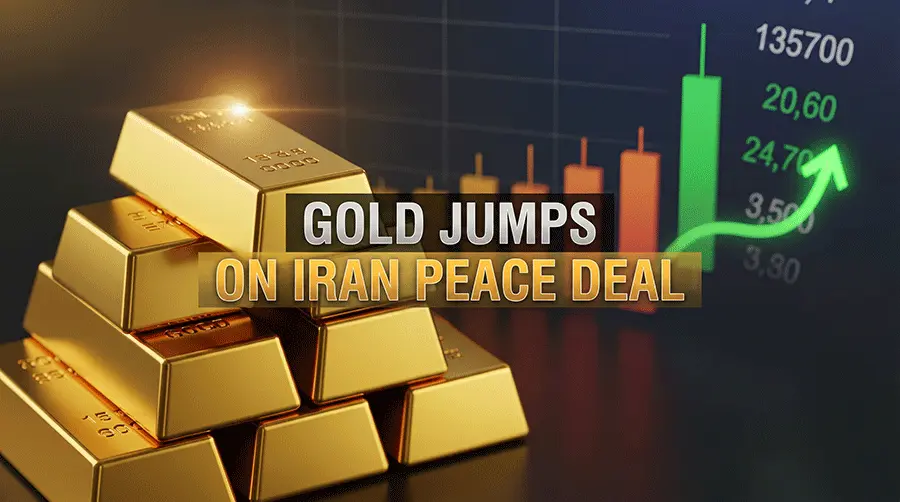
Gold futures gapped higher on the open Monday after President Trump announced at a press conference ahead of the G7 summit that a peace deal with Iran had been finalized. "The deal's all signed," Trump told reporters, adding that the Strait of Hormuz would be fully open by Friday. The most active gold futures contract rose $91, or 2.15%, to settle at $4,331 — a move driven primarily by the geopolitical development.
The announcement triggered sharp moves across multiple asset classes. Crude oil fell steeply, dropping 4.87% to close at $80.75 per barrel, as traders priced in resumed Strait of Hormuz traffic and an easing of Middle East supply concerns. The U.S. Dollar Index edged lower by 0.13%, settling at 99.68.
While gold's traditional role as a safe-haven asset might suggest it would decline on positive geopolitical news, Monday's rally reflects the complex relationship between peace developments and dollar dynamics. A softer dollar tends to support gold prices, and with the greenback slipping on reduced safe-haven demand, bullion found room to move higher alongside the risk-on sentiment in broader markets.
Traders will be watching Friday's scheduled Strait of Hormuz opening closely. If confirmed, it could further pressure crude while leaving gold to trade on dollar and macro signals heading into the remainder of the G7 summit.
Several scheduled events in the days ahead have the potential to move gold and related markets significantly. Participants should monitor the following closely:
U.S. Producer Price Index (PPI) data is due before the open. A softer-than-expected reading would likely reinforce Federal Reserve rate cut expectations, providing a tailwind for gold. Conversely, a hot print could revive inflation concerns and push the dollar higher, potentially capping bullion's gains. Fed speakers are also scheduled throughout the day; any commentary referencing the Iran deal or energy price disinflation could move markets.
The Federal Open Market Committee (FOMC) meeting minutes from the most recent session are released at 2:00 p.m. ET. Markets will parse the language carefully for signals on the pace of any future rate reductions. Gold tends to react sharply to FOMC minutes; dovish language would be constructive for bullion, while a more cautious tone on inflation could weigh on prices. Weekly crude oil inventory data from the EIA is also due Wednesday morning, which may further influence oil's direction following Monday's sharp decline.
The most geopolitically significant event of the week is the expected full reopening of the Strait of Hormuz, as indicated by President Trump. Roughly 20% of the world's oil supply passes through the strait, and confirmation of unrestricted passage would likely extend crude oil's selloff. For gold, the effect is more nuanced: if the reopening proceeds smoothly and risk appetite remains elevated, the dollar could firm modestly on reduced safe-haven flows, creating a potential headwind. However, any complications or delays in the reopening — or fresh geopolitical tensions — could spark a quick reversal higher in both gold and crude volatility.
The G7 summit continues through the week, and additional headlines around trade policy, sanctions relief for Iran, or coordinated economic statements could move markets with little warning. Gold historically benefits from uncertainty around multilateral diplomatic meetings, and traders should be prepared for headline-driven volatility at any point during market hours.
The path of least resistance for gold in the near term will be shaped by the interplay between a potentially weaker dollar, declining energy prices feeding into disinflation, and any residual geopolitical premium tied to the Iran situation. A confirmed, durable peace deal and smooth Hormuz reopening would test gold's ability to hold the $4,300 level. Failure to hold that support on follow-through dollar strength could open a move back toward $4,250. On the upside, any diplomatic setback or unexpected macro data surprise could quickly push prices back toward and above $4,400.
For those that would like more information about our services click here.
Wishing you as always good trading,
