
Strengths
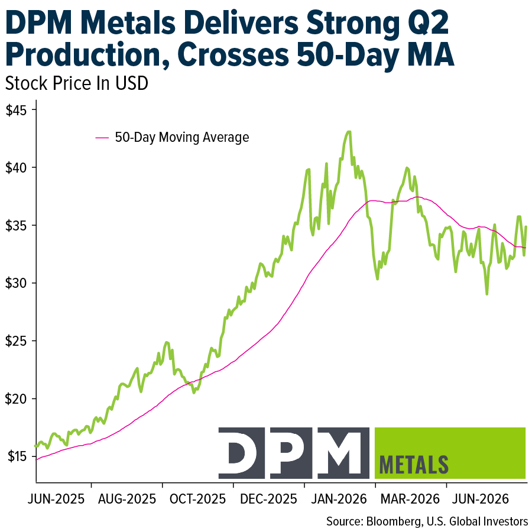
- The best-performing precious metal for its second consecutive weekly gain was palladium, up 0.63%. The gains may reflect short covering following its steep decline that began in February or potentially reduced Russian exports. According to Canaccord, DPM Metals’ gold production exceeded its estimate by 31%, primarily due to stronger-than-expected performance at Vares, where the planned plant shutdown was completed in seven days versus the scheduled 20 days. Production also benefited from a strong quarter at Ada Tepe following its final production blast in April.
- Central bank gold buying accelerated in May, with purchases reaching 41 tons, the highest monthly total since November 2025, according to World Gold Council data. Poland led buying activity with 18 tons, extending its purchase streak and bringing year-to-date purchases to 64 tons. China added 10 tons, its largest monthly increase since December 2024, raising its gold reserves to 2,331 tons. Uzbekistan and Kazakhstan also remained notable buyers, adding 9 tons and 7 tons, respectively.
- India's restrictions on silver imports are creating shortages in the world's largest silver market, according to Reuters, pushing premiums to their highest levels in six months despite weaker-than-usual demand. Silver premiums over official domestic prices surged to $6.50 per ounce this week, or more than 10% above benchmark prices, according to dealers interviewed by Reuters. The increase followed a sharp decline in silver imports, which fell to 46.8 tons in May from 534.3 tons a year earlier, with one dealer suggesting June imports declined even further. India's silver restrictions are part of a broader strategy to ease pressure on foreign exchange reserves and support the rupee following the Iran oil shock.
Weaknesses
- The worst-performing precious metal for the week was silver, down 1.46%, as the 2-year Treasury yield climbed 7 basis points. However, softer U.S. labor market data and more dovish comments from Fed Governor Warsh created strategic diversification demand tailwinds. According to BMO, the largest weekly gold ETF outflows since 2018 suggest that speculative institutional and retail investors continue to rotate out of gold amid improving sentiment toward AI and growth sectors.
- De Beers has implemented some of the deepest cuts ever to its official diamond prices, potentially signaling the end of its years-long effort to keep prices well above market levels, according to Bloomberg.
- Torex Gold Resources declined 14% this week after reporting headline gold-equivalent production of 96.3K ounces, which was 10% below NBF’s estimate and 9% below consensus expectations. The shortfall reflected lower-than-expected grades. While NBF anticipated grades would remain low in Q2 at levels similar to Q1 based on the company’s planned mine sequencing, actual results came in below estimates. Management maintained its 2026 guidance and continues to expect grades to improve during the second half of the year.
Opportunities
- Genesis has submitted a definitive scrip and cash offer to acquire Vault Minerals for a headline value of A$5.6 billion. The offer represents a 14.5% premium to Regis Resources’ May scrip bid based on the last closing price. The potential Vault-Regis Resources combined company would have pro forma gold production of 600,000 to 700,000 ounces, lower milling costs, and a combined market capitalization of A$12.5 billion.
- Hong Kong’s pension fund will reportedly be able to invest in additional gold exchange-traded funds as part of the government’s initiative to position the city as a global gold trading hub, according to the South China Morning Post, citing an unidentified source familiar with the matter.
- Mineros increased its full-year 2026 consolidated gold production guidance to 220,000 to 240,000 ounces, up from its previous estimate of 213,000 to 233,000 ounces. The revised guidance reflects sustained metallurgical outperformance and throughput improvements at its Hemco Property in Nicaragua, according to Bloomberg.
Threats
- Silver substitution risk: China’s largest solar manufacturer, Longi Green Energy Technology Co., has begun producing solar cells that use copper instead of silver in response to surging silver prices. Its Shaanxi facility is now operational, marking an important step toward large-scale adoption of the company’s next-generation cell technology. The shift reflects broader efforts across the solar industry to reduce costs through alternative materials, with the sector accounting for approximately 17% of global silver demand.
- Substitution between platinum and palladium also plays a role, with the choice between the two metals largely driven by economics. Morgan Stanley noted that original equipment manufacturers (OEMs) typically require six to 12 months to change formulations. Adjustments in catalyst metal composition apply to both existing vehicle models and new models within that timeframe. For context, China’s palladium consumption has declined by 434K ounces since 2022 to 1.4 million ounces in 2025, while platinum consumption has increased by 275K ounces to 683K ounces over the same period.
- A wave of profit-taking in the gold market has brought a three-year bull run to an end, but there is limited evidence that investors are establishing large-scale short positions in anticipation of further declines. Investors have withdrawn nearly $18 billion from gold exchange-traded funds tracked by Bloomberg since prices peaked at all-time highs near $5,600 per ounce in January.
