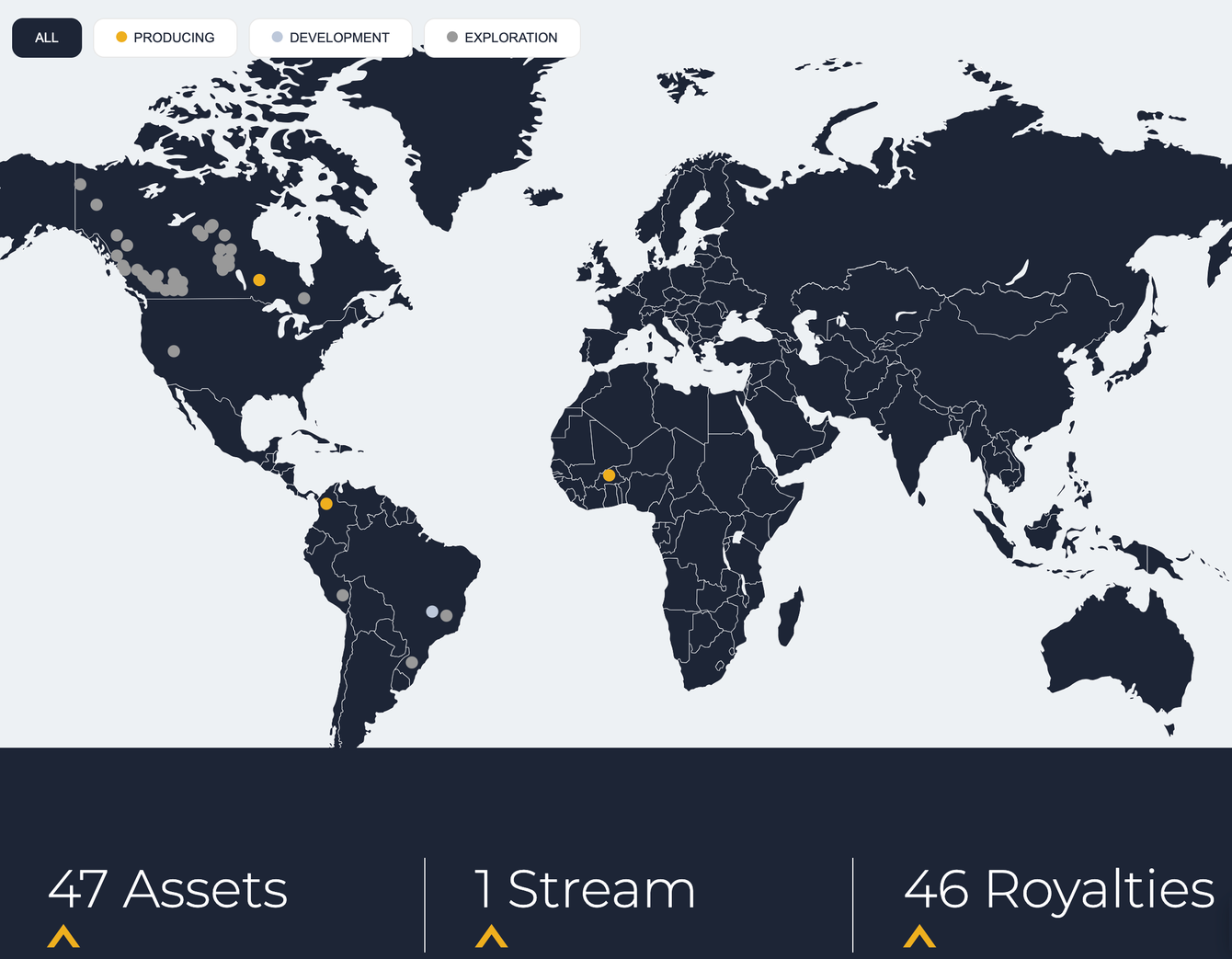
- In less than a year, Summit built a portfolio of 47 royalties through a small number of disciplined transactions.
- More than half of the value of the portfolio is already producing or close to it, giving clear visibility on revenue growth without operating the mines.
- A clean structure with raised capital largely without warrants, no debt, and meaningful insider ownership has helped attract long-term investors, even as the company trades below established royalty peers.
Royalty companies tend to take time to mature. Portfolios are assembled deal by deal. Cash flow usually comes later. Credibility is earned slowly.
Summit Royalties Ltd. (TSXV: SUM | OTCQB: SUMMF) has compressed that timeline into less than a year.
In early 2025, the company had no assets and little capital. Today it holds 47 royalties and streams, with exposure to producing and expanding gold and silver projects across multiple jurisdictions. For investors, that speed is part of the appeal. But it’s not the whole story.
What’s drawing attention is how Summit has grown, what it owns, and why the structure is resonating in a market that is rewarding discipline over speculation.
“We have passive, non-dilutive interests in mining properties that require no ongoing costs once acquired,” CEO Drew Clark said in a recent interview.
“When those assets go into production or expand, we receive top-line revenue.”
That single sentence captures Summit’s model and its appeal. The company is not a miner. It doesn’t build mines, operate equipment, or absorb cost overruns. Instead, it finances royalties and streams on projects run by other operators and collects a share of revenue or metal production when those projects perform.
In practical terms, it’s a way to gain exposure to rising gold and silver prices while sidestepping many of the risks that have challenged mining companies over the past several years.
“It’s a diversified way to participate in precious metals prices without operating costs, capex overruns, or concentration risk,” Clark said.
From zero to 47 royalties
Summit’s growth was built through a small number of carefully structured transactions with credible counterparties.
"In early 2025 we had five thousand dollars in the bank and no assets," Clark said. "Today we have exposure to cash-flowing assets and are publicly traded."
Summit’s first major step was acquiring a royalty portfolio from IAMGOLD. That was followed by a reverse takeover of Eagle Royalties, which added the bulk of Summit’s royalty count, including its interest in the large AurMac gold project in the Yukon. The final piece was the acquisition of a producing royalty on the Madsen mine in Ontario, purchased from Sprott.
“In three transactions, we went from zero to forty-seven royalties,” Clark said.
Equally important for investors was how those deals were financed. Summit raised capital without warrants, creating a tight share structure and avoiding the overhangs that often weigh on junior resource stocks.
"We raised our main financings without warrants, and our key share issuances were structured as free-trading shares," Clark noted. "That's helped us build a strong shareholder base."
Cash flow now, growth ahead
A common critique of young royalty companies is that they promise future optionality but deliver little near-term revenue. Summit’s portfolio looks different.
Roughly 55% of the company’s net asset value is tied to producing assets or projects with a committed path to production, giving investors visibility into current and near-term cash flow.
That cash flow is anchored by Madsen, where Summit holds a 1% Net Smelter Return (NSR) royalty on the project. Madsen, operated by West Red Lake Gold declared commercial production in January 2026 and is ramping toward steady-state output, making it a cornerstone asset in a Tier-1 jurisdiction.
Alongside Madsen is Bomboré in Burkina Faso, operated by Orezone, where Summit holds a 50% silver stream. Bomboré is already producing and is in the middle of a hard-rock expansion that is expected to lift output meaningfully. As silver production increases, Summit’s revenue grows alongside it, without any exposure to capital or operating costs.
Zancudo, an underground gold-silver mine in Colombia operated by Denarius Metals, adds further diversification. Summit holds a 0.5% NSR royalty on the project, which is currently in ramp-up mode as a new mill is installed to increase throughput and improve recoveries later in 2026.
Looking ahead, Pitangui in Brazil provides the next layer of growth. Operated by Jaguar Mining, Pitangui is expected to start constructing in 2026 and move into production in 2027. Summit’s royalty structure is particularly attractive here with an $80-per-ounce gold royalty for the first 250,000 ounces, followed by a 1.5% NSR thereafter. That structure delivers high-margin exposure early in the mine’s life, when ounces tend to be most valuable.
“Next year we’ll have one asset ramping up, one starting production, and another expanding,” Clark said.
Beyond its producing and near-term assets, Summit also holds meaningful exposure to development-stage projects that could re-rate as they advance.
For Summit, the appeal is straightforward. If the project grows, advances, or moves toward production, Summit benefits without spending a dollar on drilling or construction.
Protection in an inflationary mining market
Cost inflation has been one of the defining challenges for miners in recent years. Summit’s model largely sidesteps that issue.
“From a cost inflation standpoint, there is no cost other than running the business,” Clark said. “Those costs are minimal relative to revenue.”
That doesn’t mean royalties are immune to operational issues. When a mine slows down, royalty revenue slows too. But the exposure is linear and transparent.
“When the mine produces more, we get more. When it produces less, we get less,” Clark said.
For investors, that clarity is often preferable to the binary risks associated with mine construction, permitting, or capital overruns.
Leverage to the metals cycle
Summit also offers direct leverage to rising metal prices. Higher gold and silver prices generally translate to increased revenue for the company.
“For every 10% increase in gold prices, we see a corresponding increase in revenue,” Clark said.
But the upside doesn’t stop there. Higher prices are improving the financial health of Summit’s operating partners, allowing them to drill more aggressively and accelerate development plans.
“It’s not just price participation,” Clark explained. “Higher prices mean operators are drilling more, expanding faster, and pushing projects forward. Our operators have raised more than C$300M since we first started the business and are aggressively expanding their operations and exploration budgets”
In one case, a project that previously operated a single drill rig is now running four. For a royalty holder, that translates into potential resource growth and longer mine life, without additional capital investment.
Why investors are paying attention
Despite how quickly it has grown, Summit’s shares are still priced lower than many established royalty companies when investors compare overall value and revenue.
“The market is still underestimating how much of our portfolio is already online or being built,” Clark said.
That gap is part of the attraction for investors who believe the company’s execution will eventually be reflected in its valuation.
“We’re seeing steady institutional buy-in rather than quick spikes and give-backs,” Clark added.
Insider alignment is another factor. Management and directors collectively own about 15% of the company, a high level for a royalty company at this stage.
“The team has executed more than two billion dollars of transactions over the past decade,” Clark said.
Where Summit is heading
By the end of 2026, Summit expects multiple catalysts to have played out across its portfolio, including production ramps, expansions, and updated economic studies.
“Every one of those assets has meaningful catalysts embedded in it,” Clark said.
Rather than chasing promotional growth, Summit’s strategy is to let the portfolio do the heavy lifting while continuing to add accretive royalties where they make sense on a per-share basis.
“We evaluate everything in the context of net asset value per share,” Clark said. “Every transaction has to grow the business on a per-share basis.”
For investors, that discipline, combined with real cash flow and visible growth, is what’s making Summit Royalties stand out in a crowded precious metals landscape.
About Summit Royalties Ltd.
Summit Royalties is a precious metals streaming and royalty company focused on disciplined growth. Their foundation is strong – anchored by royalties that generate steady cash flow today – while their upside is driven by exploration potential and strategic acquisitions. With a disciplined acquisition strategy, Summit is positioned to continue scaling rapidly, where each transaction unlocks outsized opportunities to grow production, expand cash flow, and create lasting value for shareholders.
To learn more about Summit Royalties, visit their website here. For the latest updates, follow the company on LinkedIn and X.

Market One
Market One is a collaborative content marketing, strategy and creation agency with a stable of award winning journalists and videographers focused on providing robust solutions for Canada's capital markets.
