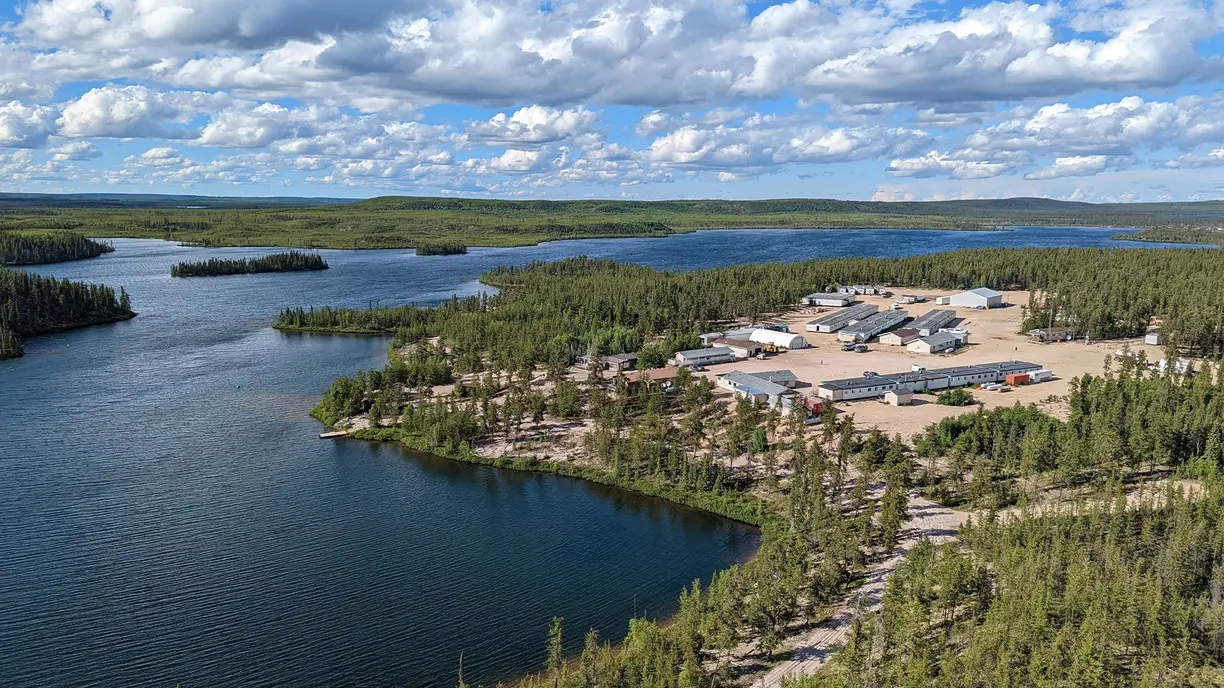
Big Bear Camp near Davidson River, located in the Southwest Athabasca Uranium District of northern Saskatchewan, is Standard Uranium’s flagship asset.
Disseminated on Behalf of: Standard Uranium Ltd.
Key Takeaways
- Standard Uranium returns to drill its flagship Davidson River project this summer for the first time since 2022, with a robust drill program already permitted and ready to launch.
- The company sits directly across a fold structure from NexGen's Arrow deposit and Paladin's Triple R deposit, which together host hundreds of millions of pounds of high-grade uranium roughly 25 kilometres away.
- Through a project-generator model spanning 10 projects and more than 232,864 acres in the Athabasca Basin, Standard Uranium is running three drill programs in 2026 at a market capitalization of roughly $14 million.
Uranium is in the middle of a structural reset. Demand from new and restarted reactors, small modular reactor build-outs, and the electricity needs of AI data centres is colliding with a supply base that has run below consumption for more than a decade. Utilities have papered over the gap by drawing down stockpiles, but those stockpiles are finite.
A new round of long-term utility contracting is now underway, and Western buyers are increasingly unwilling to lean on Russia and Kazakhstan for fuel. That leaves Canada, and specifically Saskatchewan's Athabasca Basin, as the most strategically important uranium district in the world.
That is where Standard Uranium Ltd. (TSXV: STND | OTCQB: STTDF | FSE: 9SU0) now finds itself.
The Vancouver-based junior controls 10 projects spanning over 232,864 acres across the Athabasca Basin, anchored by the Davidson River project in the Southwest Athabasca Uranium District. Davidson River sits across the street from NexGen's Arrow deposit, which received its final federal construction licence in March 2026 and is moving toward becoming the largest development-stage uranium project in Canada. A project-generator model funds exploration on the rest of the portfolio with partner capital, while management focuses Standard's own dollars on Davidson River.
This year is set up to be the company's busiest in years, with three drill programs across three projects and a long-anticipated return to the flagship.
"It's going to be a transformative year for us," said Sean Hillacre, President and VP of Exploration at Standard Uranium. "Look around the market and try to find another company of our size doing three different drill programs on three different projects."
The mirror image of Arrow
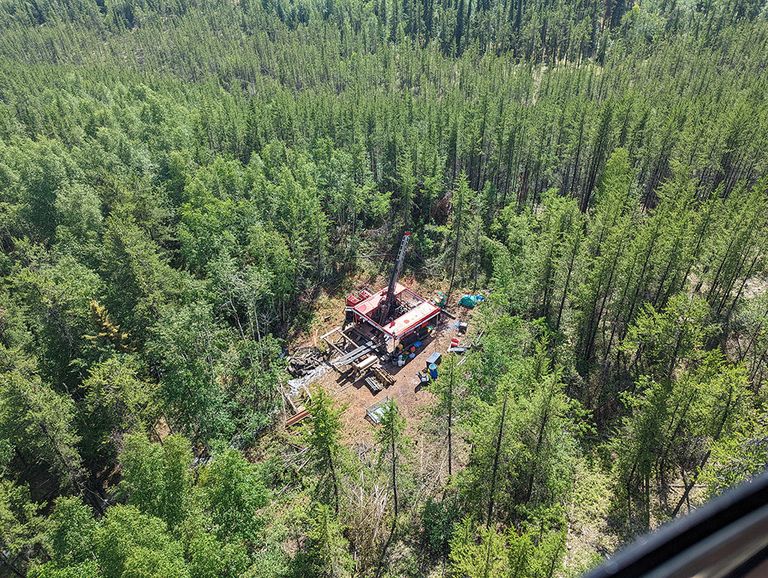
Drilling at Davidson River to begin this summer.
Davidson River is not an area play; it is a geological one.
Standard Uranium's 30,737-hectare Davidson River Project sits on the western side of a fold structure from NexGen's Arrow and Paladin's Triple R, two of the most important high-grade uranium discoveries of the past 15 years. The same conductive rock packages that host hundreds of millions of pounds of uranium, roughly 25 kilometres east, continue, mirrored, into Standard's ground.
That matters because Athabasca uranium deposits are blind. They sit beneath younger cover sequences and only reveal themselves through geophysics, drilling, and pattern recognition. The further you can demonstrate that the right ingredients are in place, the more credible the case for a discovery becomes.
"We're surrounded by billion-dollar companies," Hillacre said. "Cameco, NexGen, Denison, Paladin — they're all our neighbours. And then there's us, right in the hot spot of all that excitement."
Earlier drill programs from 2020 to 2022 confirmed that the same rocks and structural trends extend into Standard's land. What has been missing, until now, is the resolution to know exactly where to point the drill.
"We're surrounded by billion-dollar companies. And then there's us, right in the hot spot of all that excitement." — Sean Hillacre, President and VP of Exploration, Standard Uranium Ltd. |
Four years of targeting work, about to be tested
Standard Uranium last drilled Davidson River in 2022. The intervening years were not idle.
The company became the first uranium explorer in the Athabasca Basin to apply ALS GoldSpot's machine-learning targeting platform, training the algorithms against the geophysical signatures directly over Arrow and Triple R, then scanning Davidson River for matching anomalies. The output was a prospectivity heat map that both validated previous target areas and surfaced new ones.
It also became the first company to deploy Fleet Space Technologies' multiphysics surveys on the western side of the basin, combining two types of passive seismic with ground gravity to image the basement rocks beneath the cover sequence.
The reason that combination matters is specific. Arrow was found because an electromagnetic conductor, the "plumbing system" along which uranium-bearing fluids travel, coincided with a gravity low marking the clay alteration that high-temperature uranium fluids leave behind. Davidson River had the conductors mapped. The gravity signal, masked by overburden, had not.
"This unlocked the density lows and gave us the layers of data we needed to generate Arrow-style targets," Hillacre said. The result, he added, "significantly upgrades our targets and shows us where we want to go for the first time in 2026, four years since we last drilled."
New targets across the Warrior, Bronco, and Thunderbird conductor corridors will be tested during the summer drill program. Permits are in hand, exploration agreements with the Clearwater River Dene Nation are signed, and vendors are retained.
The project-generator engine
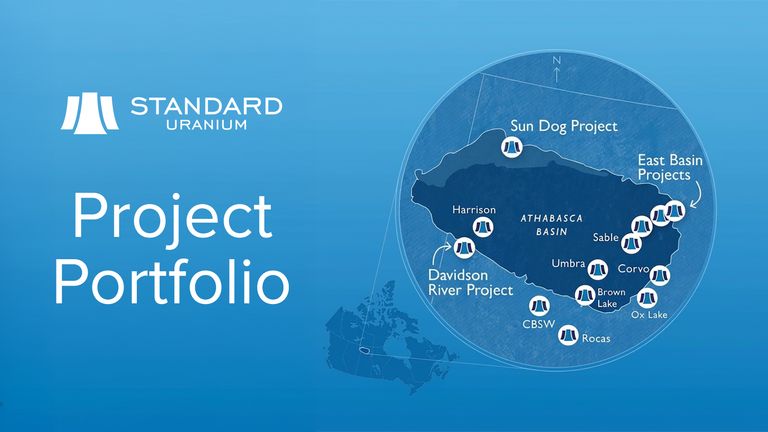
Standard Uranium’s project portfolio covers 219,327 acres across the Athabasca Basin in 55 mineral claims.
While Davidson River drives the discovery thesis, the rest of the portfolio earns its keep without diluting shareholders.
Standard Uranium options non-core projects to other junior explorers under structured agreements: the partner funds exploration over a defined period to earn up to a 75% stake, while Standard retains operatorship and converts partner flow-through dollars into hard cash through operator fees. The company keeps geological upside on every project while generating revenue that most juniors at this stage do not have.
"All of the money we raise—or 90% of it—is focused on Davidson River," Hillacre said. The project-generator side, he added, "allows us to advance our other projects through partner funding while retaining upside on discovery."
The model is currently in motion at two projects. Corvo, optioned to Aventis Energy Inc. under a three-year earn-in agreement, wrapped its inaugural drill program in March. Ten holes intersected anomalous radioactivity in seven of them: a 23-metre composite of elevated radioactivity across the Manhattan, Brooklyn, and Tribeca target areas, with assays pending.
A successful maiden drill program at the Rocas project in the southeast Athabasca Basin was just completed, also under the project-generator model with Collective Metals Inc. Multiple intervals of anomalous radioactivity exceeding 300 counts per second were intersected in three of the four holes, totalling 1.5 metres of composite radioactivity, and assays are pending. Both programs are funded by partner capital.
For a junior with a market capitalization of roughly $14 million, putting drill bits in the ground at three different projects in a single year is unusual. Doing it without leaning entirely on equity issuance is rarer still.
Hello from South Point Camp. Standard Uranium President and VP Exploration, Sean Hillacre, checks in from the very first drill program ever at the Rocas project. Stay tuned for more updates from camp. $STND $STND.V $STTDF
Watch here : https://t.co/XfR5raFJQz— Standard Uranium (@StandardUranium) April 9, 2026
What investors are watching
Uranium remains a binary commodity in the eyes of generalist investors, but Hillacre argues the asymmetry cuts both ways.
"All it takes is one or two drill holes, and you're 10 to 20x," he said. "The torque you can get as an investor on a uranium company is exceptional compared to other commodities."
Standard's threshold for a discovery hole is straightforward: anything intersecting more than 1% uranium oxide qualifies as high grade in the Athabasca, and historically, that is the kind of result that triggers a re-rating in this sector.
At a roughly $14 million market cap, the company trades at a meaningful discount to peers with comparable land positions in the basin. Management's view is that the gap closes one of two ways: a discovery hole at Davidson River, or sustained progress across the partner-funded portfolio that forces the market to price the optionality.
Either path runs through 2026.
The macro setup is doing its part. Long-term contracting is rebuilding, Western utilities are reorienting their supply chains away from Russia and Kazakhstan, and Saskatchewan is emerging as the most strategically important uranium-producing jurisdiction outside Asia. NexGen's Arrow received its final federal construction licence in March, with construction set to begin this summer. Denison's Phoenix project received its own federal approval in February and broke ground in March, on track to become the first in-situ recovery uranium mine in the Athabasca Basin. The neighbourhood is being revalued.
Standard Uranium owns the postcode next door. This spring, after four years away, it gets to test what's underneath.
About Standard Uranium
Standard Uranium Ltd. (TSXV: STND | OTCQB: STTDF | FSE: 9SU0) is a uranium exploration company and emerging project generator poised for discovery in one of the world’s premier uranium districts. The company holds interest in over 240,670 acres (97,395 hectares) in the Athabasca Basin in Saskatchewan, Canada. Since its establishment, Standard Uranium has focused on the identification, acquisition, and exploration of Athabasca-style uranium targets with a view to discovery and future development.
To learn more about Standard Uranium, visit its website. For the latest updates, follow Standard Uranium online: LinkedIn, X, and Facebook.
The scientific and technical information contained within this article has been reviewed and approved by Sean Hillacre, P.Geo., Standard Uranium Ltd.’s President and VP of Exploration, who is a Qualified Person, as defined under the terms in National Instrument 43-101.

Market One
Market One is a collaborative content marketing, strategy and creation agency with a stable of award winning journalists and videographers focused on providing robust solutions for Canada's capital markets.
