
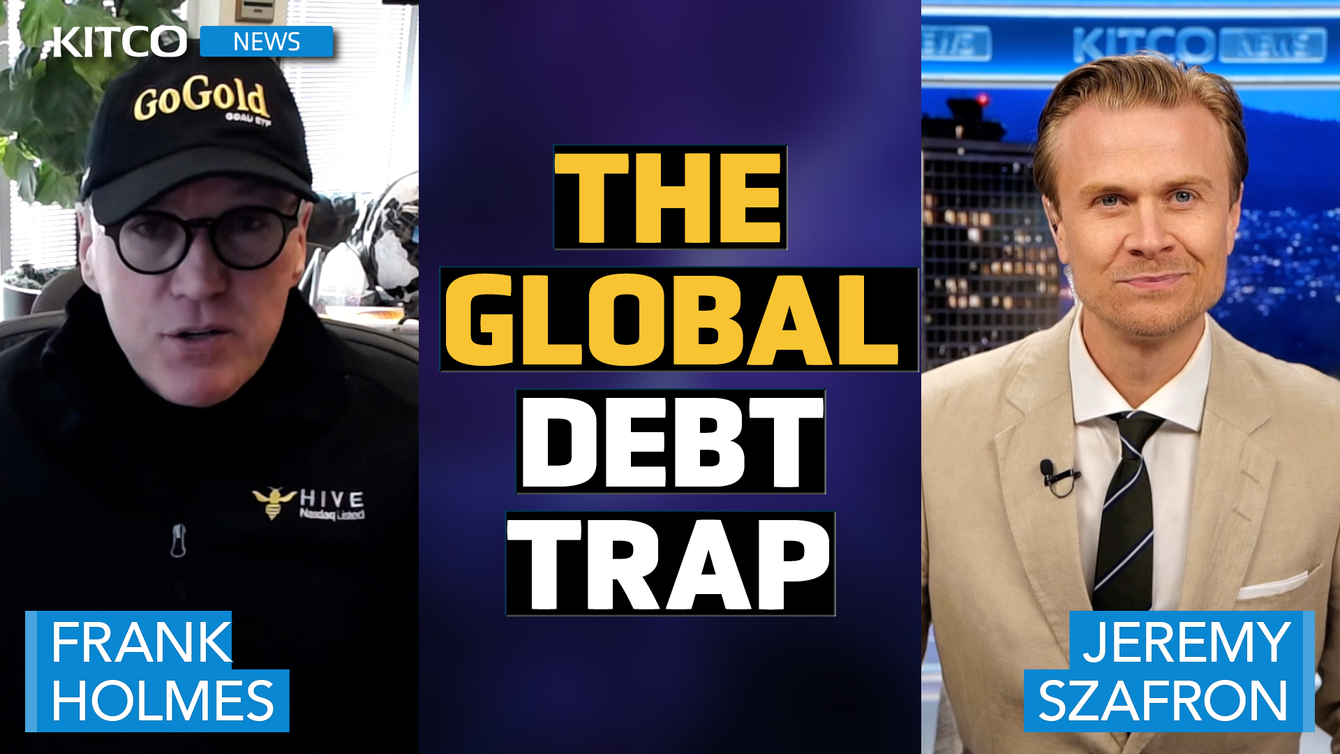
(Kitco News) Frank Holmes said the next phase of the gold cycle may be driven less by price and more by where capital can move efficiently, as liquidity, geopolitics, and infrastructure reshape investor behavior across mining and digital assets.
Speaking with Kitco News on February 24, 2026, Holmes, the CEO and chief investment officer of U.S. Global Investors and executive chairman of HIVE Digital Technologies, said a record $350 trillion global debt load and rising security-driven spending are reinforcing demand for scarce assets. But he argued the more immediate shift is structural, with capital concentrating in U.S. markets and setting up a new wave of consolidation across the mining sector.
Debt, Security and the Case for Hard Assets
Holmes framed the current macro environment as a shift away from globalization and toward national security and domestic investment. “Trade is a subset of national security,” he said.
He said a growing share of global spending is now tied to defense, infrastructure, and energy security rather than trade expansion, reducing the likelihood that governments will reverse monetary expansion.
“The money printing is not going away,” he said. “Tangible real assets are really important, and we've not seen any major copper mines come onstream for four decades.” Holmes noted that the backdrop continues to support demand for scarce assets, including gold and copper, particularly as supply constraints persist.
Dollar Pressure and Central Bank Demand
Holmes pointed to rising geopolitical competition as another driver of gold demand, particularly from central banks.
He said China’s expansion of trade influence through initiatives such as One Belt One Road, along with coordination among BRICS nations, is contributing to reducing reliance on the U.S. dollar in global trade. In response, he said central banks are increasingly turning to gold as a neutral reserve asset.
Holmes believes gold remains undervalued relative to global debt and money supply, framing that view as a long-term valuation framework rather than a near-term price forecast.
In late February, gold was holding around the $5,100 to $5,200 range ahead of major geopolitical escalation. Following the outbreak of the Iran conflict on Feb. 28, prices initially surged before pulling back toward $5,000 an ounce by mid-March.
Liquidity Shift and the ‘Pacman’ M&A Cycle
Holmes said the most immediate impact of this environment is visible in capital markets, where liquidity is becoming a defining factor. “The lowest cost of capital is at public companies where there’s the most liquidity,” he said.
He argued that U.S. exchanges are increasingly attracting mining issuers due to deeper capital pools and stronger price discovery, while Canada and the U.K. face structural constraints tied to regulation and capital formation. Holmes pointed to Newmont’s voluntary delisting from the Toronto Stock Exchange in September 2025 as an example.
“I think we’re going to see that Pacman happen,” he said.
He said juniors and developers trading at discounted valuations relative to their resource base could become acquisition targets for mid-tier and senior producers seeking to replace reserves. Rather than building new mines in a slow permitting environment, Holmes said producers may increasingly look to acquire existing assets.
Holmes also said gold equities are beginning to reflect stronger operating performance, pointing to improving revenue and cash flow trends even as broader investor participation remains limited. He added that gold-related ETF allocations, which declined sharply over the past decade, are only beginning to recover.
Bitcoin, AI Infrastructure, and Mispriced Assets
Holmes also pointed to a parallel opportunity in digital infrastructure, arguing that Bitcoin miners may be undervalued relative to their role in the AI buildout. “The cheapest data centers are Bitcoin miners,” he said.
He said mining operations already control power, land, and basic infrastructure, allowing for faster conversion into AI-ready facilities compared to building new capacity from scratch.
On February 24, AMD and Meta announced an expanded strategic partnership to deploy large-scale AI infrastructure, highlighting the scale of demand for compute and energy. Holmes said the primary constraint is execution rather than demand. “It’s really hard to get the technologies necessary,” he said, pointing to long lead times for cooling systems and power infrastructure.
Holmes was more cautious on Bitcoin’s near-term outlook, describing the recent drawdown as influenced by structural and geopolitical factors. By mid-March, Bitcoin had rebounded above $70,000 after a sharp earlier decline.
“I think we’re witnessing against the financial integrity of the American dollar and Bitcoin ecosystem,” he said.
He maintained that both gold and Bitcoin serve as alternative assets, but said gold remains the more stable expression of monetary risk in the current environment.
Silver and Policy-Driven Demand
Holmes said silver is also seeing a shift in its demand profile, driven by industrial and defense-related uses. He linked that shift to U.S. policy developments in late 2025. On Nov. 6, 2025, the U.S. Geological Survey published its final list of critical minerals, which includes silver, highlighting its importance to industrial and technological supply chains.
“That’s probably healthy that’s taking place,” he said, referring to recent volatility following a sharp move in silver prices.
A Capital Cycle Driven by Scarcity and Access
Holmes said capital is rotating toward assets tied to scarcity, infrastructure, and liquidity, including gold, select mining equities, and energy-linked digital infrastructure.
He said the shift also favors jurisdictions where capital can move efficiently and at scale, reinforcing the role of U.S. markets in the current cycle.
In that environment, Holmes said the next phase for mining may be driven less by discovery and more by consolidation, capital access, and structural demand.
Watch the full video on the Kitco News YouTube channel.
This content is sponsored by Swan Bitcoin. Start your Bitcoin journey today at Swan.com/Kitco.