
Introduction
Gold prices are pushing toward new highs today as market participants react to key U.S. economic data and rising geopolitical tensions. The ADP Non-Farm Employment Change report released today came in well below expectations, with a significant miss that has fueled speculation about the Fed's next steps. This weak employment data has strengthened the narrative of an impending rate cut by the Federal Reserve, providing support for gold. With growing doubts about the economic recovery and ongoing concerns about global instability, gold’s safe-haven appeal is more relevant than ever.
Here is more on this.
1. Expectations of Federal Reserve Policies and Trump’s Selection of the Next Fed Chairman
Among the many factors that affect gold prices, the speculation regarding the U.S. Federal Reserve’s monetary policy stands out. The recent confirmation by President Trump that he plans to nominate the new Federal Reserve Chairman in the first part of next year has led market speculation regarding this possible change in monetary policy, anticipating this may result in a dovish Fed approach in favour of lower interest rates.
This trend regarding lower interest rates has the attention of investors in particular, as gold tends to perform favourably in this kind of rate structure. Gold historically performs well under conditions of reduced real yields because gold provides investors with asset alternatives that would no longer be of interest in such conditions. It appears investors are anticipating the Fed's possible announcement of a rate cut in December, in which the probability of this action being taken stands at 89%. This possible easing in Fed policy would result in gold’s favour regarding hedge functions in view of the weakening dollar.
2. Geopolitical Risks and Safe-Haven Demand
The other factor benefiting gold’s prices is rising geopolitical tensions, especially in areas such as Latin America, due to the aggressive approach taken by President Trump in dealing with counties like Venezuela. The threats by President Trump regarding possible military strikes in drug-trafficking countries and recent statements regarding immigration policy are contributing factors in this respect.
3. Economic Data and the Impact on Gold Sentiment
Today’s ADP Non-Farm Employment Change report showed a 32,000-job loss for November, significantly worse than the forecasted 5,000-job increase. This miss reinforces expectations for a Fed rate cut in December, which is favorable for gold.
Additionally, the ISM Services PMI came in at 52.6, slightly above expectations, indicating that the services sector is still expanding. While the data mixed slightly, the overall tone has supported the case for a dovish Fed and lower yields, which directly benefit gold.
Looking ahead, traders are closely watching the Non-Farm Payrolls (NFP) data, which is expected to be released soon. The NFP report is particularly significant given the lengthy government shutdown, which delayed data collection, making the upcoming report crucial in gauging the health of the labor market. A weak NFP print could further support the case for a rate cut, strengthening the bullish sentiment for gold.
4. Technical Analysis and Future Outlook
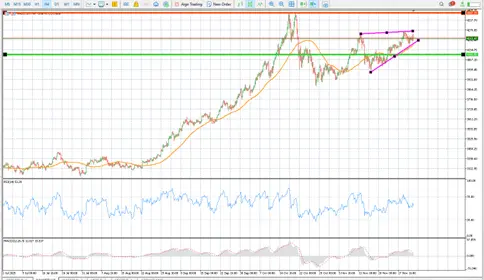
Technically speaking, the gold price has formed a bullish pattern on the 4 hour time frame which is shown on the chart. In addition to this, the price trading above the 50-day SMA on the intra-day time which means that the bulls are strongly in control of the price. Both RSI and MACD are not showing signs of overbought which means that the momentum in the gold price can very much continue.
The important price levels in terms of support and resistance are shown on the chart below

Gold trading chart: XTB
Conclusion
The precious metal gold continues to follow an upward path based on many factors including the expectation of a dovish Federal Reserve, geopolitical tensions, and strong demand for safe-haven assets.
Despite the optimism in the future prices of gold, especially in the prospect of interest rate cuts from the Fed, investors are advised to be abreast of key data in the economy and other unforeseen events in global governance.