
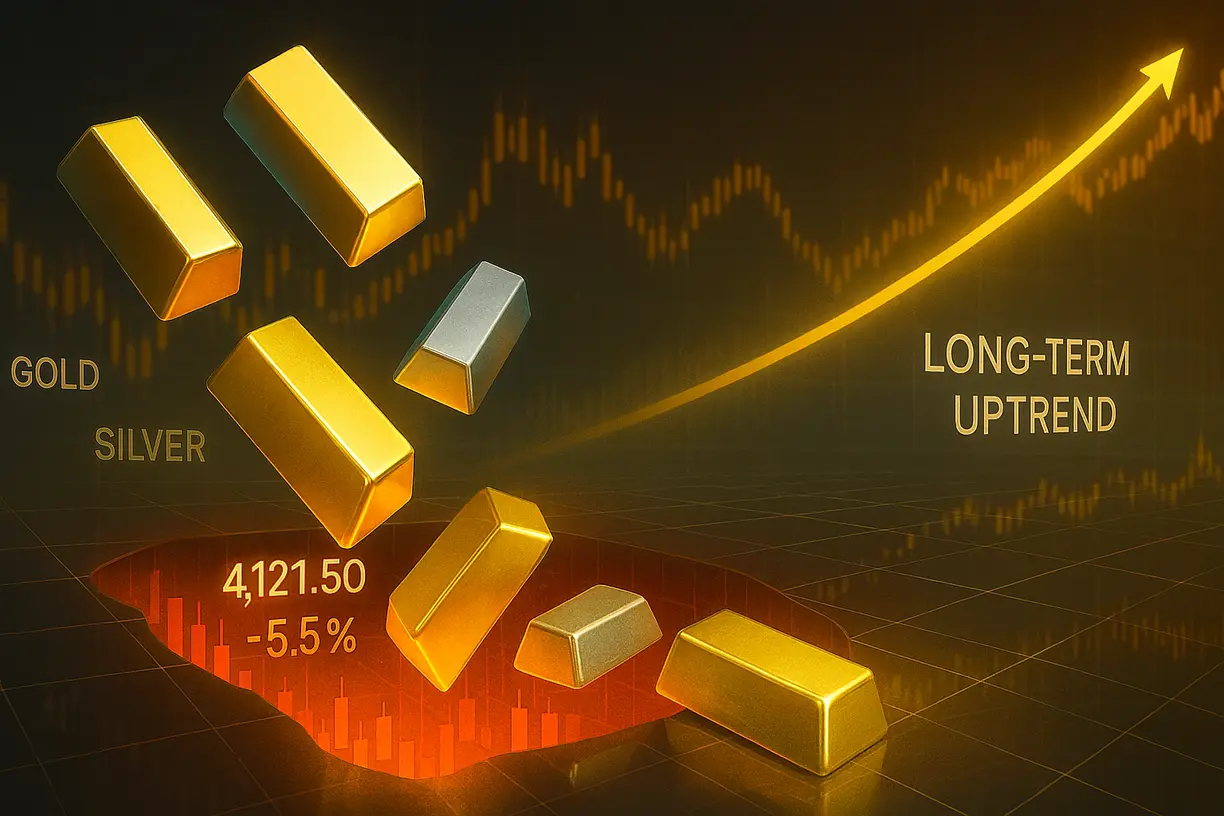
(Kitco News) - Extreme volatility in gold and silver is attracting significant attention, as prices experience their worst one-day declines in four and five years, respectively. While both precious metals have room to move lower, analysts note that both markets remain in strong long-term uptrends.
Spot gold last traded at $4,121.50 an ounce, down nearly 5.5% on the day. However, prices have only fallen to their lowest level in four days and remain up more than 56% since the start of the year.
Meanwhile, silver is facing even stronger selling pressure, with the spot price trading at $48.37 an ounce, down 7.5% on the day. The grey metal is trading near a two-week low but is still up more than 67% year-to-date.
The selling pressure began with the opening of the London market and has persisted throughout the North American trading session. Some analysts note that improving sentiment around the U.S. government’s trade war with China and record equity prices in Japan’s Nikkei 225 index triggered the selling pressure in gold and silver. Others suggest this is primarily technical selling in a market that has experienced parabolic bullish momentum.
“The consolidation in gold is a function of profit-taking — pure and simple,” said commodity analysts at TD Securities. “Our read of positioning screens extreme on many fronts: algos won't buy more at any price, risk parity and vol-control fund leverage is near common-sense caps, macro funds are likely max'ed out (OTC uncertainties), the central bank bid is down notably q/q, obscured central bank purchases are absent, retail participation (at least decade high), and China remains on a buyer's strike. Profit taking has a ways to go.”
In a note published on Tuesday, Fawad Razaqzada, Market Analyst at City Index and FOREX.com, said that today’s selloff was always in the cards given the scale of this year’s rally.
“Some would argue, what took it so long? With so much buying lately, investors have finally started to take profit after the record-breaking run, either willingly or otherwise,” he said. “The impact of profit-taking and long-side liquidation has added some real selling pressure for a change, after what was one-way traffic.”
Looking at gold’s technical picture, Razaqzada said he is watching initial resistance at $4,100, followed by $4,080 and $4,060.
“If we go below these levels, a dip back to the next major psychological level of $4,000 is likely,” he said.
Ole Hansen, Head of Commodity Strategy at Saxo Bank, said in a post on social media that gold prices could drop as low as $3,973 without affecting the long-term uptrend.
However painful it may feel for latecomers to the #gold rally, the metal could withstand a 10% correction to around USD 3,973 without breaking its bullish narrative. pic.twitter.com/0cxVCMuTBD
— Ole S Hansen (@Ole_S_Hansen) October 21, 2025
Hansen added that silver has room to fall to $47.80 an ounce in this environment.
Despite the short-term risks, Hansen said in a note Monday that both gold and silver remain in structural bull markets driven by a re-pricing of trust in global finance.
“The fundamental backdrop remains dominated by the same themes that propelled gold through successive record highs: a waning confidence in the old financial order leading to persistent central-bank accumulation, renewed demand for ETFs from investors in the West on top of continued demand from Chinese households seeking alternatives amid a four-year long property market slump, a fourth year demand, and a gradual erosion of trust in fiat and fiscal management in the West,” he said.
Ricardo Evangelista, Senior Analyst at ActivTrades, said he continues to expect higher prices despite the recent correction.
“The path of least resistance still appears to be to the upside, as traders continue to view any price dips as buying opportunities.”
He added that geopolitical turbulence, trade-related economic uncertainty, and the ongoing U.S. government shutdown continue to support gold’s safe-haven appeal. At the same time, expected interest rate cuts later this month and in December should also provide a tailwind for gold, as falling bond yields are likely to weaken the U.S. dollar.
