
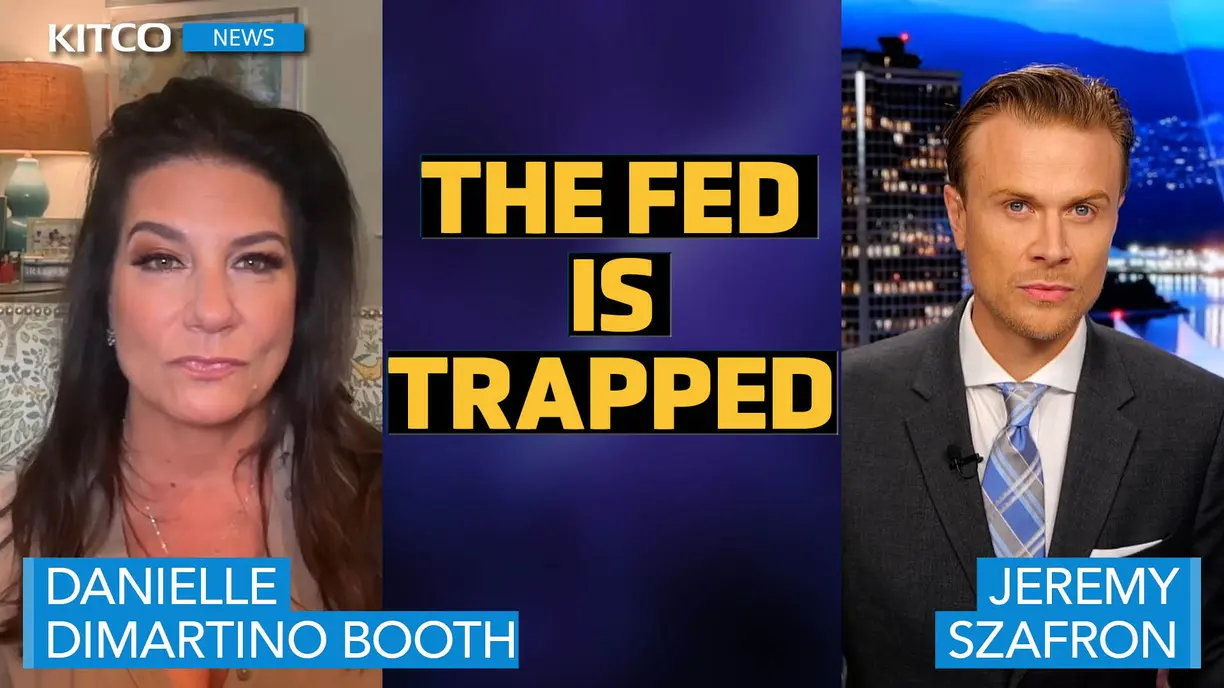
(Kitco News) - A former Federal Reserve advisor issued a stark warning on Tuesday, arguing that a systemic “liquidity crisis” is already underway, a development she says will force the central bank to abandon its inflation fight not because it has won, but because the financial system itself is breaking.
The warning comes amid a period of pronounced market contradiction. On Tuesday, the Dow Jones Industrial Average gained over 200 points, fueled by strong earnings from companies like General Motors and Coca-Cola, pushing the S&P 500 to within fractions of its all-time high. This optimism stands in sharp contrast to the stress emerging in the fixed-income and commodities markets.
Danielle DiMartino Booth, who served as an advisor to former Dallas Fed President Richard Fisher from 2006 to 2015, says this divergence is unsustainable. Now the CEO of QI Research, a macroeconomic consulting firm, Booth has been a persistent critic of Fed policy, arguing the central bank's actions have created deep-seated vulnerabilities.
"It certainly looks like the system is running out of sufficient liquidity," Booth said in an interview with Kitco News. "And that the Fed is going to be forced to pull over to the sidelines."
Her assertion refers to the Federal Reserve's ongoing policy of "quantitative tightening" (QT), a program that has been removing liquidity from the financial system by letting up to $95 billion in Treasury and mortgage-backed securities mature off its balance sheet each month.

A 'repeat of March 2020'
Booth’s comments came as gold suffered one of its steepest single-day declines in five years, falling over 5% to near $4,125 an ounce after reaching a record high above $4,380 the previous day. She argued this is not a fundamental rejection of the precious metal but a sign of forced selling due to a market-wide "dash for cash," a dynamic last seen during the severe market dislocations at the onset of the COVID-19 pandemic.
“I think that's what we're witnessing right now. I think we're witnessing a repeat of what we saw in March of 2020,” she stated. In such an environment, investors who receive margin calls or need to raise cash quickly are often compelled to liquidate their most profitable and liquid assets.
"People tend to, if they get margin calls, if liquidity becomes an issue, they tend to sell their winners," Booth explained. The resulting volatility, she cautioned, is not a healthy sign for the asset. “You never want to see gold behave like a meme stock”.
The 'cockroaches' in the credit market
The core of Booth’s warning is centered on the private credit markets, a sector that has grown explosively to over $1.7 trillion and which operates with less regulatory oversight than traditional banking. She sees a significant risk of contagion stemming from the lax underwriting standards that persisted during the era of near-zero interest rates.
Her analysis validates recent concerns from global financial leaders. On Tuesday morning, Bank of England Governor Andrew Bailey testified before Parliament and drew a direct parallel between recent blowups in U.S. private credit and the 2007 subprime crisis. Financial stability reports from both the Fed and the IMF have highlighted the rapid growth of this opaque market as a potential systemic risk.
"If we are seeing these blowups in the private credit market... they are indicative moreso of banks not necessarily having proper due diligence and sound enough underwriting standards when the money was flowing freely," Booth said.
She believes these are not isolated incidents but that the problem is systemic, echoing a recent warning from JPMorgan Chase CEO Jamie Dimon about finding "cockroaches" in the financial system.
“If the lending standards have been... laxer than they should have been, then we're going to find, as Jamie Dimon would suggest, more cockroaches,” she stated. This risk, she added, extends across the entire consumer loan spectrum. According to the New York Fed's latest data, U.S. household debt stands at a record $18.4 trillion, with credit card and auto loan delinquencies rising steadily above pre-pandemic levels.
The final warning sign
While the market appears optimistic, Booth pointed to underlying data showing a consumer under pressure, with recent reports from Vanguard and Empower noting that 401(k) hardship withdrawals are at a two-year high, partly driven by the recent resumption of student loan payments. She maintains that the real economy is weaker than headline figures like the Atlanta Fed's 4% Q3 GDPNow estimate suggest.
When asked what definitive signal would confirm that the hidden credit crisis was spilling into the public view, Booth identified the Collateralized Loan Obligation (CLO) market.
"If I start to see CLO spreads, collateralized loan obligation spreads begin to widen out... that would tell you that whatever's happening in the private space, that credit event is bleeding into the public space," she concluded. "That would get the market's attention."
CLOs are complex financial instruments that bundle and sell leveraged loans made to corporations. As of October 2025, spreads on the highest-rated tranches of CLOs have remained relatively tight, but riskier, lower-rated tranches have begun to show signs of stress.
A significant widening across all tiers would indicate that investors are demanding a much higher premium to hold corporate debt, signaling a growing fear of defaults and a broader loss of confidence.