
Strengths
XRP ETFs continue to post record inflows, signaling rising institutional adoption. U.S. spot XRP ETFs have logged 13 straight days of inflows, adding $50.27 million on December 3 and bringing cumulative net inflows to $874 million, on pace to reach $1 billion in under a month. This momentum places XRP ETFs among the fastest-growing digital-asset vehicles and aligns with strong demand for other crypto ETFs, including spot Bitcoin and Ether funds, which have attracted $58 billion and $13 billion, respectively.
The CFTC’s approval of spot crypto trading on federally regulated U.S. exchanges marks a major step forward for market legitimacy and investor protection. Moving spot Bitcoin and other digital assets onto CFTC-registered venues—long considered the gold standard for market integrity—boosts institutional confidence, enhances transparency, reduces counterparty risk, and shifts activity from offshore platforms to U.S. oversight. It represents one of the strongest structural tailwinds the industry has seen in years.
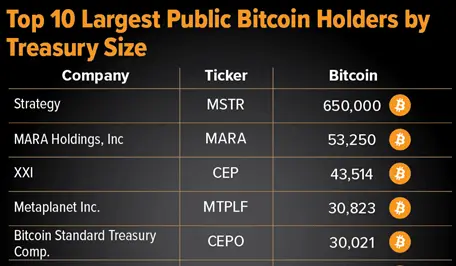
Twenty One Capital’s upcoming NYSE debut, backed by Cantor Fitzgerald, Tether, Bitfinex, and SoftBank, underscores accelerating institutional adoption of Bitcoin. With 43,500 BTC (about $4 billion), it will become the third-largest corporate holder, adding scale and credibility to the Bitcoin-treasury landscape. Despite recent volatility, the rise of publicly traded BTC-treasury firms signals sustained demand and expanding institutional market infrastructure.

Weaknesses
Politically linked crypto firms are experiencing severe volatility and reputational risk. American Bitcoin fell more than 50% within minutes after its lockup expired, adding to steep declines in other Trump-associated projects such as WLFI (-51%) and Alt5 Sigma (-70%). These drawdowns highlight how political ties can magnify market fragility and undermine investor confidence during broader crypto stress.
Meta’s potential 30% budget cut to Reality Labs—after more than $70 billion in losses—signals a structural slowdown in metaverse adoption. Crypto metaverse tokens have collapsed from over $500 billion to under $3.4 billion in 2025, underscoring weak real-world demand, limited user traction, and narrative fatigue. The contraction reflects the vulnerability of non-Bitcoin digital-asset sectors as institutional focus shifts from Web3 to AI.
According to CoinMarketCap, among the top 100 crypto assets, the largest seven-day declines came from Aerodrome Finance (AERO) at –19.09%, followed by Canton (CC) at –14.79% and Decred (DCR) at –11.96%.
Opportunities
JPMorgan sees significant upside for Bitcoin if it is valued similarly to gold. Analyst Nikolaos Panigirtzoglou argues Bitcoin could reach $170,000 under a gold-parity framework, noting that BTC has rebounded 12% from its November lows and is back in positive territory for the year. With production costs near $90,000 providing a soft floor and a favorable MSCI decision possible in January, both Bitcoin and Strategy could benefit from asymmetric upside as futures-market deleveraging winds down.
The new Base–Solana bridge, secured by Chainlink’s CCIP, enables direct movement of SOL and SPL tokens into Base applications, expanding liquidity and cross-chain activity. This interoperability milestone allows developers to support Solana assets natively while advancing institutional-grade security, accelerating the creation of integrated, always-on digital markets across the crypto ecosystem.
Drift’s launch of v3 on Solana delivers a major performance improvement—10x faster execution, with 85% of market orders filling in under 0.5 seconds and slippage reduced to about 0.02%. These upgrades make on-chain trading feel comparable to centralized exchanges, lowering friction for both retail and institutional users and positioning Solana to capture broader liquidity in on-chain derivatives.
Threats
Malaysia has deployed a joint air-and-ground task force, using drones and thermal scanners, to shut down nearly 14,000 illegal Bitcoin-mining rigs that have siphoned $1.1 billion in electricity since 2020. Authorities warn that these operations threaten national infrastructure, highlighting growing scrutiny of mining practices globally. With electricity theft up 300% since 2018 and thousands of sites already dismantled, the crackdown signals rising regulatory and enforcement risks for Bitcoin mining across emerging markets.
The SEC’s approval of a 2x leveraged SUI ETF, just weeks after the largest leverage-driven wipeout in crypto history, raises systemic-risk concerns across digital assets. Leveraged products amplify volatility and liquidation cascades, which contributed to October’s $19 billion meltdown and Bitcoin’s drop from $126,000 to below $80,000. The decision underscores fears that excessive leverage remains a structural vulnerability in the crypto market.
The IMF’s call for stronger institutions and coordinated global oversight signals increasing regulatory pressure on stablecoins, which could slow innovation and raise compliance costs. The fund warns that fragmented frameworks and limited blockchain interoperability pose systemic risks, prompting tighter controls that may restrict cross-border liquidity and create uncertainty for digital-asset markets.
