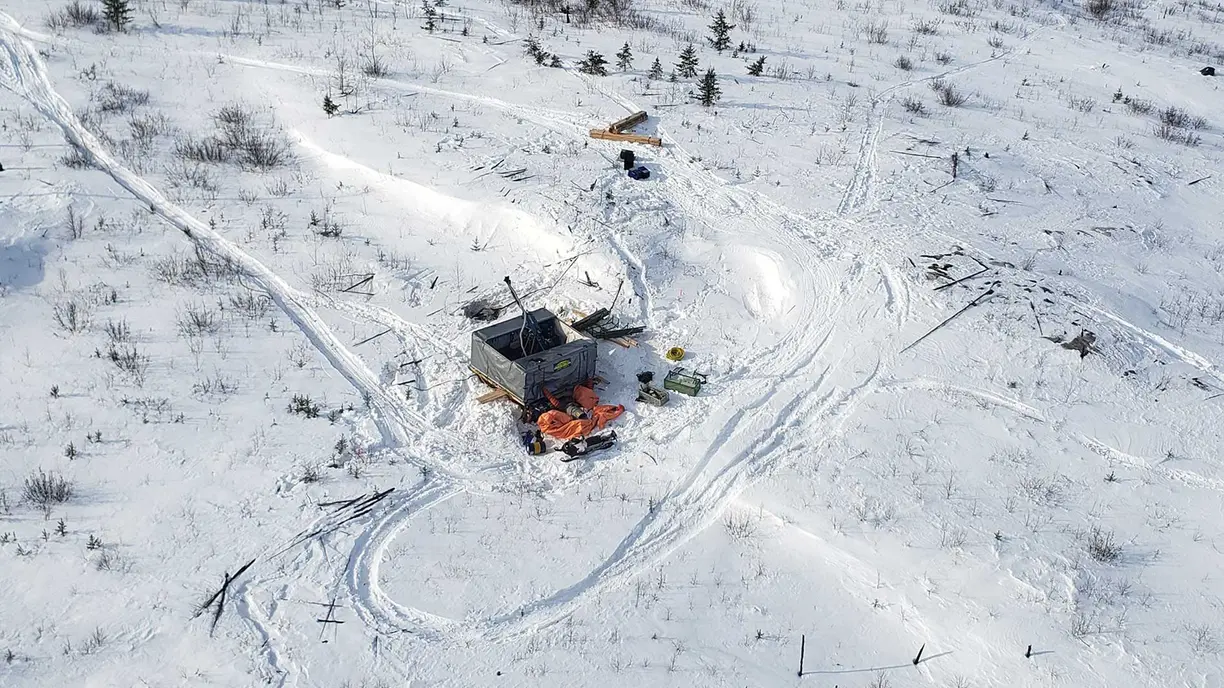
From above, the scale becomes clear. Trident Resources Corp. is not just drilling a target. It is advancing a district. The La Ronge Gold Belt remains underexplored relative to other Canadian camps, yet it hosts multiple historical resources, favourable structures, and proven mineralizing systems.
Disseminated on Behalf of: Trident Resources Corp.
- Trident enters 2026 with greater than $30 million in hard and flow-through capital, active drilling underway, and one of the largest land positions in Saskatchewan’s underappreciated La Ronge Gold Belt.
- The company controls substantial gold resources across multiple deposits and is actively drilling the past-producing Contact Lake Gold mine.
- With a reset share structure, meaningful insider ownership, and capital in hand, Trident fits the profile of juniors that tend to re-rate as markets begin to revalue existing ounces and disciplined execution over speculative discovery.
Fresh off a major financing and a successful return to drilling at a past-producing Cameco gold mine, Trident Resources Corp. (TSXV: ROCK | OTCQB: TRDTF) is heading into 2026 with momentum that few junior explorers can match.
The Vancouver-based company has emerged from a three-way merger with a consolidated land position, a growing gold resource base in northern Saskatchewan, and the balance sheet strength to drill without interruption.
With gold prices holding near record levels and investor interest beginning to return to well-funded explorers, Trident has positioned itself as a district-scale gold story in an underappreciated Canadian jurisdiction.
Trident’s portfolio sits in the La Ronge Gold Belt, a Proterozoic greenstone belt that hosts multiple past-producing mines, deposits, and mineral showings. The belt benefits from surface exposure, simple geology, road access, and power infrastructure, all factors that reduce exploration cost and risk.
More importantly, Trident controls ground near the intersection of the La Ronge, Kisseynew, and Glennie geological domains, a structural setting often associated with large orogenic gold systems.
“This is a real gold belt that simply hasn’t seen the level of modern exploration applied elsewhere in Canada,” said Trident CEO Jonathan Wiesblatt. “We’re working in rocks that are proven to host high-grade gold, with infrastructure already in place.”
Contact Lake moves back to centre stage
Trident Resources is proud to share that it's been named to the 2026 TSX Venture 50 as one of the Exchange’s top performing companies滋
2025 was a transformational year, highlighted by strong drilling success at our Contact Lake Project in Saskatchewan’s La Ronge Gold Belt.… pic.twitter.com/ZnsyOxQs7y— Trident Resources (@Trident_RSC) February 19, 2026
The company’s flagship Contact Lake Gold Project anchors the story.
Originally operated by Cameco between 1994 and 1997, Contact Lake produced roughly 188,000 ounces of gold at an average grade of 6.16 g/t gold. Mining stopped when gold prices were below USD$300 per ounce, and gold was no longer core to Cameco’s strategy.
The Contact Lake project was acquired from the Saskatchewan government in the early 2020s, and under new management at Trident, the first exploration program at Contact Lake occurred in 2025 for the first time in nearly three decades.
The results were decisive.
A 6,838-metre program across 19 holes delivered a 100% hit rate, intersecting gold mineralization in every hole. Drilling extended mineralization beyond the historical mine footprint and confirmed that high-grade gold continues along strike to the north and northeast, and below the depth where mining previously stopped.
Highlights included broad intercepts of multi-gram gold, including zones grading more than seven grams per tonne over 43.25 metres, with localized higher-grade intervals. Several holes tested depths well below the historical mining level, reinforcing comparisons to deeper orogenic systems elsewhere in the belt.
“These results changed how the market views Contact Lake,” Wiesblatt said. “We’re no longer just talking about a historic mine. We’re talking about a system that remains open laterally and at depth.”
From single mine to multi-deposit camp
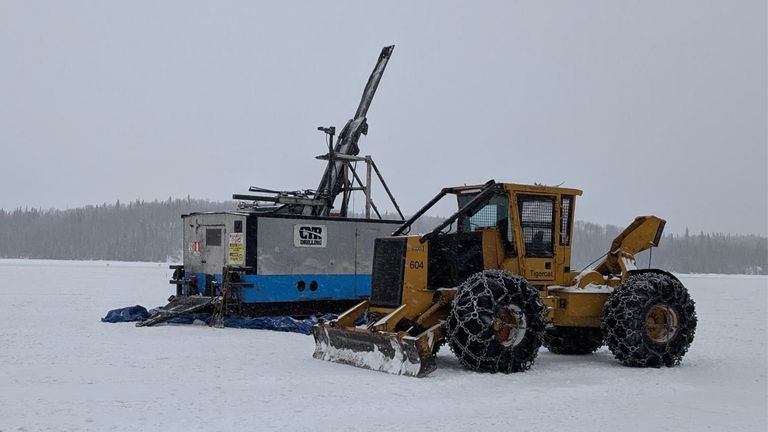
Trident Resources Corp. is advancing its winter drill program at Contact Lake with three drill rigs now turning, two on the ice at Contact Lake and one at the adjacent Preview SW deposit in northern Saskatchewan. The addition of a third rig accelerates step-out and expansion drilling aimed at growing and upgrading the existing gold resource, while also testing high-priority targets along trend.
The broader Contact Lake project area includes four deposits with current or updated mineral resources: North Lake, Preview SW, Preview North, and the Greywacke Gold Project area, along with additional targets such as Point Lake.
Across these deposits, Trident now reports 896,530 ounces of gold in the Indicated category and 1,129,643 ounces of gold in the Inferred category, based on updated 2025 resource estimates (calculated using a gold price of USD$2,600). Much of that mineralization sits near surface, with grades that support both open-pit and underground scenarios, depending on geometry and continuity.
North Lake, in particular, stands out as one of the more advanced deposits, with road access, nearby power, and proximity to the community of Missinipe. Preview SW and Preview North add scale and optionality, with shear-hosted gold systems that remain open along strike and at depth.
Taken together, management describes the portfolio as the foundation of a district-scale gold camp rather than a single-asset story.
“Our goal is not to advance one deposit in isolation,” Wiesblatt said. “It’s to systematically grow ounces across a belt-scale land package.”
Capital in place to execute
Execution depends on capital, and here Trident holds a clear advantage.
In early 2026, the company announced the full exercise of an overallotment option tied to its bought-deal financing, lifting total gross proceeds to approximately $18.6 million. Combined with existing cash and marketable securities, Trident expects to carry more than $30 million in hard and flow-through capital.
That funding fully covers an expanded 2026 drill program focused primarily on Contact Lake, with follow-up drilling planned to expand new zones of mineralization, extend strike length, and expand known deposits across the project.
“Being fully funded changes everything,” Wiesblatt said. “It allows us to drill continuously, make decisions based on geology rather than cash flow, and avoid coming back to the market mid-program.”
That financial position also aligns with a broader valuation thesis articulated by John Kaiser, a long-time Canadian mining analyst, who pointed to Trident as an example of what he sees emerging across the junior sector.
In Kaiser’s view, Trident’s combination of active drilling, expanding resources, and balance sheet strength places it among the juniors investors tend to re-rate once higher long-term metal prices gain broader acceptance.
Beyond gold: Copper optionality
While gold remains the core focus, Trident also controls the Knife Lake copper project, a volcanogenic massive sulphide system with a historical resource of 86 million pounds of copper in the Indicated category and 117 million pounds of copper in the Inferred category.
Management views Knife Lake as strategic optionality rather than a near-term distraction, providing exposure to copper at a time when long-term supply constraints continue to tighten.
“We’re disciplined about where we deploy capital,” Wiesblatt said. “Gold is the priority, but Knife Lake adds another layer of value that the market can revisit when the timing is right.”
“Our goal is not to advance one deposit in isolation. It’s to systematically grow ounces across a belt-scale land package.” — Jon Wiesblatt, CEO & Director, Trident Resources Corp. |
What comes next
For investors, the next 12 months are likely to be defined by drill results and resource growth. Key milestones include ongoing drilling at Contact Lake and continued exploration across the broader La Ronge land package.
With a tight share structure, meaningful insider ownership, and the capital to execute, Trident is now transitioning from consolidation to discovery mode.
In a gold market that rewards execution over speculation, Saskatchewan is emerging as an unlikely but compelling place to look for the next chapter of Canadian gold exploration.
Trident is already there.
To learn more about Trident, visit its website. For the latest updates, follow Trident online: X and LinkedIn.
The scientific and technical information contained within this article has been reviewed and approved by Cornell McDowell, P.Geo., Trident Resources Corp.'s VP of Exploration, who is a Qualified Person, as defined under the terms in National Instrument 43-101.

Market One
Market One is a collaborative content marketing, strategy and creation agency with a stable of award winning journalists and videographers focused on providing robust solutions for Canada's capital markets.
