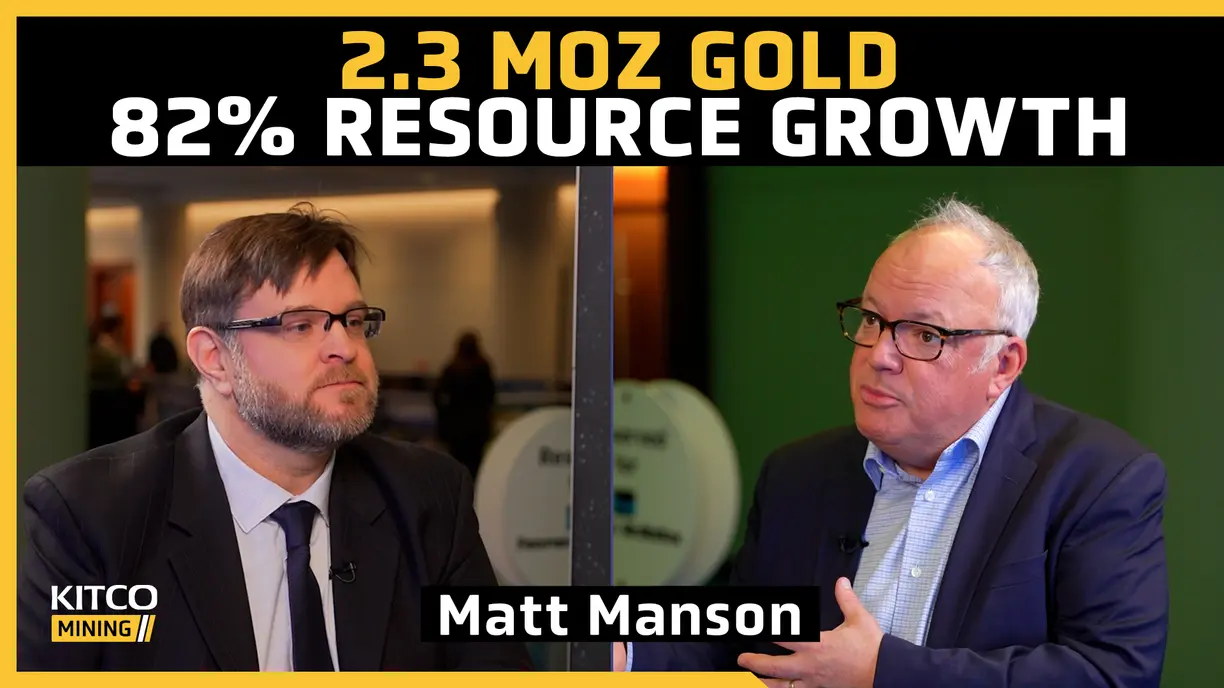
After more than a decade of being ignored, interest and capital are creeping back into the mining sector, and valuations should continue to grow as gold prices consolidate above $5,000 an ounce, according to one mining executive.
Speaking with Kitco Mining at the Prospectors & Developers Association of Canada (PDAC) 2026 convention, Matt Manson, President and CEO of Radisson Mining Resources, said that after years of underperformance, gold funds and institutional investors have benefited from the metal’s rally, encouraging renewed participation from both retail investors and generalist funds.
Despite gold’s surge, Manson believes the broader investment community remains underexposed to the metal.
“Only recently have major Wall Street firms started telling investors that gold should be part of a diversified portfolio,” he said. “Even now, when you look at the numbers, investors are still seriously underinvested in gold.”
Manson said improving sentiment across the gold sector is helping junior miners gain access to capital. Radisson raised $20 million in financing in October, with the offering more than twice oversubscribed and drawing strong institutional interest.
“The book was $40 million,” he said. “The market’s only gotten better since then.”
Manson’s optimistic outlook on the exploration sector comes as Radisson embarks on a large drilling campaign to position itself in one of the strongest markets for gold equities in decades.
Manson said the company has released an interim resource update showing significant growth at the historic deposit, which sits along the Cadillac-Larder Lake Break near the town of Cadillac. The project is located just three kilometres from Agnico Eagle’s LaRonde mine and is surrounded by operating gold mines across the Abitibi belt.
“We put out a new resource update. The project’s getting bigger,” Manson said, noting that the company now reports about 1.7 million ounces of inferred resources, an 82% increase from the previous estimate published a year ago. Indicated resources also increased by roughly 8%, bringing the combined resource base to about 2.3 million ounces.
Radisson believes the deposit has the potential to grow further as drilling continues. The company is currently running a 140,000-meter drill program, but only about 25% of that work has been completed so far, meaning a significant portion of drilling results has yet to be incorporated into the current resource estimate.
“We think the ultimate target here is something in the three- to four-million-ounce range,” Manson said.
The O’Brien project itself has a long history. The original mine operated from the 1920s to the 1950s and produced about half a million ounces of gold, meaning the current resource estimate already exceeds the historic mine by several multiples.
Although market conditions have improved, Manson said the junior mining sector remains significantly undervalued relative to current gold prices.
He pointed to a common valuation metric used in the industry—market capitalization per ounce of gold in the ground. Many junior companies are trading at $50 to $150 per ounce, despite gold prices hovering around $5,000 per ounce, he said.
He noted that Radisson itself recently traded at roughly $160 per ounce of gold, but after incorporating the new resource estimate, the valuation dropped closer to $100 per ounce, highlighting the potential upside as the project grows.
“There’s your investment thesis,” Manson said.
As for what it will take for junior exploration companies to realize their full market potential, Manson said investors simply need to be patient.
He pointed out that in a typical mining bull market, investment first flows into major producers such as Barrick and Newmont, followed by mid-tier producers, before eventually moving into the junior exploration sector.
One key advantage for the O’Brien project is its location within a mature mining district with extensive infrastructure already in place.
Instead of building its own processing facility, Radisson is evaluating the possibility of sending ore to nearby mills operated by other companies. Several processing plants are located within short trucking distance of the project.
“The heritage of gold mining in the Abitibi is that mills run for decades and successive ore bodies feed them,” Manson said.
A preliminary economic assessment released last year examined this satellite-deposit model, which could significantly reduce capital costs by eliminating the need to build a new mill or tailings facility.
While Radisson continues to focus on expanding the O’Brien resource through drilling, Manson said the company ultimately sees the project becoming a producing mine.
The company’s board includes several executives with extensive mine-building experience, collectively involved in the construction of multiple operations across the mining sector.
“We’re not here to drill this deposit for the next 10 or 20 years,” he said. “We’re here because there’s a mine here.”
With gold prices high, strong sector sentiment, and increasing exploration success, Manson said the company’s immediate priority remains straightforward.
“Our job right now is to drill—and drill—because the ounces are there,” he said.

Kitco Spotlight Editorial
Kitco Spotlight Editorial is sponsored content, articles and announcements paid for by our advertisers that support our journalism. Our sponsored messages are targeted and hand-curated, highlighting the best of what's happening in the mining sector.
